
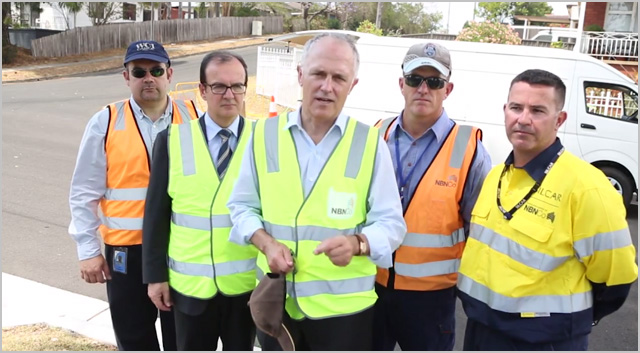
news Malcolm Turnbull late yesterday used the Federal Budget announcements process to again erroneously claim that the Coalition’s technically inferior version of Labor’s National Broadband Network project would be $32 billion cheaper, despite the fact that the Communications Minister is aware this claim is not true.
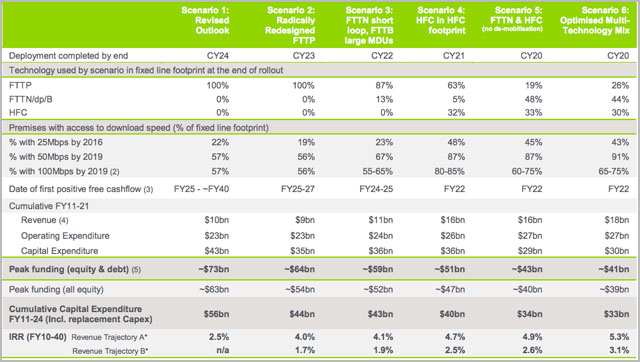
Under Labor’s NBN policy, some 93 percent of Australian premises were to have received fibre directly to the premises. The remainder of the population was to have been served by a combination of satellite and wireless broadband. However, the Coalition has drastically modified that policy, instructing NBN Co to go ahead with a model which will see 30 percent of the 93 percent served by the existing HFC cable networks owned by Telstra and Optus. A further 44 percent will receive a hybrid Fibre to the Node service (integrated with Telstra’s existing copper network), and only 26 percent will receive Fibre to the Premises.
NBN Co’s Strategic Review document, published in December last year and available online in PDF format, provides a range of possible network deployment models, ranging from the previous Labor Government’s FTTP plan, to the so-called “Optimised Multi-Technology Mix” which the Coalition has chosen for its own rollout.
The report makes it clear that under almost every scenario, the NBN project as a whole will make a modern return on the Government’s investment in the project, ranging from 2.5 percent to 5.3 percent. This means that the Coalition’s MTM policy would make slightly more money than Labor’s FTTP option — but neither will, in the long-run, actually cost the Government anything. The money will be recouped through monthly broadband subscriber fees paid by ordinary Australian residents and businesses.
Last night, Turnbull confirmed, as the Coalition Government had previously stated, that the Government would limit its total capital investment in NBN Co to $29.5 billion. This amount is factored into NBN Co’s financial projections for all models. Under all models, the remaining investment the project will require is to be funded by the private sector. This year’s Budget allocated $20.9 billion in equity funding to NBN Co over the period from July this year until mid-2018, to make up the $29.5 billion total.
However, Turnbull also made several statements in his media release associated with the Federal Budget allocation for NBN Co which the Minister is aware are inaccurate.
“The Strategic Review released in December 2013 identified that completing the NBN under Labor’s plan would cost $72.6 billion ($28.5 billion more than we were told), increase prices for consumers by up to 80 per cent and not be complete until 2024. We face a significant task in getting the NBN back on track,” the Minister said.
“The Government has agreed that the NBN should be completed using a multi-technology mix. This will match the right technology to the right location and make use of existing networks where possible to deliver very fast broadband. This new approach to NBN implementation will save $31.6 billion in funding costs, get the NBN finished four years sooner and enable nine out of ten Australians in the fixed-line footprint to get access to download speeds of 50 megabits per second or more by 2019.”
According to the Strategic Review, commissioned by the Coalition following the September Federal Election, which Turnbull has read and is familiar with, the Minister’s statements that the Coalition’s approach to the NBN implementation would save $31.6 billion in funding costs is inaccurate.
The NBN Co Strategic Review shows that the Coalition’s approach will make a higher return on investment than Labor’s original all-FTTP NBN approach (5.3 percent compared with up to 2.5 percent), but neither will, in fact, ultimately “cost” the Government anything, as detailed earlier in this article. The capital required is not defined as a “cost”, but rather as an “investment”, which the Government will recoup, plus a modest additional return.
Furthermore, the Strategic Review also indicates that if NBN Co radically redesigned Labor’s FTTP model (for example, making greater use of overhead cabling) and an all-equity model was used to support the rollout, which the Federal Government can afford due to its extremely favourable financial situation when compared with other countries globally, the total capital investment requirement for Labor’s model would be $54 billion, just $15 billion more than the Coalition’s model.
It is also believed that Labor’s version of the NBN would be worth more as a sustainable business that could subsequently be privatised, as its FTTP model would not require upgrading and hence further capital investment. NBN Co executive chairman Ziggy Switkowski has stated that sections of the Coalition’s MTM model — likely the re-used segments of Telstra’s copper network — would need upgrading within five years, adding additional capital requirements to the Coalition’s model.
Furthermore, Turnbull’s statement that NBN Co could not complete an all-FTTP model until 2024 is also inaccurate, with the Strategic Review stating that a reworked FTTP rollout could be completed by 2023 — just three years after the Coalition’s MTM model.
Given the only modest difference in cost and rollout timeframe, it is not currently clear why the Coalition is pursuing a radical reworking of Labor’s NBN project. The model has also been roundly criticised by industry commentators, with veteran telecommunications analyst Paul Budde, for example, describing it as “a dog’s breakfast”.
Turnbull has made similar inaccurate statements over the past several weeks through the mainstream media, repeating the claims on radio stations Triple J and 2GB. In addition, other aspects of the Minister’s statement last night are also questionable — for example, there is currently no evidence to show that NBN Co’s prices would rise by up to 80 percent as the Minister claimed, with current retail NBN prices on par with current broadband pricing, and NBN Co having locked in its prices for only modest growth over the long-term.
NBN Co executive chairman Ziggy Switkowski has also stated that the 50Mbps minimum speeds promised by Turnbull for most Australians by the end of 2019 cannot be guaranteed, unlike the 100Mbps speeds pledged under Labor’s FTTP model.
A number of surveys and polls have shown consistently over the past several years that the majority of the Australian population supports Labor’s original all-fibre model for the NBN. In mid-February, Shadow Minister for Communications Jason Clare presented to Federal Parliament the signatures of 272,000 Australians who want the new Coalition Government to build Labor’s all-fibre version of the National Broadband Network instead of the technically inferior version which the Coalition favours.
Late yesterday Turnbull published the following infographic, clearly demonstrating some of the inaccurate statements the Minister has been making with respect to the NBN project’s financials:

opinion/analysis
It’s absolutely outrageous that Communications Minister Malcolm Turnbull has subverted the Federal Budget process to broadcast severely misleading statements regarding the National Broadband Network’s financials.
NBN Co’s Strategic Review makes it very clear that the company could deliver an all-fibre FTTP network to Australians for just $15 billion more in terms of capital investment and only three years later than the Coalition’s Multi-Technology Mix project. This infrastructure would be vastly technically superior to the Coalition’s version and would not need to be upgraded. In the long-term, I strongly suspect it would be worth more financially than the Coalition’s MTM Mix. And, of course, it would still make a return on the Government’s investment, meaning that the actual capital requirement figures are largely irrelevant.
With this in mind, Australians are very entitled to ask: Why is the Coalition not focusing on the option that would deliver us significantly better value for money? Why buy a second-hand 1979 Toyota Corolla when we could get a Tesla Model S for only a little bit more, and only a little later? Seems like basic common sense to me.
One can only describe much of what Turnbull said yesterday as “Turnbullian” logic which doesn’t make sense in the real world. Black is white, one plus one equals three, and Labor’s version of the NBN costs what Turnbull says it does — even if his own Strategic Review contradicts his statements on the issue.
Hell, I don’t know why Turnbull even bothers using any specific figure at all at this point. Why not just claim that Labor’s NBN will cost “eleventy quillion” and the Coalition’s version $200 million, but deliver the same speeds? It’s not as though Turnbull is paying any attention to the actual figures, so why not just go hog wild? I mean it’s not like fiscal accuracy matters at all on Budget night. Right? Right?
Image credit: Office of Malcolm Turnbull