

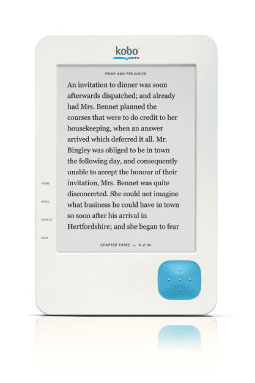
This is a sequel to sorts to my article on DRM in eBooks. The Kobo eReader currently has investors from Canada (Indigo Books and Music) US (Borders), Aus/NZ (REDGroup) and Asia.
It is an e-ink based platform, with a proposed Australian price of $199.00. The Powered by Kobo logo is currently on the Borders Australia webpage, so we can assume that Borders will use the Kobo platform to sell books. It uses the Adobe DRM scheme within the ePub standard, and can also read PDF files natively.
So, what does this mean for the Aussie book buyer?
1. No real vendor lock-in. Any retailer that sells the ePub standard will be able to market to the Kobo. So it means that all aussie eBook retailers can produce books for the Kobo reader. That includes:
So, apart from the inability to load Kindle eBooks onto the Kobo, Most eBooks — including Project Gutenberg books — will be available for the Kobo platform.
2. Platform agnosticism. There is currently Kobo Apps for iPhone, Blackberry, Android and Palm Pre. An interesting point from the National Post talks about about the API from Kobo:
Kobo said manufacturers would be given APIs, software development kits and custom integration options which will allow them to customize the Powered by Kobo application for their device. The sotware (sic) is designed to support various screen types as well as Wi-Fi and 3G technologies.
This means that you will not have orphan eBooks if you migrate to a new device. And the Kobo software will keep all bookmarks and last page read synced with all other platforms with the Kobo software.
3. Price. When I saw news of the Kobo, I guessed it would cost AU$200. Well, I was right. $199 is a great price point, making it far cheaper than the Kindle or iPad. While not as flexible as a Kindle or an iPad, the Kobo is a reader and seems to have been optimised for reading. Features such as an audio player and web browser may have been nice, as a text to speech feature, but by making a stripped-down reader, it allows a price that undercuts the competition.
It remains to see how much the eBooks will cost, as pricing details are unavailable as of this time on the Borders website. However, on the Kobo app, prices seem to be around the $2-$12 mark. I assume this is Canadian prices, and Canada has comparable exchange rate and a similar tax regime as Australia (5 percent GST and C$1=AU$1.09245 as of today). The book prices seem to be similar as well on a quick check at Indigo CA. So my hope will be realistic eBook prices, but I will have to reserve judgment on that.
The DRM is a good compromise. DRM-free would be better, but as we can see, Adobe’s DRM schema is widely deployed. I don’t know if DRM on PDF will be supported — that too I will have to experiment with when I get the chance.
The Kobo can be bought online or over the counter at Borders. As a eBook play, Borders (as part of the REDgroup) has made a very strong play for the eBook market and unlike Apple (who are recruiting a eBook person for Australia) and Amazon (which only has an international subset of the Amazon library), will start with a strong catalog of books available for the Australian market.
My personal opinion is this is the best project we can expect to see in the market in the short to medium term, and should be successful for Borders Australia.
Darryl Adams is a government worker and internet tragic. A former IT worker, he still pines for the days of IBM keyboards that go CRUNCH and the glow of green screens. He can be found on on Twitter or on Facebook. The views expressed here do not reflect the views of his employer, the ATO.
Image credit: Kobo
This interests me. Our Cybook stopped working recently, haven’t been able to resurrect it. Would love to see the nook in Australia though.
My main concern about all of this is DRM. Going back half a decade I converted all of my CDs to high quality MP3s and then put the CDs in the garage. I haven’t ever looked back from that move. I would very much like to follow a similar formula with my extensive book collection, but I’m not sure of the way forward — it doesn’t look as though there is one holy standard to rule them all yet, that will work across any device.
I have bought many PCs over the years, yet my MP3s stlll work on all of them. Will the same be able to be said of books?
More devices means more confusion for me, so I’ve always used a PDA, and now a smartphone (the iPhone) for reading. However, I applaud both Amazon and Kobo for making their reader software available on other e-reading platforms. I wouldn’t buy a Kindle or a Kobo reader, since a single handheld device works better for me, but I would certainly buy the associated ebooks and use their app. to read them on my device. (I’ve already done that with the Kindle app. on my iPhone.)
I think this wider availability will be a major marketing point for both Amazon and Kobo. As far as Kobo itself is concerned, the Canadian website does seem to have a good range of books, and it’s one of the more polite in telling us to go away because we’re Australian. (Yes, I am keeping score, and will put my money where I’ve encountered courtesy and consideration.)
The launch of the Kobo reader, like the Kindle launch earlier on, will spread awareness of the ease and availability of ebook readers and ebooks themselves. We Australians read a lot (being “geographically limited” gives us an inferiority complex, so we hide away in our dunnies and read ;) ) and love new tech, as Delimiter has remarked previously. There’s also a significant “over-the-shoulder” effect with e-readers. I’m not able to have much face-to-face contact with people, but those I can see are always curious about and impressed by my iPhone, particularly the reading access to books, newspapers and magazines. Others have commented here (and on ebook fora) about this phenomenon, and I expect it to cause a cumulative flow-on effect in purchases.
So: bring it on! Australia wants ebooks and ebook readers NOW. :)
P.S. Seriously, Renai, where do you keep all your paper books? My family ran out of bookshelf space long ago. Do you rent successive shipping containers? Put new stories (heh) on your house? Substitute piled-up books for furniture? Tell us your space-saving secret.
Comments are closed.