opinion/analysis The botched resurrection of Labor’s mandatory Internet filtering policy late yesterday afternoon would appear to be more the work of one continually inept Liberal MP than a grand conspiracy by the Coalition to hoodwink the Australian public into generating a false mandate for Internet censorship.
Boy, are the Internet conspiracy theorists out this morning in Australia’s techno-media landscape. Outraged by the Coalition’s botched launch of its new online child safety policy late yesterday afternoon, this morning my web browser is crackling with flames around its edges, as commentators pile vitriolic phrase after vitriolic phrase into a giant bonfire to roast the conservative side of politics for its suspicious behaviour and posit grand shenanigans.
The consensus is that the either Coalition’s internal policy-making and checking procedures were so inadequate that almost anything could get through its unlatched gate and make it into formal policy, or that the quiet release of a new mandatory Internet filtering scheme 36 hours before the election, with no associated launch event or media release and after many Australians have already voted, was a criminal attempt to get the idea into the realm of formal policy with no chance for debate.
Adam Turner’s energetic piece for the Sydney Morning Herald epitomises the current wave of antagonism the Coalition is facing. Writes Turner:
“So what really happened? Did the Coalition seriously expect this policy to slip through unnoticed? Did they change their minds at the last moment? Are they trying to pull the wool over our eyes, or are they merely incompetent? None of these options bode well for a bunch of politicians hoping to form the next government of Australia.”
But not everyone was so polite with their criticism. Telecommunications blogger Michael Wyres was blunt in the way he characterised the Coalition’s moves:
“It is dirty and underhanded. It is disingenuous, and it is deceitful. It is a bloody disgrace … frankly, what happened here is they got caught out and forced into a backflip. It must be wonderful living up high in the clouds on bullshit mountain.”
And there’s plenty more where that came from. I encourage you to dip your mind into the fervid waters of the Australian Twittersphere, if you are in search of diversion on this sunny Friday afternoon. I guarantee you fill find enough insults and suspicions leveled at the Coalition on this issue sufficient to build a pile of dung a mile high.
Now, on the face of it, there certainly is a lot to be concerned about from this little episode. Right from the get-go, it’s important to acknowledge that the Coalition’s online child safety policy as released yesterday would never have included paragraphs pertaining to the UK’s own highly restrictive and unpopular filtering scheme if someone, somewhere in the Coalition’s policy-making hierarchy hadn’t been considering porting that model to Australia.
The sheer idiocy of such a move, given the extreme public displeasure with Labor’s version of the policy that eventually dragged a reluctant Coalition into blocking it (a move that was led by Turnbull himself, as well as Shadow Treasurer Joe Hockey), should have been obvious to all but the most neophyte policy advisers within Liberal ranks. The fact that the idea was being considered at all lends credence to the idea that someone very junior was putting this document together.
The fact that Opposition Leader Tony Abbott approved the policy on Wednesday night after a cursory glance at it probably doesn’t indicate that much; after all, who would reasonably expect Abbott to understand complex matters involving technology policy? The Member for Warringah has never demonstrated any such nous in the past, and is in fact famous for his techno-gaffes. “I’m no Bill Gates” doesn’t even begin to cover the situation.
But the fact that Shadow Communications Minister Malcolm Turnbull hadn’t seen the policy before it was published is downright damning. Not only has the Earl of Wentworth enjoyed a long-standing close relationship with the policy’s author, Liberal MP and former Optus executive Paul Fletcher, but Turnbull does lead the communications portfolio for the Coalition. All of the measures which the policy outlines would be administered through client departments and regulators under Turnbull as Communications Minister. One would think Turnbull should have seen the policy as a basic first step, before it even went to Abbott for the final check mark.
All of this represents a wake-up call for the Coalition. This sort of thing, in a credible political party, shouldn’t happen, pure and simple. There should have been many opportunities through the process of publishing this document for wise heads to send it back for revision.
However, if you want to look for an ultimate culprit for the debacle, I suspect there’s only one real contender: The policy’s nominal author, Paul Fletcher.
For his part, it’s impossible not to acknowledge that Turnbull’s actions as the affair proceeded last night were commendable. The Member for Wentworth was ambushed by the release of the filter policy as he went into a live interview with radio station Triple J; he had no opportunity to do anything other than to follow the party line and support it. To do otherwise, as many politicians have found to their peril, would have been to risk the censure of the party and its leadership.
Put simply, politicians must support their party policy in public, if they want to keep their seats.
However, as soon as Turnbull exited Triple J’s studio, he took immediate action to have the policy revoked; extracting permission to surgically remove its offending sections and returning its pages to the realms of rationality. The Duke of Double Bay then took the necessary step of admitting the Coalition’s mistake in an official media release. Case closed.
But one suspects the case is not closed this afternoon for Paul Fletcher, who doesn’t appear to be returning calls from the media.
After all, one can forgive Tony “no tech-head” Abbott for not fully understanding the mandatory Internet filtering policy Fletcher wrote. And one can hardly blame Turnbull for letting it be published, considering Fletcher didn’t bother send the Member for Wentworth a copy for review. One can even forgive whatever hapless staffer presumably inserted the offending paragraphs in the policy to start with.
But one cannot forgive Fletcher for letting the policy be published. Fletcher is an expert in the communications portfolio, and a long-time critic of Labor’s previous filter policy. You can see the MP flaying Labor for the policy in this 2010 public meeting he attended, hosted by Turnbull in his electorate before the Coalition officially opposed the policy.
Moreover, Fletcher is not a Shadow Minister of any kind. He does not have senior responsibilities at the level that Turnbull, Abbott or Hockey (who was also blindsided by the filter launch) do. He has only a limited amount of responsibility during the current election campaign: To get re-elected (which shouldn’t be a problem, given his 18.2 percent margin in 2010), to deliver an inoffensive online child safety policy sourced from his time on the Parliament’s Joint Committee for Cybersafety over the past few years, and to stay out of trouble.
I think we can safely say that the Member for Bradfield abjectly failed at most of these basic tasks.
Proposing a highly unpopular policy which had trashed Labor’s reputation when it held it? Failing to consult the portfolio Shadow Minister about the policy before publication? Failing to realise that he and the Shadow Minister had personally opposed the same policy under Labor? Leaving the Opposition Leader and several other Shadow Cabinet members in the lurch and taking questions from the media live on radio and television?
If Fletcher wasn’t a sitting MP, one would have to argue that all this was a sackable offence. Certainly I expect that Turnbull has had a few choice words to say to Fletcher this morning. At best, Fletcher has been politically naive; at worst, his actions will be the subject of an internal Liberal Party review.
Of course, this isn’t the first time Fletcher has landed himself in hot water through misspeaking or writing. Seasoned watchers of Australia’s techno-political sphere will remember the opprobrium Fletcher attracted in mid-2011 when he attacked the “discount” NBN pricing of ISPs like Exetel and Dodo. The attacks earned Fletcher a backhander from Dodo chief executive Larry Kestelman at the time.
In August last year the MP heavily criticised what he said were misleading advertorial-style paid articles about the National Broadband Network appearing in Fairfax and News Ltd newspapers. But again, the attack misfired after it was revealed NBN Co hadn’t paid for the coverage. That same month, a fact-checking analysis conducted by Delimiter on an article published by Fletcher highly critical of Labor’s National Broadband Network project found the Liberal MP had made a number of contextually misleading statements.
And the former Optus executive even made the unsightly move back in March 2010 of backing Telstra against proposed government intervention in its business, in a high-profile interview with radio shockjock Alan Jones.
Your writer was particularly disappointed to see Fletcher, in December 2010, questioning whether the NBN would force higher costs on basic voice telephone services. At the time, I wrote: “… frankly, it’s hard not to come to the conclusion right now that the MP is barking up the wrong tree when it comes to criticising the NBN on the basis of basic services. When you roll out fibre internet around the nation and start providing broadband services at 1Gbps, the provision of “basic voice services” at an affordable price is the least of your problems. Basic voice telephony will be virtually free at that point (through Skype, Google Talk etc).”
What we’re seeing here, from Fletcher, is a long-standing trend of low-level inept behaviour that is continually landing him in puddles of hot water in the telecommunications portfolio. That puddle became a downpour yesterday, and I expect the MP’s fortunes in the Coalition will suffer for some while as a result, until he can regain some of his much-needed credibility.
Perhaps Turnbull can send Fletcher to the same “charm remediation” camp where he famously consigned adviser Stephen Ellis to, after Ellis’s outburst last month to anti-Coalition NBN blogger Steve Jenkin. “Equanimity” has been restored, this morning: After a three hour blip, Australia once again has a situation where every major political party remains opposed to mandatory Internet filtering. But let’s hope Turnbull can prevent Fletcher’s next thought bubble from making it into the public domain in quite so high profile a manner.
In August 2010, at the Internet filter forum he held in Paddington with Fletcher by his side, Turnbull proclaimed that Labor’s filter policy was “dead, buried and cremated, and if it shows any signs of revival it will then be exorcised”. No doubt the Shadow Communications Minister was very surprised to find Fletcher, of all people, trying to raise the dead.
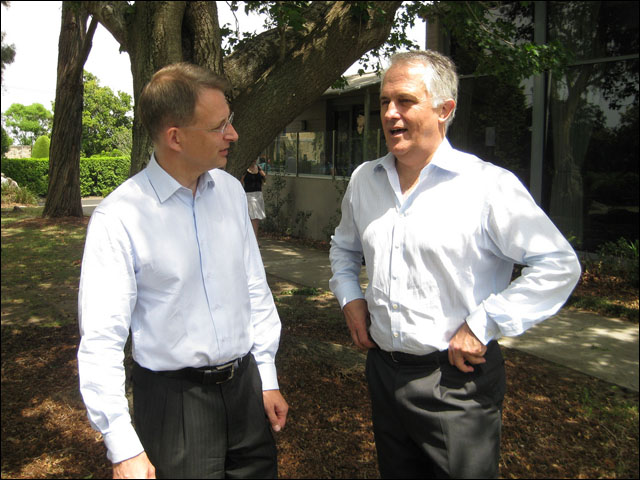
Image credit: Office of Malcolm Turnbull