

opinion If there is one thing I have learnt conclusively over the past few months, it is that Australians feel pretty intensely about the growing electronic book phenomenon.
This lesson has been pounded into me, slowly, but gradually and repetitively, from multiple angles, like Iron Man’s Tony Stark pounding massive pieces of steel together into a giant suit of comprehension. Only without so much champagne and flunkies.
Firstly, it would be safe to say that virtually everyone in Australia’s book publishing universe has now called me about the eBook feature I published back in February.
Most of the publishers and retailers have called. Authors have called. eBook reader manufacturers have called. And representatives of publisher and author organisations have called. If you haven’t called me about the article yet, and you work in Australia’s publishing industry, please do – I would love to chat about that article.
In fact, I have a script that I can read from which has prepared answers for everything you could say or ask. I have been called about this article so many times that I have prepared a formula to make each call more efficient.
Then there are the readers.
There seems to be a trend over the past few months that any article I write about eBooks attracts more comments and page impressions in general than other articles. It’s as if attaching the “eBook” tag to an article is like sprinkling it with a tiny golden shower of magic dust.
Kind of like the sort of stuff that happens in Enid Blyton.
I’d say this eBook interest probably stems from the happy conflux of three trends affecting Australia.
Firstly, as Australian Bureau of Statistics data shows, Australians are big readers. In the 2003/04 financial year, Australians bought some 80 million new books, with a total value of $1.4 billion. The overwhelming percentage of those books were sold from actual bookstores, instead of to casual browsers in supermarket checkout lines, for example.
If you speak to Australians about books, they will gladly tell you about how they fondly remember reading something like Colin Thiele’s Storm Boy or The Magic Pudding in their childhood – and maybe John Marsden’s Tomorrow When the War Began series. Later on they will tell you about how influential Tim Winton’s novels – the most notable of which is Cloudstreet – has been in their thinking about Australia.
Others (myself included) will proudly show you their massive science fiction and fantasy collection and rant about how depressed they were when Robert Jordan tragically passed away before he could finish The Wheel of Time, and how happy they are now that Brandon Sanderson is completing the series.
Yes, Australians love books.
But Australians also love technology. Both in corporate IT departments and in our personal lives, Australians love to get the latest gear in to tinker with. Perhaps the pinnacle of joy many adult Australian males could feel would be to be clustered around a BBQ on the beach with their mates, a beer in one hand, proudly displaying the new iPhone that they lined up overnight in the freezing cold to pay mega-dollars for.
It’s a rite of passage.
(There is one pinnacle currently higher – to be the one to pull out a HTC Desire and tell the iPhone owner how they are nothing but a stooge to Steve Jobs. There is nothing Australians love more than one-upping each other.)
But there is a dark side to these two loves that Australians have – technology and books. More than anything else, Australians get frustrated when – due to our geographical isolation compared to major population centres in the US and Europe – we get something late, or not at all, or it is overpriced.
This especially applies to technology and books. And when you take the two together – whoah, boy, there is a problem.
If you could sum up Australia’s attitude to eBooks at the moment, it would be something like: “We would, if we could, but we can’t.”
That is, as I was discussing with a professional colleague yesterday, it is not possible in Australia (even with the Amazon Kindle) to get most of your reading done electronically, despite the obvious maturity of the technology, because there are many publishing industry restrictions stopping Australians from getting the right level of access to eBooks.
This is causing a great angst out there in the Australian population. We don’t want to be the country that is left behind in the eBook revolution. Ideally, we want to be leading it.
Book publishers who understand this mostly hidden tidal force of anger and who can leverage their operations in a way that they can harness it, will be able to make millions and millions and garner themselves an immense amount of goodwill from Australians.
Book publishers who ignore Australia, on the other hand, will find themselves swept out to ocean as that powerful undercurrent of annoyance takes more visible force.
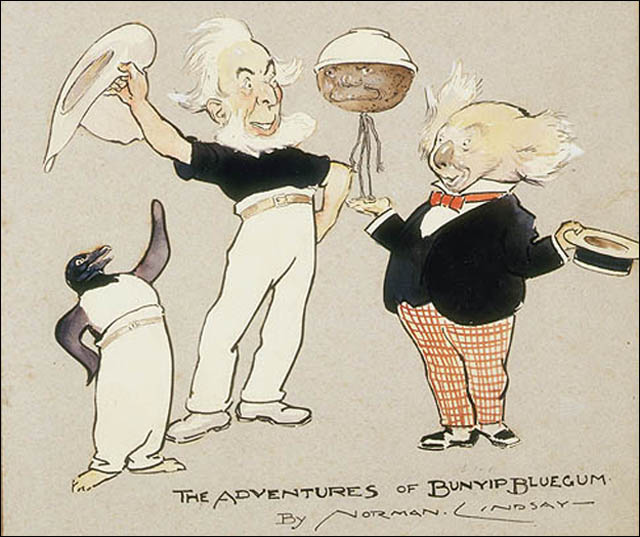
Image credit: Norman Lindsay

I dont think that people realise HOW large an audiance Australia is regarding books.
We are 1/2 the market for UK publishers. HALF!
That is despite the fact the UK is 190.5% larger (according to Wolfram Alpha) than Aus in population.
How we are treated as a market is a different topic…..
I know — we have a huge book culture in Australia, but much of it is understated (typical for Australia). I wouldn’t be surprised that we are half as large as the UK — I know there are some big readers over there, but in general they seem to be more social … watching TV together, going out more, than Australians — we tend to be more suburban as we grow older, stay home reading and so on.
“Australians feel pretty intensely about the growing electronic book phenomenon”? Really?
I think you will find that most Australians simply don’t care.
That hasn’t been my experience at all, as documented above.
I don’t think you can speak for “most” Australians.
Well then I shall stop writing, pack up my laptop, cancel Delimiter and go home.
Wait.
:)
I don’t think you can speak for most Australians either Mr. ‘None’
And the fact that the article writer might of done some research on the subject rather than just post something without any backing……
I get comments and interest from strangers about 90% of the time I use my reader in public.
Yeah people who have bought the iPad say the same thing — there is quite a lot of interest in these devices atm. The era of paper is ending and people are thinking … what’s next?
I was again reminded recently of the unreasonable way we are treated in Australia.
My new partner has a set of BBC DVD she obtained from UK newspaper.
My DVD player refused to play them, as it isn’t zone agnostic.
Heh that’s a whole other discussion Paul — the whole multimedia thing is quite annoying. We also get unfavourable treatment on the video game front, with some games not being available in Australia, despite the fact that they are made available online, and pricing being different and so on. However I should note that it’s not just Australia that has the DVD problem — there are “zone” controls all over the globe on that. It’s rather annoying.
Nice article, sums up my friends ;-)
Hmm … I wonder why that would be :)
I’m gonna wait for the coloured eBook readers so I can read comics on them……..
Save some money buy an iPad?
I wouldn’t be caught dead owning an apple product…..
Ah yes — a coloured e-reader that could read Japanese manga would be quite desirable … but then I guess most manga is in black and white anyway, so in the short term it wouldn’t make that much of a difference.
true ‘most’ manga is in b/w but I’ve also been reading allot of western comics lately which are ALL in colour.
Renai, you are certainly representing a large number of Australian ebook readers (as shown in forum threads such as Mobileread), and you are also representing the needs of disabled readers. Disabled readers who can’t hold paper books or read without adjusting background colour, font size etc. can ONLY read (or listen to) electronic media. Disabled people are a significantly larger proportion of online consumers, compared to offline, since computers make it possible for us to access services and information. So here we are, keen to buy ebooks, unable to read any other books, and the publishing industry spits in our eyes and refuses to take our money … because we’re in Australia? WTF?
I can tell you, for anyone housebound or bedridden by illness, you are already isolated enough without being “geographically limited” by commercially unrealistic and insensitive publishing choices. I have half a mind (which is all I have left ;) ) to take them to court for discrimination against disabled people.
The only thing that has got me this steamed up recently has been the move to censor the Internet. Technology has bridged so many gaps for all of us. I can’t believe governments and other ignorant/greedy types want to make life more difficult again.
Delimiter is definitely representing many Australians on this access issue. I am grateful that someone is representing me (and so many more like me), as we can’t do much ourselves. Thanks, Renai. :)
Cheers Clytie! I think there is a powerful message here. Humankind has always used technology (from the humble stick to the microchip) as a tool to enable the outcomes we wish to pursue. The use of technology to overcome disabilities is a fantastic example of this. Why, just because someone has a physical disability, should someone be stopped from access any of the world’s information and knowledge, if there are technological mechanisms that can allow them to overcome their disability?
Publishers need to realise that there are human outcomes to be found within the eBook revolution. And it has always been my experience that where businesses follow the human outcomes, financial outcomes will also follow. Many of the problems with businesses over time stem from trying to put financial outcomes first constantly … without realising that financial outcomes are usually long-term things that stem from human outcomes.
Google is a perfect example of this … solve a human problem — and you can usually work out a way to make it make money after that.
I’ve been using eBooks since Mobireader became available on Nokia’s Series 60 platform (3650 – one of the first S60 devices). Since Amazon took over Mobipocket & killed it, I’ve become wiser and will no longer buy any DRMed digital content unless it’s easily removed/circumvented. thankfully the PRCs I have are either DRM free or have been easy to de-DRM.
I’ve also got to the point where I don’t buy dead tree editions of books, especially technical/reference books and only buy classics or keepsakes.
Australian publishers need to wake up, otherwise they’ll lose market share to parallel/grey imports of digital media.
I haven’t bought an eReader yet, so am still buying books in dead tree format. I also get publishers sending me books to review for my science fiction/fantasy site Keeping the Door. But every time they do, I wonder … wouldn’t it be easier if you could send me an electronic copy that I could read on an eReader … save space, time, money for postage, etc etc? :)
I think the problem (mostly) with Australians not being able to buy a lot of ebooks is that territorial restrictions are being treated the same with digital books as they are with physical books – and that is VERY frustrating for the end user! It’s one of the reasons that good people turn to pirated content (which I don’t endorse doing by the way) and I think it’s the one part of Digital Rights Management (DRM) that is tricky for publishers to work out, but imperative.
Now that we have some dedicated ereaders in our market (and YAY, an affordable one with the Kobo reader being released) then publishers will be launching their local programs in anticipation that there will be enough sales to justify it.
I get the point about colour readers (though I don’t read Manga) and I’m hoping the iPad will meet that need – although I’m wary of their ‘walled garden’ approach and not being able to read the ebooks I purchase there on other devices.
I must say though that I happily do a lot of reading on my iPhone via the Stanza or Kobo application and I like having a multi function ‘device’
Also, let’s not forget that http://www.ebooks.com (Perth based) has been offering titles for, well I don’t know, but years and years! They have titles by Australian publishers who smartly have quietly used them for distribution years before there were other players in the market.
This was one of the points raised by publishers at the launch of the Borders Kobo eReader today — people were claiming that territorial restrictions need to remain in place so that local publishers can make money and support local authors. But the whole time, I was thinking, why do authors need publishers, if they can use the eBook channel to go direct to readers? And why do readers need publishers when they can download eBooks direct from online repositories that can be located anywhere in the world?
In any regard, however, I do see the Borders initiative as tremendously positive — it seems like they have a lot of momentum behind it, the DRM works well for the publishers but is flexible enough for the users, and there is now no excuse for publishers not to get behind it.
I have done a bit of iPhone reading via Stanza, but the frustrating thing about it for me is the constant scrolling down — I just want to change pages, which I think will be much better with a Kindle or a Kobo.
Hi Renai, I think that will be a question asked more and more in the digital era – why do authors need publishers? And I believe it’s one that publishers are asking themselves and need to justify more and more.
I believe the key things that a publisher supplies are editorial direction and marketing, and to a lesser degree typesetting management (of course for an ‘only e-book’ this is not relevant.
I could (but won’t) name a few well known Australian authors that have their editor to thank for plot development, character development and continuity. Let alone picking up all the typos! Perhaps authors themselves won’t see the importance of this, and I also do acknowledge that there are external (freelance) editors who could potentially offer this service. But it is critical to have an objective editorial viewpoint.
For marketing – yes, you can deal direct, but how will anyone find you? Yes, authors do a lot of their own marketing these days via their websites and blogs, but unless they are one of the few very successful authors with a large following already then the publisher brings access to a wider audience and negotiations with the retailer for prime position, either online or instore.
Your point about why do readers need publishers – well, I don’t think where they obtain the title is relevant. I agree with you on that.
Agree the Borders initiative is great, along with the launch of an affordable ereader into this market!
+1 to this entire post, I agree with it.
If I was writing a novel (and in fact I am, although for my own enjoyment, mostly — for the art, not for the money), and I wanted to get it published, I would realise that I need both a good editor and a good marketing strategy.
Initially that marketing strategy would involve building up a following online. That would then dramatically increase the chances that a publisher would be interested in the work — because they can see an existing audience for the books.
You would then leverage the publisher support for marketing and distribution scale that you would not be able to obtain on your own.
Of course, in the real long-term, who can say how the model will change. I guess I am mainly talking here about the next 5-10 years.
Imagine the difference it will make in education. No more lugging heavy (and often out-of-date) textbooks around. Textbooks which can be updated on the fly. Access to resources for schools in rural and remote areas. Easy access from home to journals, library stacks and archives for research – no more queuing up for the only four copies of the journal article.
And hopefully for schools, a much smaller textbook cost.
I am a Brit living in Denmark. It’s similar here. A heck of a lot of ebooks never reach Denmark. We don’t even have TV and Movies in iTunes yet because of regional restrictions.
This is the next barrier to fall, I think. Users want want they want, and it’s about time publishers stopped getting in their way; or charging some sort of premium for the content.
Regional restrictions don’t prevent piracy, they fuel it.
Comments are closed.