

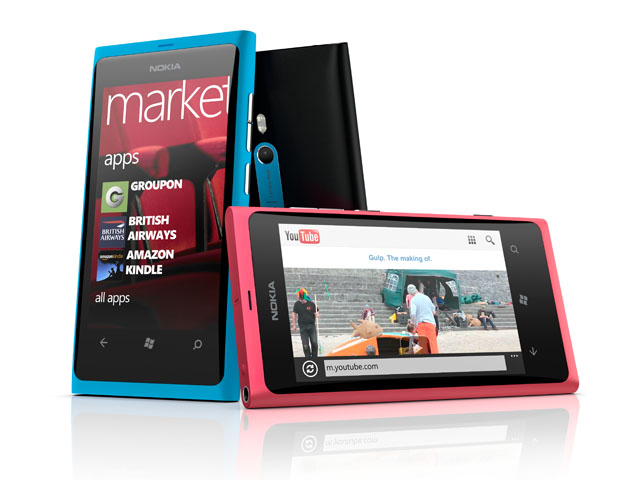
news Construction firm Buildcorp has deployed some 150 new staff mobile phones in Nokia’s Lumia line, the Finnish smartphone vendor announced this afternoon.
In a statement, Nokia said Buildcorp, which specialises in construction, commercial fit-outs, remedial building and building services projects in NSW and Queensland had upgraded its 150-strong smartphone fleet to use Nokia’s Lumia 800 and 710 smartphones, after evaluating other Windows Phone 7 models from rival companies like HTC and Samsung. “Nokia’s commitment to the Windows Phone platform was important in our decision to adopt Lumia,” said Buildcorp’s finance and systems manager Brett Hoskins. “Other phone providers have a limited number of phones on the Windows Phone platform, with the remaining running Android. This long-term partnership with Microsoft ensures we have the right product support in place now and in the future.”
The news comes as Microsoft’s Windows Phone 7 platform appears to be enjoying somewhat of a resurgence in the nation’s corporate market, after struggling in the consumer sector against the well-entrenched iPhone and Android platforms. In late May, the Australian division of tyre manufacturer Bridgestone has also picked Nokia’s Windows Phone 7-based Lumia 800 smartphone as its platform of choice for its corporate smartphone fleet, and CommBank is similarly considering a move to the Nokia Lumia platform.
Hoskins said Buildcorp’s staff spent a lot of time out of the office at construction sites or on the road, and needed to access the company’s project management application ProjectCentre, which is delivered as a software as a service application. “Previously, employees would have to return to the office throughout the day or after hours to get the most up-to-date information,” said Hoskins. “Now, with Nokia Lumia, they can access Outlook and the ProjectCentre mobile app on their phone wherever they are. The more time staff spend on site, the better results we get on the project and importantly, for our clients. Also, being able to access documents on the go means staff can go straight home at the end of the day instead of coming back to the office, giving them a better work-life balance.”
Windows Phone 7’s integration with familiar business tools such as Outlook, Internet Explorer, Word, Excel and PowerPoint had also been a key driver in Buildcorp’s adoption of the Nokia Lumia smartphones, Nokia said, as well as access to Nokia services such as Nokia Drive, providing free, voice-activated turn-by-turn navigation, and Nokia Maps, which provides offline pedestrian navigation. “With so many staff members on the road, Nokia Drive and Nokia Maps has enabled them to get from A to B easily,” said Hoskins. “The free music streaming service, Mix Radio, provided by Nokia Music has also been popular.”
“To date, feedback from staff has been great. Nokia Lumia provides them with what they need from a business perspective, but also gives them what they need in their personal lives, such as social media capabilities and music. We’ve seen a number of staff switch from their iPhones and other phones to the Nokia Lumia for personal and work use so they no longer have to carry two phones. At the end of the day, it’s about maintaining a happy workforce and if they can be more productive, then it’s a win-win situation.”
You can find Delimiter’s Nokia Lumia 800 review here and the Lumia 710 review here. We are currently reviewing the Nokia Lumia 900 and 610 devices, which also recently launched in Australia.
opinion/analysis
I wrote this about Bridgestone’s decision to switch to the Lumia platform, and the same applies to Buildcorp:
Perhaps I shouldn’t be, given Microsoft’s ongoing dominance of the enterprise IT scene, but I am really surprised by Bridgestone’s decision to go with Windows Phone 7 for its corporate smartphone fleet. I would have assumed that, by now, Apple’s iPhone devices would have become the defacto corporate smartphone platform, given the company’s massive developer and app ecosystem (including a dominance of the enterprise IT app integration scene), the fact that business users are very familiar with the platform from their consumer lives and the ever-encroaching dominant of the iPad in corporate life.
However, what Bridgestone’s decision indicates is that Microsoft’s smartphone platform is far from dead in the enterprise, and that some of the organisations which had previously been using older versions of Windows Mobile in their corporate fleets are probably looking at the new operating system as a worthwhile upgrade from the old, despite the radical, consumer-focused redesign which the platform has had over the past several years.
Another notable issue at the moment is that we continue to hear very little about Google’s Android platform in corporate smartphone fleets, despite the platform’s dominance of the consumer market alongside Apple, and despite the fact that major telcos like Telstra, Optus and Vodafone are all very strong supporters of the Android platform — beyond even their support for the iPhone. I don’t think I’ve ever seen a case where a large organisation has standardised on HTC or Samsung Android phones.
If I look ahead a few years, the corporate smartphone market will be a very interesting one. If things continue to go the way I think they will, Apple may take a strong chunk of this market, and Microsoft will be overweight in this segment compared to its consumer market share, while Android will continue to suffer a low presence, although there will be some high-profile deployments. And, of course, Research in Motion will continue to lose ground as it progresses on its gradual death spiral. Overshadowing all of this will be implications from the Bring Your Own Device movement, with the lines increasingly being blurred between personal and business mobile use.
This isn’t necessarily the way I would have seen things a few years ago. A couple of years ago I would have still placed Apple out in front eventually when it comes to corporate smartphone fleets, with Android second and RIM and Microsoft fighting it out for third place. But it seems — as with most of its businesses — that Google is once again struggling to understand enterprise IT computing. In this context, it’s not really a surprise that Microsoft does.
Image credit: Nokia
Excellent Windows phone with great features.
+1
+1.
i love wp phone.
But why the current WP7 phone does not support the upgrade to WP8?
I am really annoyed!
Wonder how they feel about the Windows Phone 8 announcement? Now all their shiny new phones are already obsolete later this year or next year, and won’t be able to run the next version of the OS!
Microsoft have been kicking consumers, corporations and their partners in the guts a bit lately… not that they haven’t done this many times in the past. I’ve been working with them for 20 years and seem many great new ideas get tossed to the side less than a year later.
There’s a reason smart IT people wait for the 2nd or 3rd iteration of anything from Microsoft (Windows Phone 7 counts as a version 1, as does Windows Phone 8). It’s often not safe to trust them till then.
While win8 devices will be out soon, these phones will be replaced in two to three years. For the two years they’re not the latest model the existing software will continue to work with all the features you bought it for. Communication protocols wont be changing enough in that time frame to worry too much about.
We still have iOS 2.0 and BBOS 4.5 users connecting to our work email just fine, and they’re pretty ancient now.
Corporate deployments always stay a bit back from the bleeding edge. I don’t see Windows Phone 8 as a problem for these corporates. In addition, I note from the lengthy media release that Nokia sent me this morning that many of the features of Windows Phone 8 will be available to Windows Phone 7 users.
That’s the thing, I would call the current release of Windows Phone 7 “bleeding edge” still. It still seems mostly aimed at consumers, yet there’s been a couple of enterprises in the last month or so that have chosen it.
Now Windows Phone 8 is coming, I doubt many devs will be starting new WP7 apps, they’ll all do WP8. So although the hardware does have a limited lifespan of only a few years, the platform choice seems to now have “f#$k you, suckers” stamped on it by Microsoft (that’s how I would feel if I had just bought one, hate to think how a CIO that just bought hudreds/thousands of them would feel!).
Any investment in apps for their new enterprise platform is now in question. Since I’m pretty sure all the new apps will be WP8 they just wont work until they do another full hardware refresh.
It is a pretty brave move by Microsoft, but it’s a PR nightmare. The message I get is “We aren’t sure what we are doing yet, trust us at your own risk, we might change everything again next year”.
The thing with Windows Phone is that though it is a nice well thought out UI, it straightjackets creativity and hence stifles innovation. The rules are its the Metro way or the highway. For some devs, this can be helpful, but for those that like to push boundaries, to innovate to come up with new ways of interaction it is simply not appealing. One has to wonder how much this is hurting their platform, and the future implications on their Surface tablet? Contrast this to something like iPad and the philosophy is that the developer owns a blank canvas. This can be good and bad, but in the hands of gifted developers it leads to new ideas and experiences that would not otherwise be possible.
Comments are closed.