

news The Federal Government has revealed it denied requests by consumer organisations to attend a secret meeting held between the content and telecommunications industries to address the issue of illegal file sharing through avenues such as BitTorrent.
The meeting, held on 23 September, saw major Australian ISPs sit down with the representatives of the film, television and music industries with the aim of discussing a potential industry resolution to the issue of online copyright infringement. The issue has come to the fore over the past several years due to the high-profile court case on the matter ongoing between iiNet and the Australian Federation Against Copyright Theft.
However, in documents released today under Freedom of Information laws to the Pirate Party Australia, the Federal Attorney-General’s Department, which hosted the meeting, revealed a representative of several public interest groups — the Australian Communications Consumer Action Network (ACCAN) and the Internet Society of Australia (ISOC) had requested to attend the meeting and been denied.
On the 8th of August this year, following media reports that the meeting was to be held, an individual representing both groups requested to participate in the 23 September meeting, the briefing documents revealed. The individual’s name was censored in the FoI documents. The documents are available in full at the website of the former president and current treasurer of the Pirate Party Australia, Rodney Serkowski, who issued the FoI request for the documents. Delimiter has also issued a similar FoI request and was advised this week that many of the same documents would be released this week to the Pirate Party.
“However, [AGD staffer Peter Treyde] advised that the upcoming roundtable will be an initial meeting to gauge the Internet service provider and copyright owner positions and obtain an update on the progress of their discussions to date,” the briefing notes state. “Mr Treyde advised that the Department will consult with relevant consumer groups once industry discussions have reached an appropriate stage.”
“Consumer representatives were not invited to the upcoming meeting as it will be an initial meeting to assess the industry’s progress toward a solution,” the document added. “This was not an oversight.”
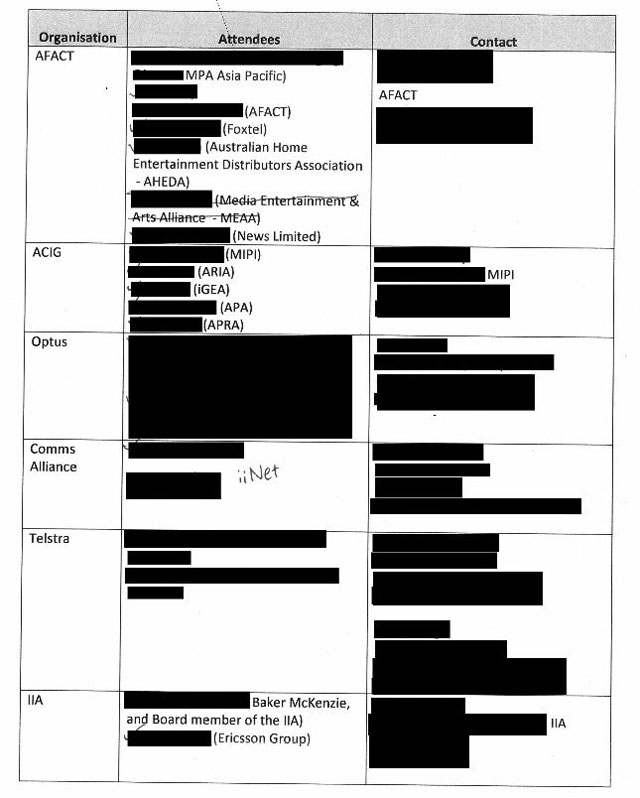
The FoI documents did go some way towards revealing the identity of the organisations which attended the September meeting, although the department redacted the names of the individuals who attended.
The majority of the organisations who attended were from content industry organisations, including the Asia-Pacific branch of the Motion Picture Association, the Australian Federation Against Copyright Theft, Foxtel, the Australian Home Entertainment Distributor’s Association, the Media, Entertainment & Arts Alliance, News Limited, Music Industry Piracy Investigations, the Australian Recording Industry Association, the Interactive Gaming and Entertainment Association, the Australian Publishers Association and the Australian Performing Right Association.
On the ISPs’ side, only Telstra, Optus, the Communications Alliance (which represents telcos), the Internet Industry Association and networking vendor Ericsson attended — although Telstra and Optus both sent a number of staff to the meeting. It is not clear whether iiNet attended. All up, about 25 industry representatives attended.
The briefing also discussed solutions in other countries, but the documents also revealed that the Attorney-General’s Department hoped to frame the discussion on the day through the lens of the so-called “six strikes” policy to tackling online copyright infringement agreed between the content and ISP industries in the US this year.
Under the deal, major US ISPs — including AT&T, Verizon, Comcast, Cablevision, and Time Warner Cable agreed with the film and music industries to forward copyright infringement notices from content owners to alleged Internet pirates. After five or six of these notices, ISPs have agreed to institute certain punitive measures, including, for example, temporary reductions in Internet speeds, redirections to educational pages and pages to discuss the problem.
There is speculation in the industry that one potential resolution to the issue of online piracy could be the implementation of a so-called ‘strikes’ system, which would see internet users disconnected after content owners had complained a certain amount of times and provided evidence that a certain user was committing copyright infringement online. Such systems have already been implemented in countries such as New Zealand and France.
So far, the ISP industry has resisted implementing such a system in Australia, although a number of ISPs — such as Exetel, for example — have already voluntarily implemented a system whereby the receipt of a certain number of complaints will eventually lead to a request for a customer to churn to another ISP. AFACT has signalled to ISPs that it wants an “automated processing system” for copyright infringement notices to be distributed to ISP customers.
A copy of the US memorandum of understanding, as well as briefings about how other jurisdictions handle the issue, was circulated in detail to participants before the meeting.
Although the various positions of the different groups espoused at the meeting appeared to have been detailed in the FoI documents but redacted in full by the department. In documents detailing its reasons for doing so, the department noted in general material from the documents had been deleted or not released because of the early stage of the discussions. The Attorney-General’s Department has previously declined a Freedom of Information request for the minutes of the meeting, stating that no minutes of the event exist.
“At this preliminary stage of the process, discussions are taking place, discussions involving various stakeholders with competing interests,” the department wrote. “It is worth noting that these discussions have not yet been completed … The discussions, therefore, are at a very delicate, sensitive and important stage.”
“Disclosure of documents while the negotiations are still in progress would, in my view, prejudice, hamper and impede those negotiations to an unacceptable degree. That would, in my view, be contrary to the interests of good government — which would, in turn, be contrary to the public interest.” Some information was also redacted because it might lead some parties concerned to not disclose information to the Government in future, or to protect individuals for personal reasons.
In general, the information released in the documents was consistent with the statements by former Federal Attorney-General Robert McClelland (the post is now held by Nicola Roxon following a cabinet reshuffle) that the government preferred an industry-based solution to the issue of online copyright infringement. In addition, speaking notes by both McClelland and departmental secretary Roger Wilkins for the event emphasised that consumer groups and interests should be paramount in any such industry solution.
However, the documents also emphasised a desire for copyright infringement issues to be addressed through societal change. The issue is particularly contentious at the moment due to the ongoing court case between iiNet and the Australian Federation Against Copyright Theft, which is slated to hit the High Court, in AFACT’s second appeal following unsuccessful rulings, later this year. AFACT is attempting to hold iiNet responsible for the piracy actions of its users.
“Regardless of the High Court outcome in Roadshow Films Pty Ltd v iiNet Limited, illegal file sharing will continue,” speaking notes prepared for McClelland for the event state. “Practical steps must be taken to educate and deter people from accessing unauthorised content. Any solution should “be educative and aim to change social norms”.
AGD’s FoI document detailing the attendees at the meeting (individual identities have been redacted):
Right, so it’s a good old “we’re going to decide how to screw you, then ask you how you feel about it” sort of thing. And they want “societal change” – good luck with that, fellas.
“we’re going to decide how to screw you, then ask you how you feel about it”
They think they can apply the old rules to the internet, like they are dictators… Just to spell it out for them, the internet doesnt respect borders.
The nation is dead, Long live the people !
Piracy is not a legal nor a technical problem for ISPs to fix. It’s a marketing and service delivery problem for content providers to fix.
iTunes showed the world there’s big money to be made in selling people exactly what they want with no nonsense. The equivalent services on offer for movies and TV shows are poor, and cable TV is just plain pathetic.
In a world of high speed internet and media enabled devices, it should be trivial to sell TV shows and moves episodes or season at a time for a reasonable price, that can be played on any device without special software or hardware vendor lock-in, and do so free from advertising.
The video game industry has seen this boom already. There are dozens of online services available now to purchase and play games with few restrictions and for reasonable prices. Why have the media industries (with the exception of Apple iTunes) not figured this out yet? Instead they’re wasting their time on stupid “three strikes” laws, when they should be working out how to beat their competition into delivering a profitable service that keeps paying customers happy.
Come on Renai – ‘secret meeting’ ?
I heard you had a secret meeting yourself the other day. At least I wasn’t told about it, so it must have been ‘secret’. There are meetings going on all over the country, all the time. Just because everyone is not part of it doesn’t make them ‘secret’.
Private maybe.
Getting past that pedantic peeve, I would hope that any solution needs to take consumers into account. After all it is them that consume and distribute the unauthorised content. To paraphrase the old saying “If you are part of the problem, you should be a part of the solution”.
throughout the iiNet trial we’ve heard very little from rights holders about a solution, plenty of rejection, but little by way of removing the incentive to seek out unauthorised content. Perhaps consumers would have some suggestions.
Happy Christmas to you and your readers.
S
I believe Steve, the meeting wasn’t so much secret as in, no one knew it occurred (as you imply), but more that the content of the meeting is being deliberately withheld from those that are having things decided on their behalf.
Indeed Renai is pointing out that consumer groups were specifically denied access to “this part” of talks. The part of the talks where they decide what is best for us as consumers of media. I am sure consumer groups will be invited in to listen to the new plan for us all, once all the objections the you guys might raise have been ironed out.
I believe Steve, the meeting wasn’t so much secret as in, no one knew it occurred (as you imply), but more that the content of the meeting is being deliberately withheld from those that are having things decided for us *during this meeting*.
Indeed Renai is pointing out that consumer groups were specifically denied access to “this part” of talks. The part of the talks where they decide what is best for us as consumers of media. I am sure consumer groups will be invited in to listen to the new plan for us all, once all the objections that you guys might raise have been ironed out.
The point you are missing, which was pointed out, is not that the talks were done in private, but that the consumer groups were refused access to parts of the talk
Those two are incredibly different things
Heres a question Steve.
Regarding that voluntary Interpol filter, exactly how were you able to ascertain the ‘really nasty stuff’ was on it? Had a peek? Got all your ASIO clearances yet? Elected to act by anyone as your customers rep for what they see or don’t? Get to call the shots as an isp employee? No illusions of grandeur there at all?
Happy New Year, watch out for the TPGer in the woodpile though…
On the filter – since we’re not participating, and never have, your sarcasm is wasted.
Sarcasm? I asked how you were able to describe the content of the Interpol list as ‘really nasty stuff’ if you hadn’t seen it, and if you had, what authority you had to do so. Or if you had not, why you were so confident about the content. No relevance whatsoever to whether or not you had or had not implemented it.
Many criticise Conroys babblings about internet control but when their positions are questioned they are dismissed with similar arrogance. At least he was elected.
I want to know why isp staff are somehow given insights into controls that the public are not. Are they police, lawyers, or security agents? No, they are members of the public employed by isps yet they seem to have some god given authority to make value judgements we are not.
Happy New Year.
hey Steve,
firstly, the meeting was indeed held in secret. The only reason we know it was held is because the existence of the meeting was leaked to The Australian. The Attorney-General’s Department declared in its FoI documents that it was planning to issue a press release following the meeting, but it never did.
Secondly, as other commenters have noted above, AGD is actively preventing the public from knowing what took place at this meeting. As I have noted in our articles on this, AGD has declined to provide the public with minutes of the meeting, has redacted position statements given at the meeting by the attendees from FoI documents released over the past week, has redacted the names of the individual attendees and has declined to provide further information about what was said at the meeting.
Furthermore, it has declined explicit requests by consumer groups to attend a meeting, the outcomes of which will primarily affect consumers.
To my mind, this is the very definition of a “secret meeting”, and entirely different to the kinds of meetings which are held every day that you mention.
I have been disturbed by the Government’s response to this issue, and, as my readers have urged me to do, will continue to shine the light in on this secretive process. I am sure that the Attorney-General’s Department, following the multiple FoI requests that it has fielded on this issue, is feeling itself pressurised to be more open and transparent about this whole issue, and that can only be a good thing for the general public.
Cheers,
Renai
+1!
@Steve Dalby – iiNet
So, Steve, you are incapable of distinguishing between the meetings of private citizens, and those held by Government Departments and paid for with our taxes are you?
@Steve Dalby – iiNet
“Perhaps consumers would have some suggestions.”
There’s lot of well-intentioned people on the threads and forums hammering this out with gusto, intelligence and informed opinion. Maybe the rights-holders would find their time well used to read some of them.
No consumer reps but News Limited and Foxtel are there… so good to see the twisted golems minions are sitting in on the future of the oznet…
I’ve figured it out.
Ed Husic needs to get involved. Just say to the content industry, you fix your price gouging and the distribution issues in the Australian market and we will look into the piracy thing for you. Then change patent laws and copy right laws so that companies suing restricted market pricing and restrictions on the distribution on goods don’t enjoy access to the laws designed to the protect them.
Comments are closed.