
news The long-held vision dreamt up by senior Labor politicians Stephen Conroy and Kevin Rudd in 2009 of a universal fibre broadband network covering Australia is officially dead, with a solid election victory set to sweep the Coalition into power and a technically inferior fibre to the node plan into Australia’s streets.
Although the return of Kevin Rudd to the Prime Ministership several months ago gave the Australian Labor Party a significant boost in national polling at that stage, exit polling throughout Australia today has shown a clear and decisive victory for the Coalition. Respected ABC election analyst Antony Green called the Federal Election for the Coalition earlier tonight, and other major media outlets have followed.
At this stage it appears as though the Coalition will enjoy a sizable majority of close to 40 seats in the House of Representatives which, historical results suggest would mean it would be likely to maintain two terms in power. The situation is much less clearer in the Senate as Senate results take significantly longer to tabulate than results in the lower house.
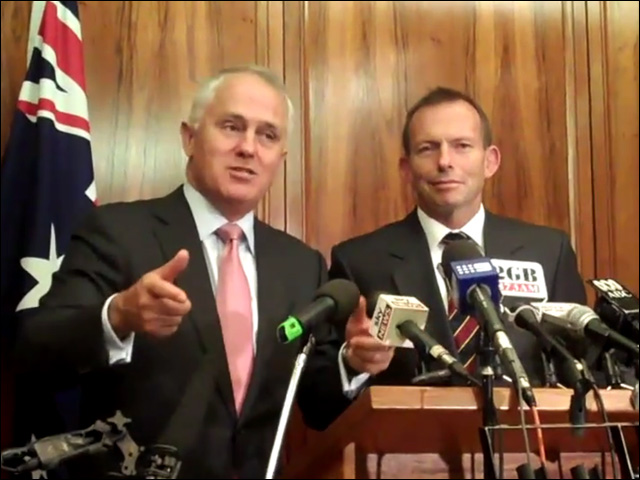
Shadow Communications Minister Malcolm Turnbull’s seat of Wentworth — one of the safest Liberal seats in the country — is also seeing a minor swing towards Turnbull, meaning it is likely that Turnbull will be appointed Communications Minister in a new administration led by Tony Abbott, as the Opposition Leader has publicly intimated several times.
The news will have immediate and drastic consequences for Labor’s NBN project, which the Rudd and Gillard administrations have pursued as one of the Federal Government’s major projects in its current form since mid-2009.
Turnbull has consistently stated that the Coalition plans to “complete” Labor’s NBN vision more rapidly and more cheaply than Labor itself could. However, the Coalition’s NBN alternative is largely based on radically different technology than Labor’s vision, and will deliver vastly reduced broadband service delivery outcomes to many Australians.
Under Labor’s NBN policy, some 93 percent of Australian premises were to have received fibre directly to the premise, delivering maximum download speeds of up to 1Gbps and maximum upload speeds of 400Mbps. The remainder of the population will be served by a combination of satellite and wireless broadband, delivering speeds of up to 25Mbps.
The Coalition’s policy will see fibre to the premises deployed to a significantly lesser proportion of the population — 22 percent — with 71 percent covered by fibre to the node technology, where fibre is extended to neighbourhood ‘nodes’ and the remainder of the distance to premises covered by Telstra’s existing copper network. The Coalition’s policy will also continue to use the HFC cable network operated by Telstra and will also target the remaining 7 percent of premises with satellite and wireless.
According to the Coalition’s media release issued in April upon the policy’s launch, the Coalition’s policy is based on the core pledge that the group will deliver download speeds of between 25Mbps and 100Mbps by the end of 2016 — effectively the end of its first term in power — and 50Mbps to 100Mbps by the end of 2019, effectively the end of its second term. According to the Coalition’s statement, the 25Mbps to 100Mbps pledge applies to “all premises”, while the higher pledge by 2019 applies to “90 percent of fixed line users”. The Coalition has not specified certain upload speeds for its network.
Labor has costed its policy at about $44.5 billion, while the Coalition has costed its policy at $29.5 billion. However, both have stated that their policies will eventually pay for themselves, with NBN Co slated to make a return on investment on either. Additionally, the Coalition has claimed that Labor’s policy will actually cost significantly more than $44 billion.
Opposition Leader Tony Abbott this week described the Coalition’s NBN policy as “absolutely bulletproof”, despite the fact that the Coalition has refused to formally cost the plan, and despite it containing a number of controversial assumptions which have been significantly questioned.
Telecommunications industry experts have consistently stated that they believe Labor’s NBN policy to be highly technically superior to the Coalition’s more modest vision, and having the potential to deliver Australia superior long-term outcomes in terms of service delivery and boosting Australia’s economy through productivity gains.
In addition, questions have been raised about the extent to whether it’s possible to deploy the FTTN technology the Coalition is focused on in Australia. The technology is being widely used internationally in countries such as the UK, France, Germany and the US, but several of those countries have more modern copper networks and a much higher population density than Australia.
There are also questions as to whether Telstra, which owns the copper network which would need to be used as part of the FTTN rollout, will consent to modify its existing $11 billion arrangement with the Labor Federal Government and NBN Co. Turnbull has stated that he does not believe a Coalition Government would need to pay Telstra any extra to get access to its network, but some industry commentators have signalled their belief that Telstra will seek extra blllions of dollars in recompense for its network.
Turnbull has stated that current contracts which NBN Co has already signed with construction firms and equipment vendors will be honoured, but it is believed that a number of the contracts include modification or exit clauses that would allow a Coalition Government to modify them along the lines of a FTTN rollout.
What this means for Australians is that those areas where the all-fibre NBN is currently being rolled out are likely to still receive FTTP broadband, in many cases, but in some cases those areas will have their rollout modified so that they receive FTTN instead. The Coalition supports the use of wireless and satellite technology for the same proportion of rural and regional areas, meaning that construction in those areas will proceed along the same lines as it would under Labor.
For further analysis of Turnbull’s likely first steps in office, see Delimiter’s (subscription-only) analysis of the moves the new Communications Minister will need to take in his first 100 days in office.
opinion/analysis
Well. It finally happened. After three years of argy bargy between Labor and the Coalition on the issue of broadband, the long-held dream of a universal fibre network in Australia is now officially dead.
From the perspective of technologists such as myself, who have consistently highlighted the fact that Labor’s all-fibre NBN vision was superior on every count, as well as the majority of the Australian population which consistently supported the NBN throughout its lifetime, the situation is nothing short of a tragedy. It’s absurd that the Coalition is seeking to radically alter Australia’s largest-ever infrastructure project mid-way, and the move will be immensely destructive to the project.
As Shadow Minister, Turnbull was able to raise many valid points about the rollout of the NBN, and the Member for Wentworth has been very correct in his claims that Labor has mismanaged the rollout. The NBN should have been much further ahead at this point than it is now; after all, Labor has had two terms in Government to make its broadband vision irrevocable. The fact that it has not been able to do so is an indictment of Labor.
However, none of this changes the fact that the rollout of an all-fibre NBN was the best telecommunications policy Australia has ever seen. This was a real game-changer for the Australian economy, for every industry, for consumer broadband service delivery and more. The Coalition’s FTTN-based vision will be inferior in every respect; and there is absolutely no doubt that debate will begin about how it will be upgraded to FTTP, even before it gets across the line to completion in 2019.
From my point of view, what this situation represents is a failure of Australia’s political system in general. The NBN is a policy which has always been enormously popular with the electorate at large, and globally and in Australia, telecommunications experts have been strongly in agreement that the FTTP model which Labor proposed was the right one. Even though the project has so far failed to deliver on its goals, I think the population was willing to wait for NBN Co to get its rollout up to speed.
In the pantheon of Labor policy, the NBN has always been a bright spot. But due to generally separate factors, the Coalition has won power from Labor, and the all-fibre NBN will die along with it, even though it’s what most of Australia wants.
Well, it is what it is. It’s time for Australia’s technologists to get used to the situation. We now have a new Federal Government and a new NBN policy. We’re not getting FTTP any more, and we won’t be leading the world in telecommunications infrastructure. We’re getting FTTN and we will generally be behind other similar countries such as the UK. Plus, suddenly Telstra’s role in Australia’s future telecommunications industry is going to become much more central.
Plus, we have a new Communications Minister. Whether you love Malcolm Turnbull or hate him, it is inevitable now. Turnbull will very likely be sworn in with the rest of Abbott’s new administration in the next few days ahead. It’ll be very interesting to see what wider ripples come from this giant stone thrown in the pond of Australia’s technology sector, and fascinating to see whether Turnbull can actually deliver on the Coalition’s policy.
In the Communications portfolio, the debate now turns squarely to the performance of Turnbull himself in getting the Coalition’s FTTN-based NBN done. Turnbull has been heavily, incessantly, even offensively critical of Labor’s performance delivering the NBN. Well, now the shoe is squarely on the other foot. As Minister, Turnbull will need all of his capabilities to get the NBN back on track and the Coalition’s vision delivered.
Anything less will see those critics of the Coalition’s inferior NBN policy roast Turnbull personally over a slow BBQ for his failures and then feed the Earl of Wentworth to the sharks off Bondi Beach in his electorate. I’ll be first in line to do so if Turnbull puts a foot wrong. If you are going to heap bile upon Australia’s largest ever infrastructure project for three years, you had better be able to prove that you can do a better job.