

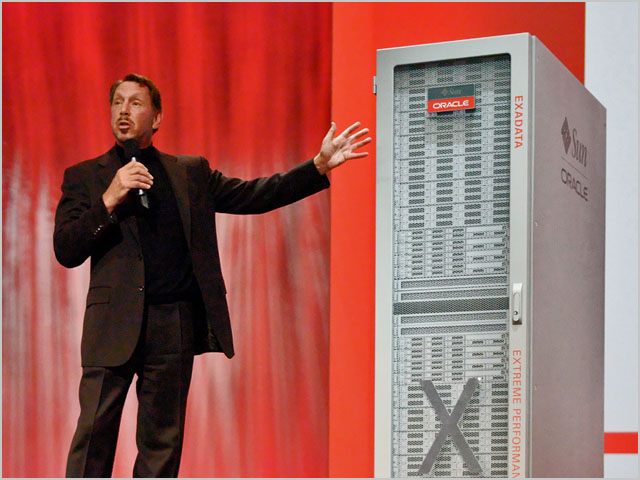
news Top-tier bank Westpac has revealed that it will shift some processing resources off existing mainframe infrastructure and onto Oracle’s Exadata and Exalogic platforms, as it attempts to gain higher levels of efficiency in the platforms that underpin its project to achieve a single view of customer information.
In a statement issued by Oracle this morning, the bank revealed it was currently engaged in a project to deploy Oracle’s Master Data Management (MDM) applications as part of the single customer view project. Oracle defines ‘Master Data’ as the critical business information which supports the transactional and analytical operations of an organisation like Westpac. In this context, the vendor’s MDM suite (PDF) aims to consolidate, “clean” and augment this data, synchronising it with other applications, business processes and other analytical tools.
The specific MDM application which Westpac is deploying, according to Oracle, is based on Oracle’s Siebel Universal Customer Master (UCM) solution (PDF).
Currently, according to Oracle, the bank is using existing mainframe infrastructure to support the implementation. However, the bank recently evaluated Oracle’s Exadata and Exalogic solutions — integratedsoftware/hardware combinations — and found that the platforms could deliver a 40 times improvements over the mainframe platform, with transaction volumes up to 10,000 transactions per second against what Oracle said was a target of 800tps, and response times of 29ms against a target of 200ms. The bank also expects to achieve “significant cost savings” over the next five years due to the switch.
“We are responding to the changing face of banking by significantly enhancing our branch and digital offerings” said Westpac’s chief technology officer Jeff Jacobs.“Providing more flexible and agile branches and continuing to innovate in online and mobile are key to the success of our strategy. Oracle’s platform will help us provide a single source of customer truth that delivers a consistent and high quality experience – irrespective of how our customers choose to bank with us.” Jacobs added: “This collaboration with Oracle is an important piece of work for Westpac Group and builds on the high quality relationship that the two companies have enjoyed for a number of years.”
The news caps off a strong series of wins for Oracle with the integrated Exadata and Exalogic platforms in Australia over the past series of years.
Earlier this month, for example, Oracle announced that giant retailer Coles had deployed the company’s Exadata Database Machine and Enterprise Manager 12c running on Oracle Linux to enable what the vendor described as ‘critical trend reporting” during retail seasonal spikes. The Commonwealth Bank of Australia is also known to be using Exadata.
In late November, for example, Oracle revealed that it signed a wide-ranging $63 million contract with the Federal Department of Defence earlier this year that will see the US technology giant supply virtually all of its major product lines, ranging from its popular PeopleSoft, Database and Fusion products to its Exadata hardware and even its Exalogic Elastic Cloud technology.
Virgin Mobile Australia has also recently commented on how happy it is with its Oracle Exadata machines, and in May last year Oracle revealed its involvement in a series of new Australian technology rollout projects, with all of the initiatives using multiple pieces of the US software giant’s complex software stack and some additionally using some of the hardware products which it has been pushing following its integration of Sun Microsystems. Some of the names revealed at that point were home improvement retailer Masters, as well as Surat Basin Homes and Australian Hearing.
Westpac itself is known to run a heterogenuous IT infrastructure environment including technology from a number of vendors, as is extremely common in an organisation of its size and complexity. For example, in late 2010 the bank revealed that it had deployed its own private cloud computing facility within its operations, working closely with the VMWare, Cisco and EMC cloud consortium to do so.
opinion/analysis
Well, I have to say Oracle’s Exadata series (and the companion lines) have certainly proven themselves over the years. I remember back in 2008 when they were first announced, there was a great deal of criticism and flak out there about whether Oracle would be able to successfully integrate hardware and software into a single platform. This was also before the Sun Microsystems acquisition, and Oracle didn’t have a strong history in hardware at that point.
However, since that time Oracle has slowly but surely eked out a niche for the machines in the Australian market. Typically they’re bought by large organisations such as the banks and other large companies for pinch-hit deployments where a large amount of processing performance is needed in predominantly Oracle environments. They’re not general purpose machines. But where they are put in, they tend to do a good job, according to what I’ve heard.
This article published by Computerworld US in April last year does a good job of showing what users tend to think about Exadata. This paragraph really says it all:
“Users at the Collaborate conference in Las Vegas who have worked closely with Exadata said this week that it lives up to Oracle’s claims of stunning performance over traditional database setups, but the systems’ high price tags, as well as the array of skills needed to use them effectively, call for careful planning and consideration on the part of customers.”
In short, you don’t always want to put Exadata in, and you’ll probably want to have some in-house resources familiar with it before you do, as Oracle consultants cost a lot and the machines are a little non-standard, requiring specific knowledge to handle them. However, if you get it right, Exadata really can deliver stand-out performance, at a top-range price. In fact, what am I saying. This could probably describe every product Oracle has ever produced.
Image credit: Oracle
Ok – stunning performance, if a hardware vendor can not make a rack or two packed with powerful servers crammed with memory, full of flash disk and cache connected with infiniband scream they should not be in the business of flogging kit.
Sure they have some additional smarts with in the software but I’m sure IBM and Microsoft could achieve respectable results using a simular configuration and 10% of the price oracle charges.
“IBM and Microsoft could achieve respectable results using a simular configuration and 10% of the price oracle charges.”
Personally I don’t believe this. Exalogic and Exadata wouldn’t be seeing the adoption it is seeing in Australia without actual result. The fact is that Oracle has shown it has a very good point hardware/software integration solution for specific deployments, usually where Oracle software is being extensively used. It’s dense and a bit proprietary, but I suspect that a similar solution from another vendor would require a lot more hardware and wouldn’t perform quite as well as what Oracle’s got going on here. Sure, you pay a lot for the privilege … but that’s Oracle ;)
Exadata is a successful mainframe, but Exalogic is a miserable mess.
Comments are closed.