

Hi everyone,
well! It’s been a very busy week for news with respect to the National Broadband Network. I think it’s safe to say that everyone and their dog are currently weighing into the NBN debate following the release of the company’s second corporate plan yesterday.
I realise that I have already enlisted your help this week once in helping to conduct a fact-checking exercise with respect to an important NBN-related media release which Communications Minister Stephen Conroy and Finance Minister Penny Wong published yesterday. And I know that you all have a lot on your plate with your own work as well.
However, I hope you will forgive me for requesting your help on a second article this week which I would like to conduct another fact-checking exercise on. This article was written by Liberal MP Paul Fletcher and published on his site this morning. It is entitled; “NBN hopelessly behind targets”.
You might also like to refer to another, related article published by Fletcher yesterday. It is entitled: “What to look for in NBN’s soon to be released Second Corporate Plan – following its dismal underperformance against its first Corporate Plan”.
In the interest of maintaining a level of objective truth in the ongoing National Broadband Network debate, I would like to publish a fact-check analysis of Fletcher’s article next week. We will also be sending this fact-check analysis to Fletcher’s office to invite him to respond.
With this in mind, I invite the Delimiter community to help fact-check Fletcher’s article. Please read it carefully, and post in the comments below this article your view on which statements are accurate and which not. This will help us greatly in responding to this article. Please keep in mind our comments policy when doing so, and bear in mind that off-topic comments will be deleted, with no exceptions. Unfortunately no comments will be accepted from representatives of politicians or political parties at this time.
Note that we are seeking your views strictly on whether Fletcher’s comments are accurate: Not whether you agree with them or not.
Thank you for your help with this important exercise; your assistance is greatly appreciated. I know I am asking a lot of the Delimiter community this week, but it’s an important week in terms of the NBN debate, and I want to try to improve the quality of public debate around the NBN through this kind of initiative. Rest assured that your efforts in this regard are having an impact.
Kind regards,
Renai LeMay
Editor + Publisher, Delimiter
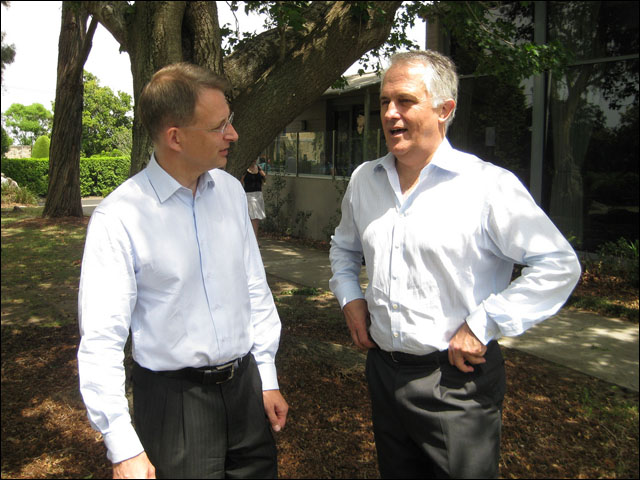
Image credit: Office of Malcolm Turnbull
Interestingly, while the AFR declares “Paul Fletcher is a Liberal MP”, it makes no mention of his association – (Director of Corporate and Regulatory Affairs, 2000 to 2008) – with Optus at the time of their HFC rollout. Of course he’s going to speak in glowing terms of that project, since it was a project he was directly involved in!
I also love:
“If NBN were funded by private sector investors, the CEO would probably have been fired by now.”
It isn’t.
Oops…he was there after the HFC rollout – however his book wildly praised the HFC rollout. My memory is failing in my old age.
Yep the CEO would be fired why spend billions of dollars on something that only make 7% and pays for itself in 20 years and not 2, and that is why the NBN will not be built by the private sector. It’s all about short term gains because CEOs need to make the money now and not 5 years after they move on to another company. It is part of the reason for outsourcing also as the cost to business while your CEO or CIO or whatever senior position your “term” is less than the outlay to continue in house where you won’t see the benefits until after you left.
This attitude is very much extending into politics with a number of politicians only thinking as far ahead as the next election. Why plan further ahead when your party might be out next term and any forward planing and long term projects might get canceled next term or have the credit for completion stolen by the other side. That is the biggest problem the NBN has with the LNP is they have to “change it” because it is a project so associated with Labor at this point in time that if it completes successfully while they are in they won’t be able to claim the credit unless they make changes. This won’t change until we start punishing politician in the poles for failing to think long term or reward those that do. Remember most of us are going to live in this country for more than the next election.
If NBN were funded by private sector investors, the CEO would probably have been fired by now
Case in point BHP just wrote off $2.7Bil on assets purchased last year and the BHP chairman Jac Nasser backs CEO Marius Kloppers
Backs and sacks mean the same thing right?
Fletcher: “In mid-2010 Conroy abandoned the commitment to private sector investment – after receiving advice in the McKinsey-KPMG Implementation Study that private investors would regard the project as too risky and hence taxpayers would need to provide one hundred per cent of the equity.”
Page 368 and there abouts in the report doesn’t say this. It does say that the return expected by private investment would be higher as they have a different assessment of the risks and rewards. That is not the same as saying the project is risky. Indeed, the report says overall the project is essentially certain to generate a return (something like that, summarising 500 odd pages in one line you know..).
Fletcher: “NBN Co released the Second Corporate Plan yesterday – and it confirmed what objective observers have long suspected. NBN Co is hopelessly behind the targets set in that first Corporate Plan – and the signs for the future are getting worse, not better. The first Corporate Plan promised that by 30 June 2012 there would be 317,000 premises passed or covered on the fibre network; the actual number is 39,000. There were supposed to be 137,000 premises with active service; the actual number is 3,500.”
I think the “excusable delay” type term is appropriate here. Am pretty sure that a 9 month negotiation with Telstra had some effect. To portray this as NBN Co being hopelessly slow / behind schedule is quite deceitful.
Fletcher: “The Optus HFC network was announced in 1994, and a roll out to over 1.4 million households was completed by the late nineties at a cost of around $4 billion. Telstra rolled out a larger HFC network (to 2.5 million households) in roughly the same time frame.It has been over three years since Labor announced the NBN, and we now have the grand total of 3,500 premises taking a fibre service. To achieve this outcome has required taxpayers to date to contribute $2.8 billion of equity to NBN.”
I’m fairly sure both of these companies had done a lot of the work that NBN Co have done till now BEFORE their announcements; cost benefit, initial planning, hiring of CEO and staff etc. NBN Co has started from scratch in this time, its not even close to a fair comparison. And lets leave aside the fact that HFC networks are significantly simpler than the scope of the NBN, and cover a tiny fraction of the physical deployment of the NBN.
Fletcher: “This followed the collapse of Labor’s previous plan, announced in March 2007, to build a fibre to the node network in a joint venture with a private sector company, with the contribution from taxpayers to be a mere $4.7 billion.”
Is this the plan where none of the tenderers provided an adequate response? I can’t recall.
Fletcher: “The Coalition believes strongly in the need to upgrade Australia’s broadband infrastructure. But as the disclosures in the second Corporate Plan confirm, Stephen Conroy’s NBN is a really bad way to achieve that policy objective – as well as a terrible investment for taxpayers.”
Damn, shoulda got One.Tel to build it. Guaranteed investment quality when you go private. Seriously though, this statement of Fletchers is at best an opinion, and at worst it is utterly made up. The plan shows that the NBN will have a real return on investment, although possibly small by commercial standards. How can this possibly be used as evidence to confirm it is a terrible investment? This is ignoring the other benefits that are likely to accrue outside direct revenue, such as a positive impact on overall GDP, and on having a well connected populace in general.
Dear oh dear Paul…
Fletcher: “This followed the collapse of Labor’s previous plan, announced in March 2007, to build a fibre to the node network…
No Paul, this was following analysis from people even more knowledgable than you and Malcolm combined who said “listen to us”… FttN is (for the want of a better word) dumb.
Yet dumb is exactly what YOU plan to do anyway:/
“This followed the collapse of Labor’s previous plan, announced in March 2007, to build a fibre to the node network in a joint venture with a private sector company, with the contribution from taxpayers to be a mere $4.7 billion.”
So, what he is saying is that a fiber to the node network in joint venture with private sector companies is a bad idea because it has already failed once before?
Maybe he should break the news to his Leader and shadow comms minister?
“Stephen Conroy’s NBN is a really bad way to achieve that policy objective – as well as a terrible investment for taxpayers.”
So even though Paul previously said the NBN is a monopoly he believes it is a “terrible investment for taxpayers”
Amazing.
(http://www.paulfletcher.com.au/media-centre/articles-by-paul/item/582-telecommunication-journal-of-australia-article-broadband-what-is-the-problem-to-be-solved-and-is-nbn-solving-it?.html)
Indeed Hubert.
Seems today ridiculous anti-NBN contradiction is straight from the horses mouth…
The first Corporate Plan promised + NBN Co has delivered much less than it promised to date
The first Corporate Plan promised nothing. It predicted based on available assumptions and data….which changed.
It is instructive to compare NBN Co’s performance with what Optus and Telstra achieved with their HFC networks
Not sure this is factually incorrect, but it IS disingenuous. Those are commercial companies, expecting upwards of 20% return. The NBN is neither. AND they would’ve done many months if not years of planning before even THINKING of announcing said rollouts. NBNCo. did not have that luxury as a GBE.
The Coalition believes strongly in the need to upgrade Australia’s broadband infrastructure. But as the disclosures in the second Corporate Plan confirm, Stephen Conroy’s NBN is a really bad way to achieve that policy objective – as well as a terrible investment for taxpayers.
Like Ferretzor above, this couldn’t really be called factually inaccurate, but it IS opinion only.
Once again, the Coalition spokesman is able to completely misrepresent the case of the NBN while not ACTUALLY outright lying. He and Mr Turnbull must get together regularly and compare notes.
A worthy perspective from a very astute intelligent man.
http://www.smh.com.au/opinion/politics/stupidity-is-on-the-rise-in-our-age-of-enlightenment-20120808-23uiq.html
So observeable in the issue of the NBN
And people wonder why I never wanted to go into politics, even winning on the debate team….
Only problem with Barry’s analysis us, at the end, it concentrates on the ALP (reasonable seeing he was an ALP minister) but the ‘banality’ exists even MORE so in the LNP, particularly under Abbot.
7T
I was actually seeing the Generic aspect, especially the dumbing down of the population and voters who actually seem to have diminished capacity to reason and ask questions and their attention span and comprehension levels even of educated people is nothing like 50 years ago. To try to have a reasoned discussion these days is difficult, sick of banal regurgitation of the lies and half truths they have been swallowing and they become so defensive when the facts are presented
@Abel
No question. As I said I’ve been asked why I’ve never gone into politics and people wonder why I’ve not considered it.
Why would I want to sell out my beliefs and loyalty for the sake of ideology which I don’t truly believe in?
@ Abel & @ Paul Fletcher
have you guys ever seen that Movie Idiocracy….?
with people in places of potential great influence like Mr fletcher and Mr Abott and Turnbull.
i am seriously counting the days before we have a President Mountain Dew and have to hire a team of specialists to find out why the crops are dying, when we have replaced water with Gatorade….
It is interesting to reflect on the statement that Optus rolled out to 1.4 million homes at a cost of 4 billion in the mid nineties.
In today’s terms that 4 billion, when adjusted by the CPI, is 6 billion today. Optus cherry picked the suburbs that were cheap to roll out to, and had a high rate of return (as any prudent business would).
If you limit the NBN to 10 million connections, thats about 7 times the 1.4 million that Optus has connected HFC to.
7 times 6 billion is 42 billion… The NBN roll out is cheaper then Optus even though it is connecting regional and other more expensive premises.
You can expect a conservative 80% of people to have an NBN service eventually. Does Optus have even a 30% connection rate?
7 times 3 years is 21 years… The NBN will roll out twice as fast as Optus over it build time.
So, the NBN is cheaper, will be built at twice the speed, have more then double the take up rate and be cheaper to maintain while offering a far far superior service.
Yes, lets compare the Optus roll out to the NBNs…
@Paul
Those are interesting numbers however, you fail to note 4 important facts:
1- Optus rolled out HFC, using their own civil works and building their own ‘exchanges’. NBNCo, predominantly aren’t.
2- Optus has a set number of contractors they can employ and still maintain a healthy commercial profit for those years. NBNCo don’t HAVE to maintain a commercial profit.
3- NBNCo’s scope is SO far beyond Optus’ HFC rollout, the equipment buy costs and the mass labour costs cannot be easily or fairly compared. It would be like comparing Woolworths’ wholesale buying capability and IGA…..and we all know who does better and makes a better profit.
4- Once again people choose to ignore the fact that UNLIKE Optus’ HFC the NBN is a WHOLESALE MONOPOLY, meaning people MUST use the NBN if they want fixed broadband….
So please, would you mind plugging in those numbers to your equations and calculating again? I’m not being condescending, I do ACTUALLY want a comparison.
1. POI would be equivalent to an Optus “exchange”. In addition, the NBN is provisioned for 2TB per customer (far higher then what optus could provide)
2. Why is the NBN getting a better build price bad? Fletcher suggests the NBN is doing it badly in comparison to Optus, and you seem to be suggesting that paying more is good?
3. Seems alright for Fletcher to do so when he disparages the NBN (which is the point). And since labour is the largest components of both builds, how is the NBN getting cheaper labour?
4. If Telstra and Optus had jointly built and wholesaled the HFC program we could have had a FAR higher HFC penetration. If only they had…
You have provided no new numbers that I can see. I am primarily looking to refute that the Optus roll out (using the numbers Mr Fletcher provided) is in some way something that the NBN should emulate.
There are many things that are dissimilar between the Optus and NBN roll outs. If you have read Mr Fletchers book, the single outstanding theme was that Optus forgot that Telecommunication is a Natural Monopoly, and the Incumbent (Telstra) has the power to destroy the newcomer.
As it almost did.
A couple of other things should be explicitly noted when citing the Optus & Telstra HFC rollouts:
1) The respective number of households for each HFC network can’t be simply tallied as a cumulative number to be compared with the NBN. Telstra specifically extended it’s rollout plan to overbuild the Optus network (I think the overbuild was estimated at 70-80%).
2)The combined investment was probably around $9-10 billion (or around $14-15 billion in today’s dollars) for fewer unique connections than implied by Fletcher.
Partly due to above overbuild both companies wrote off significant amounts from their investment (Telstra nearly $1 billion in 1997 & Optus nearly $1.4 in 2002)
My apologies Paul for the late reply- I literally had my phone stolen out of my hand while replying to your post….fortunately I chased him and he dropped it….probably cause it wasn’t an iPhone….
1- POI is just that, POI. Optus have aggregation nodes for the Coax and the fibre hubs. They are the same as NBNCo’s FDH’s and FSAM’s. 2TB per customer? You mean total backhaul capacity per month? Sounds about right for 30 odd years of growth. Can I ask how you worked that out? Hence the extra money required to do it. But as you say, they still overestimate it for now.
2- NBN getting a better build price ISN’T bad. I never said it was. I said NBNCo. has a no obligation to return profit to shareholders WHILE it is building the network. It simply has to balance revenues and OPEX preferably, leaving CAPEX to come from external funding. Optus had to balance OPEX with profit. THAT is why they would’ve employed less contractors to do LESS work over the same time. It’s not a bad thing, just a different circumstance of cashflow.
3- Yes, well, who ever said Fletcher was being fair….NBNCo. may be able to get better labour costs because of the scale (contractor takes a, say, 2% profit hit for the tender, which will give them a boost as it is larger than they would’ve gotten otherwise). Therefore, labour, overall, is cheaper, on bulk, than for Optus because of scale.
4- No question. But that would’ve required cooperation from Telstra….not a word they understand….or even note its’ existence….
I probably SHOULD read Fletcher’s book…..but I’ll be honest and say a man who used to be involved in the running of Optus doesn’t really interest me in reading his opinions on PUBLIC telecommunications. The dissimilarities as far as I can see are greater than the similarities. But Mr. Fletcher thinks otherwise….
Yes, the NBN can deliver 2 TB a month per customer, as it is currently provisioned (this was stated in some public communication by a rep of NBN). It might be a while before we need that, but doing less does not always mean significant savings.
Wired Brown Land is well worth the time it takes to read. It’s more of a history lesson on how we got here then an opinion piece.
Unfortunately every public utterance by (The Liberal Member) Paul Fletcher now seem such a contrast to the Paul Fletcher who wrote that book. Such is politics I guess.
BTW, as far as fact checking…
“The Coalition believes strongly in the need to upgrade Australia’s broadband infrastructure.”<- There is no evidence to support this.
"as well as a terrible investment for taxpayers." Cost of borrowings 3%. Return 7%. Why is this terrible? It's a lot better then many super funds have provided over the last 5 years. I'm sure there are many Telstra investors who would be happy with a continuous growth of 4%…
"Stephen Conroy’s NBN is a really bad way to achieve that policy objective"<- Just plain wrong. You might be able to find some who believe further study might show a better way (the coalition currently can't find such a way), but it's not REALLY BAD. Being a basically a free upgrade that returns a $1.5 billion a year in profit to the gov may not be the best possible way to upgrade our broadband, but how is it even slightly bad?
Comments are closed.