

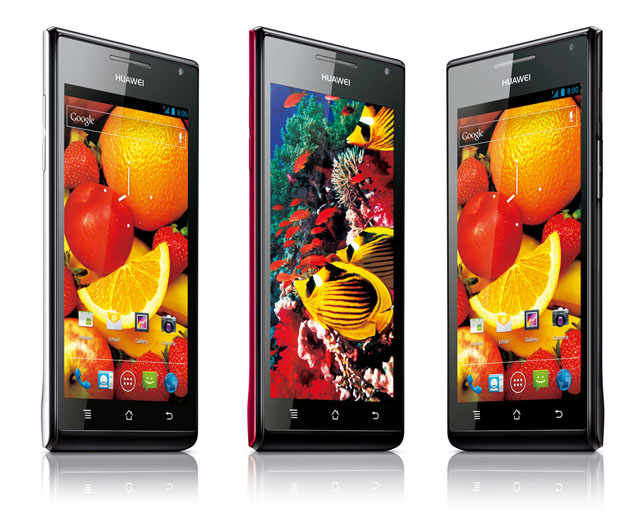
review The Ascend P1 is the first foray by Chinese manufacturer Huawei into high-end Android smartphones, and on paper it’s got the features to match up with and even occasionally exceed hyped models from rivals such as Samsung and HTC. But does this significantly cheaper model truly take it to its pricier competition? Read on to find out.
Design
In general, the Ascend P1 feels like it could have come out of the laboratories of any one of a handful of second-tier Android manufacturers such as LG, Sony or ASUS. The overall design of the handset is decidedly non-specific, although it’s notably not a Samsung or HTC model; those two companies have evolved decidedly specific design senses over the past several years.
The front of the phone is vintage Android. It’s an elongated rectangle, with shiny black plastic encasing the 4.3″ screen, which is covered with Corning Gorilla Glass. There’s a speaker grill at the top with an unobtrusive branding logo and a small front-facing camera, and on the bottom of the screen are three small buttons for options, home and back.
On the top of the P1 sits the normal 3.5mm headphone jack, a slightly protruding SIM card slot and the micro-USB port used for charging the phone or connecting it to a PC. On the left-hand side is a volume rocker, and on the right-hand side a power button and … wait for it … yes! A microSD cad port! Those Delimiter readers who pop in to every mobile phone review to take us to task for not caring about this feature can find delight with the P1. It does have a microSD card slot.
On the bottom of the P1 sits nothing much, while the back — which apparently comes in three different colours (white, red and black) is composed of similar shiny plastic to the front, with the normal embedded camera at the top.
There are two things which really sticks out in the P1’s design. Firstly, this is a thin smartphone. At only 7.7mm thick, and with a tapered back to boot, you won’t feel as though the P1 is a chunk in your pocket, the way quite a few competing models can. For comparison, HTC’s flagship One XL handset is thicker than the Ascend P1 at 8.9mm, and as it’s back isn’t tapered, it feels chunkier. Samsung’s Galaxy S III has a thickness of 8.6mm, and Apple’s iPhone 4S is 9.3mm.
Secondly, there is the matter of how nice the Ascend P1 is to hold in the hand. This is a smartphone which will fit most hand sizes, as it features a mid-level 4.3″ screen (smaller than the 4.7″ or 4.8″ sizes which the top of the line models from HTC and Samsung sport at the moment), and the Ascend P1’s plastic is quite grippy, which we don’t always see these days. We think most buyers will find the P1 quite a nice size in the hand. All of this plays into and is reinforced by the Ascend P1’s weight — a mere 110 grams.
To sum up the P1’s design — it’s moderately stylish, but not overly so. We suspect this is a model which has a more utilitarian design philosophy at heart than many of its competitors, and to be honest, we’re completely fine with that. Not every smartphone needs to make a fashion statement. The P1 makes enough of a statement, but not too much.
Features
Prepare to be impressed at what you get with the Ascend P1 — a smartphone, let us remind you, that costs just $499.
At its heart the Ascend P1 sports a dual-core 1.5 GHz Cortext-A9 processor, coupled with a PowerVR SGX540 graphics chip. Combined with its 1GB of memory, this is quite a powerful combination that will hold you in good stead for any games and other processing-intensive tasks you want to carry out on the P1. The touchscreen is a 4.3″ Super AMOLED model running at a resolution of 540×960 pixels (about 256 pp pixel density), and it’s covered with Corning’s industry standard Goreilla Glass. 4GB of storage comes on-board, and the microSD card slot can add up to 32GB.
The camera is an 8 megapixel model with dual-LED flash that can film 1080p video at 30fps, and the front-facing camera is a 1.3 megapixel model. There’s the normal HSDPA and HSUPA 3G network connection speeds (although sadly no 4G speeds), Bluetooth, Wi-Fi and so on, and the Ascend P1 runs Ice Cream Sandwich — although we’re sure it will be upgraded eventually to the latest version of Google’s Android platform — Jelly Bean.
Now, if you cast your eye over these specifications you’ll probably think: “So what?” After all, these are virtually the same specifications we see on most high-end smartphones these days, and some smartphones have some better specifications — 4G speeds, for example, a quad-core processor or a camera with more megapixels.
However — and this is the ongoing story with the Ascend P1 — it’s rare to find specifications at this level at this cost. Samsung’s Galaxy S III, for example, beats the Ascend P1 in a number of areas but starts at $609, if you pick it up from Mobicity. HTC’s One XL is on sale through Mobicity at the moment for $599 but normally costs $799. And so on and so on. The bottom line is that the Huawei Ascend P1 features most of the specifications of the highest-end smartphones currently available in Australia — but usually for several hundred dollars less — with the cost difference being especially obvious if you buy through carriers and not through third-party retailers like Mobicity or Kogan.
Performance
So there’s a few questions which you’ll want answered when it comes to the performance of the Ascend P1 — questions like: Does the phone sacrifice build quality because of its sticker price? Is the camera crappy despite its megapixel rating? And: Does the battery hold up to the demands of a busy working geek?
The answers, surprisingly enough, are pretty favourable for the Ascend P1.
Firstly, when you’re handling the phone, you probably won’t feel like this model has the build quality of a HTC or Samsung model, and it doesn’t come anywhere near Apple’s trademark level or Nokia’s star class. But does the Ascend P1 compare favourably to the next rung down of Android manufacturers? Absolutely. We’d rank this smartphone’s build quality on par with phones from Sony, LG, Motorola and so on, if not better in some cases.
The buttons aren’t perfect, for example, and of course the Ascend P1’s plastic has a cheaper feel than the polycarbonate finish we’re becoming used to from HTC and Nokia, or Apple’s metallic polish. But it still feels more than decent — and compared with more than half the smartphones we’ve fondled over the past six months, we preferred the Ascend P1. Everything fits together nicely here; it’s a solid little package.
The P1’s other features similarly performed well. The 8 megapixel camera takes solid shots worthy of its technical rating, including in low-light conditions, but isn’t up to the same standard that the top-tier manufacturers have set. And its video capabilities are a little jaggy at times — more than capable for casual use, but if you shoot a lot of video with your smartphone, you may want to look elsewhere. You’ll find very solid performance here, in other words, but not absolute top-level performance. The screen quality is also solid, but the colours were slightly off in some instances to our eyes. It depends how finicky you want to get here — this sort of things doesn’t represent a huge issue for most people, but there are some screen quality nazis out there who obsess about this sort of thing ;)
The Ascend P1’s battery life was about average — better than most 4G models we’ve examined, but not quite as optimised as a new 3G model such as Samsung’s Galaxy S III. In general we were happy with the battery life on the Ascend P1 — it more than lasted through a day’s usage, including some video use and web browsing, and if you leave it on your desk for a couple of days unattended, odds are it’ll still have some charge when you come back to it. GSMArena has conducted an extensive test of the P1’s battery life and found it was a mixed bag — with excellent video playing and talking survivability, but poor life when it comes to web browsing.
One area which we were really impressed with when it came to the P1’s performance was its user interface. As rival smartphones do, the P1 does ship with a customised Android interface, but it can be fairly easily reset to near-stock Android, and in general we found this smartphone to be extremely responsive. In terms of user interface response time, we put it somewhere between HTC — whose Sense interface tends to slow things down at times — and Samsung’s Galaxy S III handset, which has been blazing fast in anything we’ve tried to do with it (owing partially, no doubt, to its extremely high end CPU).
You really don’t notice much slowdown when you’re doing anything on the Ascend P1 — which is not something we can say for every smartphone on the market. This is one of the device’s strongest selling points — it has a very substantial amount of power for the price you pay for it.
Huawei’s minimalist design sense also means that unlike models from most of its rivals, the P1 is not plagued by much bloatware sitting on top of Android — there’s not a whole lot here which isn’t stock Android, and what there is isn’t particularly objectionable, keeping out of the way for the most part and not slowing down the operating system. We really liked this — it means that the P1’s user interface is functional rather than decorative. It works really well and isn’t cluttered. We wish more Android manufacturers would follow Huawei with this philosophy — we’re tired of every Android smartphone we review having each manufacturer’s own (usually quite flawed) interpretation of how an Android smartphone should work.
Conclusion
Would I personally buy a Huawei Ascend P1? No, because I’m an extreme early adopter, and I like to have the latest features — a large 4.7″ screen, 4G speeds, a fantastic camera and so on. And I’m relatively happy to pay a premium for that.
But if I was the sort of person who wanted to pay two third or half of the price of the highest-end smartphones to get 90 percent of their features, then yes, I definitely would buy an Ascend P1. This smartphone is just a small step below the best smartphones in Australia at the moment, and it’s significantly cheaper. The Ascend P1 has solid build quality, a sizable and good quality screen, powerful innards and a design philosophy which seems averse to bloatware.
Now let’s go crystal ball-gazing a little.
If Huawei’s next high-end Android smartphone is very similar to the P1, but with the addition of 4G speeds, a slightly better camera and a stock version of Android Jelly Bean, at a similar price to the P1, then this would be a very, very attractive model indeed, even to very high-end early adopters. Many smartphone buyers don’t want or need an excessively over-designed smartphone; what they want is solid hardware coupled with stock Android, preferably the latest version. In this sense, smartphone buyers are increasingly becoming similar to Windows PC buyers — they want to be able to choose their own hardware and run a stock version of the normal operating system on it.
If Huawei could deliver this kind of smartphone next, then I would be very, very tempted to switch from my current HTC One XL model, which runs a highly customised version of Ice Cream Sandwich (due to its Sense overlay) and adopt a Huawei model instead. Because that’s how good the Ascend P1 is — it’s not quite at the quality of the top-tier smartphone manufacturers yet. But it’s definitely not far off. And this gives us a great deal of confidence that Huawei’s next high-end model will knock it out of the park.
Other reviews we liked of the Huawei Ascend P1: CNET.com.au, PCWorld Australia, The Verge.


Image credit: Huawei
‘Does Huawei have a tradition of timely updates to Android on their hardware?’ was the biggest question I had after reading this, and the one that’d factor most in whether I recommend this phone to friends/family. And the Nexus Galaxy is still cheaper (kogan sale atm) and should come up trumps in OS updatability at least.
I’m actually not sure about Huawei’s software update policy, but it’s worth noting that the Ascend P1 beats the Galaxy Nexus in a number of areas … CPU power, camera and so on. I myself wouldn’t buy a Galaxy Nexus at this point — it’s already fairly outdated and will grow even more so quickly.
> “[the Galaxy Nexus is] already fairly outdated and will grow even more so quickly”
Especially according to the rumours surrounding a new Nexus device or 5 being released in November.
I have a IDEOS X5. Huawei provided a 2.32 version update package about 8 months after I bought it. It was 2.2 version initially. The new version looks fabulous with a 3D desktop interface as well. I’m very happy with it. Now I’m waiting for Ascend D Quad. However, I actually want a D Quad with dual sim. But it seems not on huawei’s roadmap. “_”
Does the Huawei Ascend have an AV port to enable you to transfer phone content such as your videos to your tv ?
Comments are closed.