

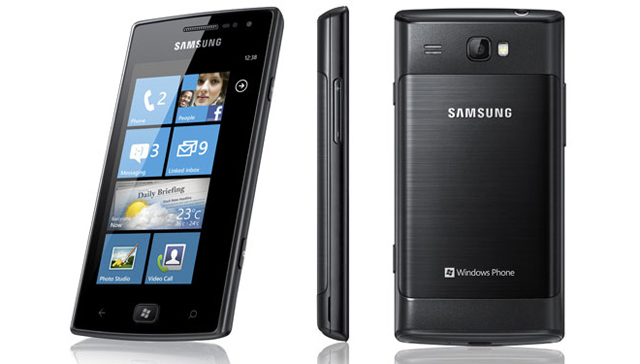
review It’s not one of Nokia’s flashy new Lumias, it doesn’t run the latest version of Android and it’s not an iPhone. But it is a high-end smartphone launched only recently on Australia’s top mobile network, Next G. Can Samsung’s low-profile, Windows Phone 7-based Omnia W compete on an even keel with the big boys? Read on to find out.
Design
When you pick up a Samsung Omnia W, the first thing you’ll notice is how superficially similar the phone is in design to Apple’s flagship iPhone series. The Omnia W is almost exactly the same size as an iPhone 4 or 4S, it’s got a similarly sized display (3.7″) surrounded by a black plastic border, there’s speaker grill at the top and a camera, and a button at the bottom to summon the home screen. It all just feels quite familiar upon first glance.
But that’s where the similarity ends. The design of the iPhone 4 and 4S, while striking, has never precisely translated into the easiest feel in the hand. There’s no doubt that the phone is the right size for most hands, but something Samsung and HTC have learnt over the years that Apple doesn’t appear to is that bevelled edges formed from moulded plastic with a gradient feel a bit more comfortable on the fingers than sharper edges with a metal casing.
Thus, the Omnia W just feels a lot more comfortable than the iPhone in the hand, and when you flip it over you can see why. Where the iPhone has a flat back, mirroring its front, the Omnia W has much more curved edges, meaning it sits more comfortably in your hand.
Apart from that aspect, there’s not much more to say about the phone’s design. It’s got the standard camera and flash on the back, volume buttons on its left-hand side, on/off and camera buttons on its right, a standard 3.5mm headphone socket on top, and the back case can be removed so that the curious can tinker with the Omnia W’s battery and insert their SIM card. It’s easy to do if you have longish fingernails.
Features
We somewhat agree with MG Siegler on TechCrunch that for many technology products in 2012, technical specifications are irrelevant. Most modern smartphones are quite similar, specification-wise, with the secret sauce being how well they’ve integrated those features, be they hardware or software. In our experience, the best melds in the smartphone space are currently coming from manufacturers like Samsung, HTC and Apple. In this case, the Omnia W is no exception. But before we get into that, let’s go through the Omnia W’s specs on paper for the record :)
The phone features a 1.4Ghz CPU (although Samsung doesn’t disclose what model it is), 8GB of on-board storage space, and a 3.7″ Super AMOLED touchscreen running at a resolution of 480×800 pixels. It measures 115.9 x 58.8 x 10.9mm and is 115g in weight, making it one of the smaller out of the latest range of top-level smartphones, which have tended to feature larger screens beyond 4″, and it’s also lighter than most by a couple of dozen grams. The Omnia W’s phone is a five megapixel model, with a VGA front camera for video calling (although we’ve never seen anyone actually do that in the wild), and it’s a GSM quad-band model supporting the 850/900/1800/1900MHz frequencies. Notably, the phone does not support the 4G/LTE speeds which some areas of Telstra’s network have been upgraded to.
And of course, the Omnia W runs Windows Phone 7.5 (Mango). It’s not clear whether it will be able to support Windows Phone 8 when it’s eventually released, as there is some debate about that issue at the moment. But there is at least a possibility, as the Omnia W has some pretty strong specifications.
Lastly, there is the obvious lack of 4G support in the Omnia W. If you love your mobile Internet access and are regularly in the CBD of a major city, it would be a little silly to buy a phone in mid-2012 without support for Telstra’s burgeoning 4G network. We don’t really consider this a weakness of the Omnia W, but it may turn off some buyers.
Performance
To be honest, the Omnia W is simply lovely to use in practice.
The phone fits really well in the hand. It’s got a lovely low-profile in its design that sort of gets out of your way and lets you get on with using it without distracting you. If you’re using an Apple or HTC smartphone, in 2012 — or even a Sony model — you can’t help but feel conscious of the design choices which the manufacturer has made. They make a statement.
In comparison, the Omnia W’s design doesn’t make a statement. Nobody, seeing you holding the phone up to your ear, would immediately be able to tell who had made it. The phone looks like a generic mid-sized smartphone. However, this is great. You feel relaxed around the Omnia W. It’s unassuming, it’s there and it’s just easy, sitting nicely in your hand or pocket. It’s kind of hard to describe this effect, so we recommend you pick one up in a store if you want to know what we mean.
The deep black colour of the screen and the associated brightness of the colourful Windows Phone 7 tiles are the only striking bits about the phone. In this sense, it emphasises its software over its form, which is perhaps appropriate, given the lovely interface which Microsoft has created in Windows Phone 7, so much more fluid than that of the iOS or Android platforms. The performance of the Omnia W, with a couple of caveats, was also stellar. It plays HD video with no problems, the interface is extremely zippy and lag-free, the touchscreen and buttons are satisfying to touch and use, and overall we just had very few problems.
Its battery is a decent 1,500mAh model (which supposedly boasts up to 6.5 hours of 3G use). In practice, we streamed HD video to the phone from YouTube over a half an hour and didn’t see any drainage, so we think it’s going to have pretty good battery life. In addition, over a day or so of using the phone for moderate use, it showed only a modest drain. The lack of 4G support and a whopping screen will help keep battery life sane.
Perhaps the only real caveats which we would attach to the phone are in its camera and its speakers.
In some phones, a five megapixel camera would be OK. But for a high-end Windows Phone selling through Telstra at a top-range cost, the Omnia W’s camera really is sub-par. We took a few shots and found them a bit grainy and hazy for a phone of this level, especially when you consider the Lumia 800, perhaps the Omnia W’s most visible high-end Windows Phone 7 rival in Australia, features an eight megapixel camera and Nokia’s trademark strong photo quality. The volume of the sound through the speakers also wasn’t great. If you wanted to watch a video on your Omnia W with friends in a crowded bar, you might struggle. Obviously this isn’t a make or break feature, but it’s worth noting.
In our opinion, the Windows Phone 7.5 (Mango) operating system used by the Omnia W is also still just about three quarters baked — it needs another year or so of polish before it’s as easy to use as iOS or Android. Although often it’s brilliant, and it’s always more than acceptable, sometimes Mango is a little confusing, hiding options in non-intuitive ways and making navigation a little difficult. In addition, we question the need to tie the user into Microsoft’s Windows Live platform. But these aren’t specifically criticisms of the Omnia W — and if you’re familiar with the Windows Phone 7 ecosystem, you’ll find the latest iteration of it here and likely be satisfied with its implementation in the Omnia W.
Conclusion
If you want an unassuming yet powerful and highly functional Windows Phone 7 smartphone with snappy performance, and you’re not a stickler for photo quality, there’s no better option in Australia than the Omnia W at the moment. It won’t grab attention in a crowded room, but it feels great in the hand or in the pocket and the quality and performance is definitely there. Plus, not everyone wants to turn heads with a fluoro Lumia. The Omnia W is no iPhone, but then Apple doesn’t have a comparable phone to this little gem from Samsung.
We think it’s probably overpriced right now through the carrier, but you can pick the Omnia W up through Telstra on a $99 per month plan with zero handset repayment fees, or head to an independent retailer like Mobicity to buy the phone outright for around $470.
Image credit: Samsung
When you can get a Lumia 710 for $389 or a Galaxy Nexus for $499 (sure to drop soon now that Google is selling them for $400 in the US), why on earth would anyone pay $470 for this piece of crap?
It’s not a piece of crap, as you would know if you’ve tested it, which I have ;)
But his point stands, it’s got competitors which beat it at pretty much everything and are comparable in price or cheaper.
Telstra’s pricing iteself is indicative of how much many of these they expect to sell, I think.
Actually, no, it doesn’t have competitors which beat it at everything. Did you read the review?
If you’re after a powerful Windows Phone 7-based phone of this nature, and you want something more unassuming and calmly-designed (as opposed to the Lumia line’s bright colours), this is the only option on sale in Australia, and it has stellar build quality.
Sometimes specs on paper don’t tell you everything about the phone. As I’ve said, I have actually tested this model. Have you guys? ;)
“If you’re after a powerful Windows Phone 7-based phone of this nature,”
But that premise doesn’t make sense. People aren’t in the market for a “WP7” based phone of a certain nature, they are in the market to buy smartphones, and my point is that there are better alternative available for cheaper price.
Also, the review fails is incorrect in saying that there is confusion about upgradability. Unfortunately Microsoft has spoken and none of the current WP7 devices will be upgradable to WP8, and that WP8 is about 6 months away. People buy phones on 2 year contracts, which means anyone buying this now will be stuck with it until Mid 2014. This means that for the majority of the time on your contract, you will be with a device with outdated OS, and no guarantee that apps will remain compatible with WP7.
I think this information is could have been hugely important to a potential buyer, but was overlooked in your review.
“People aren’t in the market for a “WP7″ based phone of a certain nature”
Not true. There are a certain proportion of people who read Delimiter who don’t want to buy Android or iOS, they want to buy a Windows Phone 7 phone. I know because readers tell me about this.
People get into certain ecosystems. Most people who read Delimiter (I know, because I have web stats) use iOS devices for mobile. The next largest percentage (it’s most of the rest) prefer Android.
But there are also people who just want Windows Phone 7 phones. It’s a third (and growing) force.
I wouldn’t recommend the Omnia W over a solid Android phone or an iPhone — the platform is much less mature. But my conclusion remains correct. If you *do* want a WP7 phone, this is one of the best options.
“Unfortunately Microsoft has spoken and none of the current WP7 devices will be upgradable to WP8, and that WP8 is about 6 months away.”
No, that is not what Microsoft has said. A minor representative of Microsoft said that all current WP7 phones will be upgradeable to WP8 and then retracted that comment. No official statement from someone who actually knows (eg. Joe Belfiore) has been released.
I think the reality is that perhaps SOME phones will be upgradeable to WP8, whilst others won’t. Ultimately Microsoft is ATM as dependent upon device manufacturers/carriers to apply OS updates to WP devices as Google is for Android (despite their original protestations to the latter). Yes, this does make it a bit unclear to current purchasers of a WP7 handset (although I dare say devices such as the Omnia W and other recent ‘2nd-gen’ WP7 handsets will be on the WP8 upgrade train). It also makes it a bit unclear to WP7 devs as to whether the same fragmentation hell that exists in Android is also going to impact WP.
The best approach really would be for MS to purchase Nokia and push all other partners out of the WP ecosystem; then they can focus WP performance on a smaller set of hardware and keep pushing updates to older hardware a la iPhone.
+1 except for the buying Nokia bit. Microsoft would screw that up if they tried it ;)
Windows Phone 8 uses the NT kernel. Windows Phone 7 uses the venerable Windows CE kernel.
Microsoft’s Windows NT on ARM efforts are heavily restricted to a few select SoC providers, namely Qualcomm Snapdragon S4, Nvidia Tegra 3 and TI OMAP 5. Windows NT will not initially run on any other ARM SoC.
ARM systems are not like x86 ones. Porting a kernel to each and every new SoC requires significant engineering resources, and I find it highly unlikely that Microsoft would port the new NT kernel to an old and out of date Snapdragon S1 SoC (which is used in all WP7 phones to day).
Those in the industry who can read between the lines have known for a long time that none of the current WP7 devices will be upgradable. Of course you won’t find Microsoft publicly saying this as it would have a devastating effect on current sales.
“Windows Phone 8 uses the NT kernel. Windows Phone 7 uses the venerable Windows CE kernel.”
You’re both right, but both wrong at the same time. This is an ARM-based processor. Windows Phone 8 uses WindowsRT kernel, which is specifically designed for ARM-based processors. This is an extension of WindowsNT Kernel, they’re not mutually exclusive. RT depends on NT as its bridging platform to allow Windows8 apps to be bridged from phone to tablet to pc. pc dedicated apps however cannot be converted to the WindowsRT extensions on Windows Phone 8.
They are not the same thing, but function the same. Think of RT as a cabinet or extended instruction set within the windows environment to emulate native NT behaviour.
Its on slashdot, engadget and the verge – they’re quite specific about how it works. However, there is nearly 6 months of testing remaining. At this point, they could well revise how the Phone / tablet extensions operate.
PS: Yes I have tested the phone. It’s part of my job to test them all (the job shall remain nameless).
I meant “piece of crap” as shorthand for “entry-level WP7 phone which (as far as I can tell from your review) it’s best feature is that it’s not flashy”. The lumia phones come in black too (and I haven’t reviewed any of those either).
Sure the specs don’t tell the whole story, but neither does anything you’ve written suggest that this phone is anything but an also-ran in a lacklustre bunch (WP7 isn’t exactly taking the world by storm).
Please tell us why this phone is worth its (not cheap) asking price. Is it really that much smoother to use or nicer to hold? If so, tell us why. I read all your words but I just can’t picture it in my head and your review sounded awfully like you were struggling to find something (anything) nice to say about it.
Can I ask what phone/ecosystem you currently use? It seems as if your comments are coming from some sort of background on another platform.
And it’s all there in the conclusion:
If you want an unassuming yet powerful and highly functional Windows Phone 7 smartphone with snappy performance, and you’re not a stickler for photo quality, there’s no better option in Australia than the Omnia W at the moment. It won’t grab attention in a crowded room, but it feels great in the hand or in the pocket and the quality and performance is definitely there. Plus, not everyone wants to turn heads with a fluoro Lumia. The Omnia W is no iPhone, but then Apple doesn’t have a comparable phone to this little gem from Samsung.
I’m currently on Android, although not particularly attached to it.. I’m currently looking for a new phone and will happily jump ship for a compelling QWERTY device, but I do have to admit I have trouble taking Microsoft seriously with WP7 since they decided that a sockets API was a feature that could wait until the point 5 release.
“unassuming yet powerful and highly functional Windows Phone 7 smartphone with snappy performance”
“feels great in the hand or in the pocket and the quality and performance is definitely there”
comes in non-flouro colours
which of the current crop of WP7 devices do those statements not apply to? Is the build quality of everything else in the price bracket much worse? Is the industrial design just that much better? (It doesn’t look great in photos.) Is the WVGA AMOLED display noticeably better than the WVGA AMOLED displays used in many other devices (maybe a subpixel layout thing)? I’m willing to believe that the Omnia is better than the others, but I’d like to know why.
Also wondering what makes the Omnia incomparable to the iPhone – is it just the price difference, or does WP7 have some really cool features that iOS doesn’t (I guess live tiles count)?
hey mate,
not sure what models you’re referring to. As far as I’m aware the only WP7 phones being sold by the carriers at the moment are the Nokia Lumias. What other WP7 devices are you talking about?
Cheers,
Renai
No idea what the carriers are selling (although the Lumia 800 is an obvious comparison with an (identical?) 3.7″ WVGA AMOLED display). If you’re buying outright there’s the Dell Venue Pro and a bunch of other Samsungs with OLED displays (although mostly with slower 1GHz or 1.2GHz CPUs).
I take your point that there isn’t really a huge selection though. I guess if you want WP7 and don’t want a Lumia then there aren’t a lot of choices. I think that’s only going to get worse too – now that Nokia are Microsoft’s “favourite child”, HTC and Samsung have even less incentive to compete in such a small niche.
hey mate,
cheers. Well, I do know what the carriers are selling. And I did compare the Lumias in this article.
From here on I’m not going to debate this issue with you, as I don’t think your criticism has been informed, and I think it’s harming the discussion. See our comments policy here:
http://delimiter.com.au/comments-policy/
Cheers,
Renai
Just so we’re clear, I also consider the Lumia 710 a piece of crap and I don’t understand why anyone would pay $389 for one.
Personally, I wish Samsung would give up on the %$^&ing Omnia moniker.
The only recent “Omnia” that was any good, was the Omnia 7 in Windows phones and Omnia Icon HD which had some excellent hardware but struggled massively with Symbian software.
Previous generations had more bugs than you could poke a stick at, were notoriously bad for reboots and resets and generally ran like a dog. They were overloaded, slow and sluggish. Performance was non-existant.
I’d like to see them come up with a new Moniker for Windows Phone 8; I think you could agree Renai – theres alot of promise in Windows 8. The question is, how well can that translate to Samsung / HTC / Nokia ?
Comments are closed.