

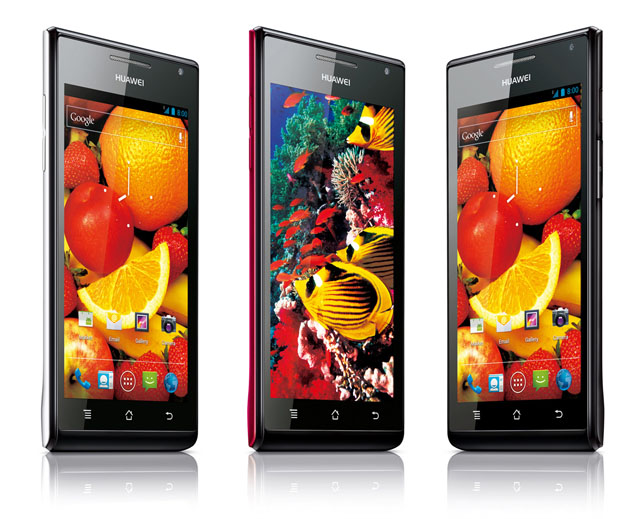
news Chinese hardware giant Huawei last week unveiled the Ascend P1 S this week at the 2012 Consumer Electronics Show (CES). With a thickness of just 6.68mm, the Ascend P1 S is the world’s slimmest phone; and the company’s working to bring it to Australia from April 2012.
The Ascend’s 4.3 inch Super AMOLED 960 x 540 touchscreen comes with Corning Gorilla Glass. With a dual-core 1.5GHz TI OMAP 4460 Cortext-A9 processor and the Android 4.0 “Ice Cream Sandwich” operating system, Huawei also claims that the Ascend P1 S is the fastest and most compact smartphone in its class.

In a statement, Mark Treadwell, Head of Marketing, Huawei Device Australia, spoke about the company’s plans for bringing the device to Australia, saying: “We’re really excited about the prospect of bringing this device to Australia later this year, once again giving Australians access to the latest in affordable innovation.”
Richard Yu, Chairman of Huawei Device said that the Ascend P1 S demonstrates the company’s ongoing commitment to designing high quality devices that incorporate the latest hardware and software technologies.
Another new product unveiled at the CES was the Ascend P1, part of the same smartphone series, with the same functionality and a 7.69mm thickness. The company claims that the Huawei Ascend P1/P1 S series is elegant and fast, providing the fastest multi-taking, gaming and video replay in its class. The series features a sleek and narrow 64.8mm body and a strong metallic, three-dimensional design with a PPVD back cover evenly distributing heat. The series offers colour choices of metallic black, cherry-blossom and ceramic white.
Other features in the series include an 8MP BSI rear-facing and 1.3MP HD front-facing cameras with dual flash LED and HDR effect optimisation, which are designed to provide sharper, clearer and brighter detail, in both light and dim environments. Other attributes include 1080p HD video capture capabilities, high-speed data connectivity through 3G, WiFi and Bluetooth, and in-built social media capabilities that allow instant sharing of videos and photos through social media.
Huawei is currently holding talks with local operators and retailers about timings and pricing for this device in the local market. The Ascend P1/P1 S series is scheduled to be available in Europe, North America, Asia-Pacific, Middle East, China and Australia from April 2012.
analysis
With Huawei’s reputation for low prices, it will be interesting to see what price it makes the Ascend available for in Australia and through which carriers or other distribution models. This model is truly a high-end smartphone; and comes in stark contrast to the low-end models which Huawei has launched so far in Australia. If the Ascend goes for a bargain basement price, it may be able to quickly gain Huawei some of the consumer market share in Australia that it’s been slowly gearing up for.
Image credits: Huawei. Analysis by Renai LeMay
Why are manufactures still making phones with hardware buttons? It’s hard to be interested in next gen phones when they are not using the simple no buttons layout that ICS provides for.
Huawei’s phones are often a bit more ‘generic’ than the more highly custom-designed models we get from Samsung, HTC, Sony Ericsson and so on.
I personally prefer the phone to have physical buttons. They feel more reliable.
Hardware buttons have there place. Would you want to have to search through menus to find your volume buttons, particularly if it is in your pocket? Or if your phone hangs and touchscreen unresponsive, is the only option to take the battery out (most being contained in the case) because the device is not responding.
Being hardware these buttons are always accessible to provide key functionality. On that note if you look at any professional camera, they have more rather then less buttons then consumer models. This provide fast control without looking at a screen and searching through menus.
Huawei might not be a leading industrial design company, but what they do well is incredibly small capable and low-price hardware.
What about battery life ?
Its great to have a powerful CPU, but sometimes extra battery life is preferable.
Comments are closed.