

opinion If you’re considering buying any form of tablet device in the next month or so Australia, stop right where you are, put your wallet and your hard-earned cash back in your pocket and go and take a cold shower for ten minutes until you calm down and your lust for loot has vanished from your feverish brain.
I can assure you, that if you ignore this advice, that you will come to regret it in only a few short months.
Over the past months, a number of signs have gradually been building that Australia is about to face a tablet price war of epic proportions, waged between vendors like Motorola, Samsung, Toshiba, Acer, ASUS and other lesser rivals, who have all launched Android-based tablets locally in the past few months.
The first signs of the incoming pricepocalypse were felt in April this year, when Telstra, Vodafone and other retailers dramatically chopped the list price for the 7″ version of Samsung’s Galaxy Tab line, first to $408, and then to $299, just a scant few months after the device launched for $999. The remarkable thing about this level of price cutting was both the speed at which it took place, as well as the nature of the device that it affected.
As we noted in our review of the device in November last year, the 7″ Galaxy Tab was no half-finished model with bugs and incomplete features. Instead, it was a stellar and high-quality product from a manufacturer with a solid reputation. Furthermore, it launched at a time when it had virtually no competition; it was the only challenger in a market dominated by Apple’s iPad.
The chief complaint against the device at the time was the fact that it won’t run the version of Google’s Android platform specifically designed for tablets (Honeycomb). But our experience with Honeycomb in practice has led us to believe that the platform is just not mature yet; it’s plagued by user interface inconsistencies. In comparison, despite the fact that many Android apps aren’t formatted for the Galaxy Tab’s larger screen, its mature Android Froyo operating system and bundled apps shine.
There are likely two explanations for the price cuts on the 7″ Galaxy Tab, then.
Firstly, it seems clear that the tablet hasn’t sold as well as could be expected; certainly it has sold less than the six million units which had been shipped to carriers and retailers as at April 2011 (Apple’s iPad has sold 25 million units globally since launch, as at June this year).
Behind this is the idea that it’s likely that the Australian market was reticent to buy the 7″ Galaxy Tab because a glut of larger, more powerful tablets running more modern operating systems was slated to hit Australia this year, to say nothing of the second generation of Apple’s iPad. Models like the Galaxy Tab 10.1v, Acer’s Iconia Tab, the Motorola Xoom, Toshiba’s AT100 and Research in Motion’s BlackBerry PlayBook have all launched in Australia over the past several months.
The problem is, as local analyst firm Telsyte has pointed out, most of these tablets have themselves launched after the iPad 2. With the crop of rival Android tablets having comparable features to the iPad 2 and similar prices, but a much diminished application library … there is simply no consumer incentive to buy an Android rival, when you could get an iPad 2 for a similar price.
The need to differentiate the rival tablets from the iPad has already driven some pretty extreme promotions; with Telstra giving away three Motorola Xooms per day over a two month period in June and July this year. That’s no less than 186 high-priced tablets in total — a pretty pricey promotion.
Internationally, industry luminaries like Nvidia CEO Jen Hsun Huang (whose company’s chips power most of the Android tablets) are already throwing around the “price point” issue in public, and Australian and international analyst firms have started to do the same.
Then too, the 7″ Galaxy Tab is not the only tablet to have already been discounted locally. Earlier this month Optus cut the price of its low-end My Tab Android tablet to $99, down from $269, and Telstra’s T-Touch Tab has also come down in price to $129, from an initial price of $299. “This could become the fastest-commoditized market in history,” said one Richard Windsor of Nomura Securities in the US last week. “The tablet honeymoon will likely be over in 2012.”
In several months’ time, with the first quarter of poor sales figures rolling in, it will become obvious to tablet manufacturers Acer and Toshiba that they are not going to sell enough units in Australia to justify launching the tablets locally. Furthermore, hype will have already begun for the next generation of devices — the iPad 3, a lighter, faster Motorola Xoom, the HTC Flyer — the list goes on.
At that stage, lower profile vendors like Toshiba and Acer, which still have decent product, will start cutting prices fairly drastically. After that point, Samsung’s Galaxy Tab 10.1v will likely come down in price through Vodafone, and eventually even Telstra and Optus will be forced to chop their margins on the Motorola Xoom.
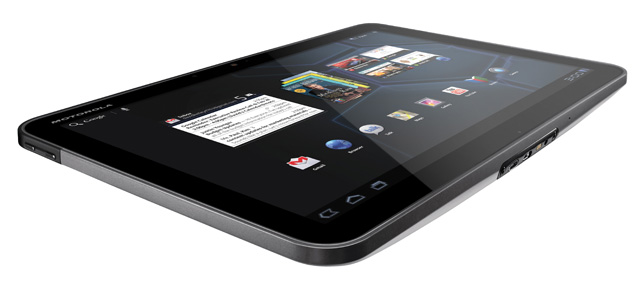
The Xoom has gone on sale through Telstra for the outright price of $840. I’d bet in September you’ll be able to buy it direct from Telstra for $699; by Christmas it should be sub-$500. Which, given the price of the iPad 2 and BlackBerry PlayBook, is where it should have been to start with. By that stage, the Galaxy Tab 10.1v through Vodafone should be even less; and you’ll be able to pick up a Toshiba or Acer unit for a song.
Of course, some tablets will maintain their price. The iPad 2, the BlackBerry PlayBook, maybe a high-end HTC model (given the company’s now massive local presence in smartphones) and even HP’s incoming TouchPad will likely maintain margin; all of these devices will have enough differentiating factors from their rivals that they’ll be seen as a little more premium.
But for those who are a little more price-conscious … sit tight for now. In just a few months you’ll be having a field day.
Image credit: Motorola
You keep talking about the Galaxy Tab 10.1v as if it’s going to exist in a few month’s time. It’s an EOL device and they are just clearing the disribution channel. The real Galaxy Tab 10.1 will then arrive in Australia from August, and by all accounts, being thinner and lighter than iPad 2, it will give it a good run for its money. The 10.1v will be out of stock by then.
Interesting, I hadn’t heard that — where do you get that from?
What is now called the Galaxy Tab 10.1v was originally called Galaxy Tab 10.1 (without the v). It was unveiled in February at MWC and was supposed to come to market in April.
Then, iPad 2 happened. It was thinner and lighter than Samsung’s tablet, and Sammy didn’t really like that.
Samsung public acknowledged that their tablet was ‘lacking’, and went back to the drawing board. By the time CITA came, they had re-designed their tablet, making it thinner and lighter than the iPad 2. They called this slim model Galaxy Tab 10.1.
The problem was, they had a stock load of the old ‘thick’ model that they now had to unload somehow. Enter Vodafone. They’ve got a pretty big global distribution channel, so they agreed to sell the outdated/thick tablet in a few countries (Australia and a few European countries like Spain and Portugal). In order to differentiate between the two, they called the thick model, Galaxy Tab 10.1v.
The 10.1v is just stock clearance from before Samsung redesigned their tablet. The new slim 10.1 went on sale in the US a few days ago, and is going to go on sale in the rest of the world in July/August. I’m sure once the stock of 10.1v is depleted, they’ll bring the real 10.1 downunder as well.
Honestly though buying a Tegra 2 tablet is really unwise. Tegra 2 was supposed to be in commercial units early 2010, but was late by a year. Unfortunately Tegra 3, the quad-core Kal-El chip with a 32 core GPU, is going to be in tablets by September. And it’s a significant upgrade.
For the kind of power a tablet should have, I think dual-core is insufficient.
I think that this is pretty much spot on – the market is too dynamic to be an early adopter (unless you are set on an iPad 2). I’d really like to see if Google do a Nexus Tablet or similar, but it seems that most of the vendors are gravitating around a 10.1 form factor, so a reference design might be unnecessary.
I’d also suggest that it will be worth seeing what Google does with it’s next version of Android, where the phone and tablet streams are meant to converge. This might help bring the android phone developers into the tablet market with a easier road to market.
Oh, while I know the pricing has been crazy, I think the statement “Optus cut the price of its low-end My Tab Android tablet to $99, down from $69” may be slightly incorrect!
Cheers! And fixed the typo :)
Yeah it would be very interesting to see Google itself do a tablet … if I were them I would be quite dissatisfied with the current crop, so it would make sense for them to try and lead the market a little in terms of design as they seemed to try to do with the previous Nexus phones.
Personally I’m looking forward to seeing what HTC can do over the next six months with the tablet form factor. They seem to be pulling out in front a bit of the other Android vendors when it comes to smartphones.
Unfortunately the Xoom is pretty much the nexus equivalent.
I agree with this article (being the owner of a discounted galaxy tab myself), the droid tablets will not sell given Apple’s overwhelming apps and mindshare dominance, and they will rapidly plummet in price.
So hopefully in 6 months or 9 you can pick up a honeycomb tablet at 3.2 with at least some decent apps out e.g. state of android phone app market circa late 2009.
How is the Xoom the Nexus equivalent? It was rumoured at one point that the Toshiba Tablet coming out soon was going to be the Nexus tablet.
I would expect the Nexus Tablet to have a USB Host port, the Xoom doesn’t have this.
The tegra2 based tablets are powered just about right. You dont NEED quad core power in a tablet device.
Desktops and servers is where quad core and higher are required.
Tablet are for media like video and music reading news, novels and emails.
The analysts are mostly modern fortune tellers with more miss than hits on their track record.
iPad (i own both generation) maybe the pioneer of the form factor of the machine, but it is far from perfect thanks to Apple’s dictatorship style close end OS system.
The Android 3.1 OS is miles ahead of iOS in over all ability and freedom for user to interact with it.
ipad’s strong point at the moment are the head start of apps, yet judge by how the android market phone apps caught up with Iphone, it is clearly once hardware update rose, the number of apps would also came closer. I did not play games on my ipad or android phone, but was able to find nearly all android version of ipad software for news, video and mapping.
the biggest issue for Android gang is how to better unite in the Software support front. At the moment, every hardware company has their own app store, the way this continue will never unite resources that would match up the head start Apple already had. Hardware companies should remain selling hardware with bundled free add one or discount apps for their tablet on a continuation bases instead of running their own app store.
They should combine resource to develop an android app foundation where apps release by this foundation is tested on all foundation member’s tablet devices. Profit from here will fund combine app store development and benefit app developers.
If things done right, ixxx devices can be easily unseated from the throne thanks to its high restrictive file system, only can do things with one way user interface.
Comments are closed.