

opinion So here I was trying to write a nice dry article on the state of the eBook marketplace leading up to the release of the iPad and the iBookstore from Apple iAustralia.
I was glad to see websites with a strong passion for e-book news and issues like Bookbee, e-book.com.au and Bookseller+Publisher Online. All these sites are informative, up to date and showing trends both in Australia and the rest of the world.
And I saw that large Aussie publishers such as Pan Macmillan have launched or are working on (such as Random House Australia) eBook retail stores. There are also lists of independent and vanity/small press eBook publishers:
Then I started to look at these e-book retailers. And cried. Big Fat Girly Tears. DRM. Lots of DRM. Lots of formats with DRM. Why is this a problem you ask?
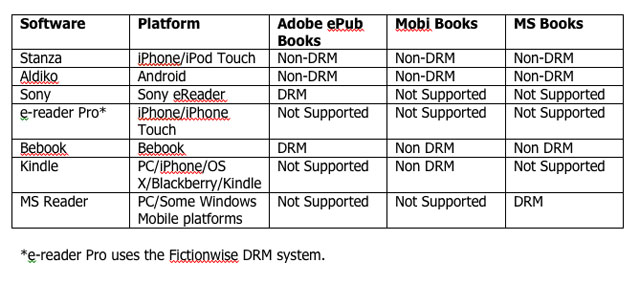
Many of these e-book retailers use a plethora of book platforms. Many use Mobipocket, others use Microsoft Reader others yet use Adobe ePub (a DRM layer on the open ePub standard). While DRM is optional on these platforms, many of the retailers use it. As a result, the usage of these books are heavily restricted.
How restrictive? Let’s do a comparison on some of the commercially available eBook readers:
Now lets look at some of the retailers who sell eBooks.
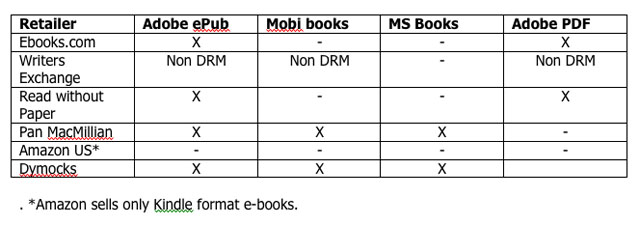
So, in order to read an eBook, I am forced to choose an eBook platform, and then look for a retailer who will support the platform. Of course, some of the DRM is so draconian that if I download it onto my PC, I cannot copy it across onto my eBook reader or mobile device. Another issue is that Amazon (and some other retailers) do not have the full range of eBooks available to Australians.
It is worth noting that smaller retailers like Writers Exchange and Poseidon do not use DRM. However the books here are small self-publishers or vanity publishers, so if you’re looking for a Harry Potter book, these sites are not for you. However, given the ability for you to read these books on most devices, this becomes the equivalent of an indie band putting their music out in non-DRM mp3 files.
I am getting some nasty déjà vu here, as if I was seeing a repeat of the music industry before iTunes came to Australia. And I can see the booksellers on the wicket like a fat, contented Mike Gatting, with Steve Jobs about to bowl the ball of the century around the booksellers’ leg.
Some feedback from when I posed some questions on eBook readers on Twitter:
- @DaMana: [On using a Kindle] It is good actually. I buy fiction and non-fiction and haven’t found a problem finding what I want. Prices are better than paperbacks. Great to travel with too.
- Tom Dullemond: [On using Stanza on iPhone] “That’s the point thou – I use Stanza’s built in bookshops (they have a few) but only download free books. Don’t want DRM files at all.”
- Rob Byrne: “Using MS reader and uBook on Windows Mobile. Supprisingly MS Reader is really good, but only read MS format (.lit). uBook is good, but I don’t like the display.”
- And a comment from me on Twitter: “I use the Stanza bookstores as well, I did come across some region issues, but the current selection of US sellers (including Books on Board) have a good selection and are reasonably priced.”
So, dear reader, what is your experience with eBooks in Australia? Do you use local retailers? Do you use a eBook app or device? How do you view the iBookstore coming with the iPad? Let me know via Twitter or the forum here about your views.
Darryl Adams is a government worker and internet tragic. A former IT worker, he still pines for the days of IBM keyboards that go CRUNCH and the glow of green screens. He can be found on on Twitter or on Facebook. The views expressed here do not reflect the views of his employer, the ATO.
Image credit: Amazon
Until an eReader is just a sheet of plastic screen, I’ll stick with my books thanks.
All those issues and more. Australia isn’t separate to the rest of world these days, even if some residents wish it was walled off and not attached to the internet.
I had a significant collection of e-books as far back as 2003 using Microsoft’s Reader application and the .lit format. The DRM on Microsoft Reader and the .lit format is tied to the actual computer’s key and requires a WindowsLive ID to validate purchased books. I now have a Kindle and it looks like I’ll have to do without my previous library and I’ve lost the investment. To replace those books I would have to buy them again because the notebook I had at the time died and I no longer use Windows. The forums at http://www.mobileread.com are helpful for most matters to do with e-book readers and books.
I use Calibre to manage my e-book library as it works on Windows, OS X and Linux. Calibre can convert many of the commonly used formats, but the DRM needs to be removed separately. There is a DRM script available on the internet but it has some limitations. Sadly, it can’t de-DRM my 2003-2004 book collection. I stopped buying e-books back then because of that problem and a failure of DRM which caused me to lose an expensive engineering standard in protected pdf format (not Microsoft’s fault, but Adobe’s).
Don’t forget the huge range of free books from Project Gutenberg. Most of them have been coverted to various e-book reader formats. Manybooks.net has most of these available and will do the conversion prior to download.
Might be worth throwing into the mix the availability of generic Ebook managers like Calibre. Doesn’t crack any of the DRM stuff but if anything non-DRM becomes available it will put it readably on any platform.
In addition, it may that the market is missing the point a little by focusing on books as what E-Readers are all about. There is a raft of great stuff out there on the web in blogs and every other format that has never been available in ANY hardcopy format. And it’s easily available in most cases in full RSS.
Something like Calibre makes any site with RSS full text feeds available on any E-Reader, automatically, just as you’d subscribe to a podcast on iTunes.
Driverly, ilago
You raise some good points. I have bought a lot of e-books from a US publisher (Baen.com) who sell non-DRM e-books in most standards, and even GIVE BOOKS AWAY.
Eric Flint has some very good articles on http://baen.com/library/ about the Baen Free Library and the publisher T. K. F. Weisskopf had a very good article, which I cant find at the moment. If it was not for Delimiter Australia focus, I would be gleefully pimping Baen’s Webscription.net and screaming “These people get it!”
The wisdom of baen is that I have never lost a book because I have changed platform. I own the book forever, in whatever format I want. If i need another copy, I can download again. Heck, they even sell books in HTLM and RTF. And I have, from Pocket PC, to laptops, nokia phones to iPhone.
Compared to another US marketplace which I wont mention, where I could not even Download a book due to draconian DRM. Guess where my money goes now?
Horses for Courses with some of that. I don’t own an iPad, but would love to read comics / graphic novels on such a device. I do own an eInk book (Cybook Gen3) and find it as good as, if not better than a book. As the article mentions, DRM is a big issue for all ebooks, Cybook doesn’t care too much it supports all sorts of goodness. I think part of the problem is that there really isn’t a market as yet. My Cybook is kind of on it’s death throws, and to be honest there is nothing in the Oz market that could beat it. With the OZ dollar the way it is, I”m considering the Nook from B&N. So for all of my ebook desires and purchases to this day, I have to step outside of the Australian market to get something worthwhile/
The Nook does look good — but I am a mite worried about support, given that there is no Barnes & Noble in Australia. How easy will it be able to buy books for it?
Another essay from an Author Ryk Spoor. I love this man’s work (a Baen author), he also has a lot of his books free to read on his LiveJournal site http://seawasp.livejournal.com/189772.html?view=1640780#t1640780
Basically the Australian media companies are like this :-
wait wait wait wait wait … maybe copy
Leadership and innovation not in the vocab.
I’ve struck the same problem as Ilago. I used Palm devices (a Handspring Visor, then a Palm T3), and I read ebooks on them, mostly in Mobipocket format because Mobipocket was the best Palm e-reader at that time.
Then I bought an iPhone. For some reason (the Mobipocket user forum speculates that it may be connected to Amazon’s ownership of Mobipocket), there is no Mobipocket e-reader for iPhone, nor will Amazon license the Mobipocket DRM format for use by any other e-reader.
So, I lost hundreds of books I’d purchased. Do we buy DRM books, or only rent them?
Before and after buying my iPhone, I bought a great many books at Fictionwise. Recently (some time last year?), they started marking many books as “only available in the US” or “only available in the US and Canada”. Their Help section kindly advised that books were available to nearly everyone, and only countries like Australia and New Zealand were likely to be excluded. Why?
I still don’t have a good answer for that, and I’ve asked repeatedly and in various places. Apparently publication contracts haven’t caught up with the digital age. But in that case, why were ebooks unrestricted for so long? Why are new titles being restricted now?
These restrictions are particularly frustrating. I can’t complete series I’ve previously bought (e.g. volumes 1-4 were available to me, but volumes 5 onward are not) or authors I’ve previously read, and in some weird cases books from the same series or author are inconsistently restricted (you can get some of them now, but not others). I fail to see how this helps the publishing industry.
I read ebooks because I think they’re a good idea, but also because I’m disabled. I can’t hold a physical book, and the large but fine-motor movement of turning pages is very difficult and exhausting for me. I can prop up an ebook and just tap it to turn the page. My vision varies: I can change the font-size in an ebook reader. I can’t read well on a white background: I can set the background colour in an ebook reader. I can’t handwrite: an ebook reader allows me to mark pages and insert notes.
In short, I want to use ebooks, I need to use ebooks, but the inconsistencies in publication and retail are discouraging me, outside oases of sanity like Project Gutenberg and Baen (who very generously offer all ebooks free to disabled readers).
(Note: for other people with reading difficulties, you can use the Readability bookmarklet to make webpages more readable.)
I’m so glad you said you are getting “some nasty déjà vu here, as if I was seeing a repeat of the music industry before iTunes came to Australia. And I can see the booksellers on the wicket like a fat, contented Mike Gatting, with Steve Jobs about to bowl the ball of the century around the booksellers’ leg”. I for one can’t wait to see it happen. Steve Jobs & Amazon Books need to get together to completely bowl the Australian publishing industry out. I’m so sick of them getting their greedy fat fingers into everything. In Australia we have been putting up with outrageous hardcopy book prices for years. Actually I buy most of my books from Amazon Books. It’s usually cheaper to buy a book from them & pay the postage to Australia than to buy the book in Australia. Why are we punished like this down here in Australia. I’m sick/sick/sick of it. And now the Australian publishing industry are doing it with eBooks. I’d love to support my country’s publishing/book industry but I won’t be ripped off in order to do it. Why don’t the Australian publishers wake up to themselves. If they lowered the prices they might actually get more sales .. duh !!
This is a great post i ever seen , it solved my Problem and gives me some motivation
Comments are closed.