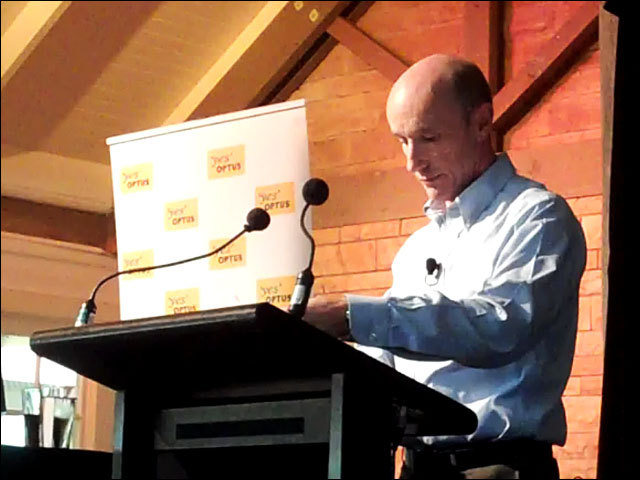
news Optus chief executive Paul O’Sullivan has accused NBN Co of attempts to cement its monopoly over the telco sector that “would make a Telstra executive blush”, in a fiery speech in Sydney this afternoon in which he also opened fire on traditional Optus target Telstra and even the Federal Opposition.
O’Sullivan told the audience that in the creation of the National Broadband Network, Australia was re-establishing a government-owned telecommunications monopoly at a time when “the rest of the world is taking them apart”. “It may only be a wholesale monopoly but it will still be a monopoly,” he added. “It would be foolish to trust a monopoly to do the right thing.”
Despite the fact that the company had only been established several years ago and is currently only a small way through its planned fibre rollout, O’Sullivan said NBN Co had already started acting like other monopolies. It’s often the case that monopoly companies will attempt to entrench their power in the face of market competition. Optus and most of Australia’s other major telcos are currently negotiating with NBN Co over the terms of the company’s wholesale services agreement — a contentious document which some ISPs have declined to sign at points.
The Optus chief cited several examples where NBN Co had taken what he saw as an inappropriate approach — such as the company’s proposal to implement only a small number of points where other telcos could connect to its network. The proposal was supported by smaller telcos like Internode but opposed by Australia’s dominant telcos Telstra and Optus, and ultimately rejected by the ACCC.
In addition, O’Sullivan said NBN Co’s special access undertaking filed with the Australian Competition and Consumer Commission contained inappropriate ideas. “Some of the things which NBN Co asked for … would make a Telstra executive blush,” he said.
The Optus chief said NBN Co would probably eventually be “one of the most powerful monopolies ever in Australia”. Because of this, he argued, it was vital that the company was subject to appropriate scrutiny.
O’Sullivan called for the company to have the same transparency controls imposed on it as the Reserve Bank of Australia — with its board minutes to be published, a register of contacts in existence between it and the Federal Government, and public consultations held before changes in its strategy. In addition, the ACCC should have a strong ability to constrain the company, there should be a cap on the price changes which NBN Co could carry out, and it should be made to outsource portions of its operations which became inefficient over time, O’Sullivan argued.
Lastly, the Optus chief also argued NBN Co should have quality of service and innovation targets build into its operations. The company’s “current wholesale contracts provide no service or performance guarantees to customers,” he said.
Despite his criticisms of NBN Co, O’Sullivan still made it clear he supported the policy overall because it was about building a better Australia and providing a level playing field for fixed-line telecommunications in general. Optus has long been seen as a strong proponent for the NBN policy, as it brings about a policy aim which the company has long agitated for, in the restraint of Telstra and the winding back of the telco’s vertically integrated structure.
The Coalition and Telstra
The Optus chief also had harsh words for the Coalition, which has over the past few months sketched the outlines of a new telecommunications policy under Shadow Communications Minister Malcolm Turnbull.
O’Sullivan said he was encouraged by the focus which the Coalition’s plan appeared to place upon the separation of Telstra — a long-time policy goal of Optus and other players in the telecommunications marketplace — but said Turnbull’s side of politics needed to say how it would force Telstra to cooperate with such a proposal.
The current Labor Government has enacted legislation which would see Telstra’s commercial abilities in the mobile and other spaces severely constrained if it did not cooperate in separating its operations and shifting customers onto the NBN infrastructure as it’s rolled out. The effort was ultimately successful, but the negotiation process with Telstra has drawn out over several years.
“We’ve seen how much effort it has taken the current [Communications] Minister to get them to sit down,” said O’Sullivan. Under the Coalition’s plan, “there is no proposed legislative instrument which would force Telstra to cooperate. We need to see that stick — it is critical to forcing Telstra to separation.”
And for Telstra itself, O’Sullivan also had a few words. It is a common occurrence for the Optus executive to make light of his competition during his regular speeches to the industry.
The first draft of Telstra’s structural separation undertaking draft filed with the ACCC was “weak” and “absolute nonsense”, said O’Sullivan, noting that another chief executive in the industry had described it as giving “the middle finger” to the industry. Telstra is in ongoing talks with the ACCC over the document and the associated migration plan. The two documents will govern how Telstra migrates its customers onto the NBN and provides competitive access to its infrastructure over the next decade.
“The improved version,” said O’Sullivan, “has even more red tape and even further restricts the ACCC. We call on the ACCC to very publicly reject Telstra’s submission.” The regulator, O’Sullivan noted, should ensure Telstra and the industry were treated the same. “It’s time for the ACCC to be supported in that; it should not compromise,” he said.
And of softly-spoken Telstra chief executive David Thodey, who took the telco’s reins from his fiery predecessor Sol Trujillo several years ago? Telstra still said one thing in public then did another in private, said O’Sullivan, but Australia had witnessed a “kinder, gentler Telstra” in recent times.
“Not as entertaining, but easier on the eye.”
A full copy of O’Sullivan’s speech notes are available online here in PDF format.
Update: We’ve received the following statement in response from NBN Co:
“NBN Co will lodge it’s special access undertaking with the ACCC in the next few weeks. It is designed to ensure that we are building the network as efficiently as possible
In our published corporate plan we have stated our intention to reduce prices as take-up and usage of the network increase. We have already seen, with seven service providers announcing retail pricing so far, significant value improvement for consumers in many of the plans based on the National Broadband Network.
We note that Optus recently released its NBN plans and said in this context there was a “a new era of competition”. As an open-access, wholesale-only network operator, we will continue to work with the industry to see an enhancement of competition at the retail level.”
Image credit: Delimiter