

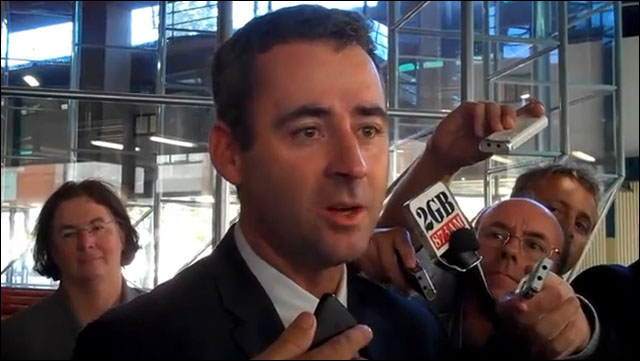
National broadband provider iiNet today proposed the creation of an independent body to administer allegations of copyright infringement by internet users, including the power to issue fines and demerits to those who had purloined television shows, films and music online.
The move comes weeks after the conclusion of an appeal in the Australian Federation Against Copyright Theft’s two-year long court case raised against the ISP and won by iiNet. After the trial, iiNet chief executive Michael Malone reiterated his view that iiNet had never encouraged illegal access to material protected by copyright, and called for the entertainment industry to provide better models for making its content available legally online.
Today, iiNet published a new paper entitled Encouraging Legitimate use of Online Content (PDF), in which it outlined a proposed framework for dealing with the problem outside of the courts.
The paper, according to iiNet, draws from considerations included in the Federal Court’s case that showed making content available, in a timely fashion and at an affordable price, reduced piracy. The purpose of the publication is to propose a new operational model for both ISPs and the film industry to enhance the provision of protected material and ensure policing of infringements.
“iiNet has developed a model which addresses ISP concerns but one we think remains attractive to all participants, including the sustainable strategy of an impartial referee for the resolution of disputes and the issue of penalties for offenders,” Malone said in a statement.
With regard to proved infringements, iiNet advised the independent body should impose penalties with a graduated scale of demerit points, fines, shaping or court action for repeat offenders, but excluded the practice of simply disconnecting users from the internet, which iiNet regards as inappropriate.
Malone added the existing approaches were unworkable and unsatisfactory and that the fundation of an independent body should be taken into account by all parts involved and the Government. “We believe that an independent umpire is the only way we can ensure natural justice and protect customer privacy, while allowing copyright owners their rights to pursue alleged infringers,” he said.
Today, Malone confirmed his stance and called for the film industry and copyright holders to work in cooperation with the industry in order to make their content legitimately available. “People are crying out to access the studios’ materials, so much so some are prepared to steal it,” he said. “A more effective approach would be for the studios to make their content more readily and cheaply available online”.
Image credit: Delimiter
If it wasn’t for the aussie tv stations being such morons when it comes to showing content i recon the majority of people would stop downloading them atleast.
As valid as this route may be, it still ignores the problem. As we can surmise by looking at the rate of digital sales in other markets, a reasonable solution is to let people pay for content via the internet.
But to avoid mutilating a dead horse any more, I’ll simply say; this is a side ways, band aid solution that will not solve the problem. Hell I dont even think it will slow the problem.
I’ll take anything over ‘three strikes and you’re out’, but yes, I agree — this problem is not one that is ever going to be solved by some kind of regulatory authority. It’s not a societal misdemeanor problem .. it’s a problem of changing technology. Simply put, content is not bound to a medium any more. And that means the companies which produce that content must adapt and provide that content in a way that meets what the customers want.
I’ve said it a thousand times before … why doesn’t Australia have Hulu? Why doesn’t Australia have a system of paid downloads, where you can get any episode of any TV show you want, for a few dollars each? Why are the content people ignoring these business models? Is it simply a matter of the current system making them so much uberdollars, that going after pirates, and all the bad publicity that ensures them, is only a fraction of a percent game in terms of the cost?
Unfortunately I can tell you exactly why they are ignoring these new business models. To fully embrace new distribution methods, they must in the long run utterly canibalise their current distribution methods, and licensing deals. It would destroy the TV industry that we know if everyone were to switch to internet distribution. Personally I think the internet a far superior method (and I’ve put my money where my mouth is, so my bias should be obvious), but I can fully understand how hard it is to turn a big ship.
I get the feeling they think if they ignore the crux of the issue, and just treat the symptoms of the problem they will be fine. Even though, they know they wont be.
It’s not that they make millions with the current system, rather they’re too scared to jump ship to a different model.
Australia doesn’t have a Hula because the licenses with FTA networks need to expire or renegotiated
Also content owners and licenser partners will make more money rather than offering direct service like Hulu. Other words you can make more money distributing content thru the broadcasters portals egl Fixplay, Iview, and 7
Hulu and renew contracts
All the more reason to freely open up some wireless access to a DMZ on your home network. Then let them prove it was you who did the downloading.
There’s that idea blown out of the water already.
+1
For most people getting caught would still be easy… People post on facebook to much about the stuff they watch.
I’m not up to speed on the methods of linking… Has anybody tried to pull the records of status updates and whatnot to use agasint downloaders ?
Well you’d have to get the IP address from the torrent, match it up to who had it at the time and then trawl facebook for public posts by any of the members of the house/location of said IP address to see if they admit guilt.
One word.
TOR.
Bad Idea. The Australian “BREIN”.
The dutch antipiracy group, BREIN — dutch for ‘BRAIN’, is an organisation that operates above the law. Established in somewhat a similar way, to deal with local ‘piracy’, BREIN has grown into an organisation with nil oversight and overwhelming power.
At their say so, BREIN has the capacity to have a domains seized, hardware confiscated and individuals prosicuted without evidence or recourse. Dont let our freedoms be erroded for the sake of a few American rights holders.
Comments are closed.