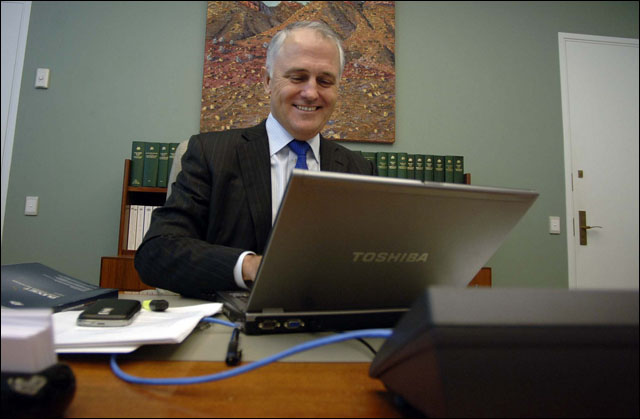

news Malcolm Turnbull has over the past several weeks given several conflicting messages on how the cost/benefit analysis into Australia’s future broadband needs that the Coalition has promised to conduct upon taking government would actually be carried out, with at least three separate approaches being cited by the Shadow Communications Minister at different times.
One of the key planks of the Coalition’s rival policy regarding the National Broadband Network has been that it has always maintained that the project should have been subject to a formal cost/benefit analysis by a government body such as the Productivity Commission before it was commenced. Over the past several years, Turnbull has repeatedly pledged to commission such a study, which would examine all of the infrastructure options for Australia’s future broadband needs, if the Coalition wins the upcoming Federal Election, due to be held in September this year.
However, in several press conferences and interviews given over the past several weeks, Turnbull appeared to flag plans to vary this approach significantly. For example, in a press conference at the Kickstart Conference on the Gold Coast several weeks ago (the complete transcription is available here), Turnbull appeared to state that at least three separate studies could be conducted into Australia’s future broadband needs if the Coalition took power.
“What we will do as soon as we get in – we will get a cost-benefit analysis done by the Productivity Commission as we have promised,” Turnbull told journalists at the conference. “But we will, very, very quickly, ensure that there is produced by the NBN Co – because they are in the best position to do it – a fully transparent, you know with all the assumptions, analysis of what it is really going to cost in terms of dollars and time to complete the build on the current plan.”
“And then we will publish a similar analysis which shows what the savings – in both time and money would be – by variations. Especially along the lines of what I’m doing about doing FTTN for much of the brownfield areas. Or indeed, for not taking fibre into every apartment.”
This approach appears to be at odds with the previous plan Turnbull had laid out — where an independent group such as the Productivity Commission would conduct one single study into Australia’s future broadband needs, considering all the options simultaneously, and with regard to the current NBN rollout.
In a separate interview held with 2GB this week, the transcript for which is also available online, Turnbull appeared to vary the Coalition’s promise on the issue again.
“The very, very first thing we’re going to do is tell the truth about the NBN,” he said. “The NBN has not been forthcoming in the way it’s published information about its activities, they won’t tell you for example how much it’s costing to pass each premise, they won’t tell you how much it’s costing to connect a premise. These are basis, essential items of information, we know less about the NBN which the taxpayer owns one hundred per cent of than we do about Telstra.”
“So what we will do is immediately we will have done a thorough piece of analysis which will show how much it’s going to cost in dollars and time to complete the project on the current strategy. And then we will publish at the same time an analysis which shows what are the savings in dollars and years by making changes to the technology that is deployed. And we’re going to lay that all out, every step we take with the NBN is going to be justified through putting the facts to the people.”
The news comes as Turnbull has recently rejected a call by NBN Co chief executive Mike Quigley for the telecommunications industry, in the form of representative group the Communications Alliance, to conduct its own independent study into the future of broadband in Australia, with reference to the various fibre to the premise, fibre to the node, HFC cable and other options.
Having that debate was a “good thing”, Quigley said. “The choices we make about our nation’s underlying telecommunications infrastructure will have an impact on how we live, work and compete.” Quigley noted that telco industry representative body the Communications Alliance was currently considering whether to embark on a study of the different options for broadband in Australia, and added that this might represent an opportunity for the industry to have its say on the matter.
However, Shadow Communications Minister Malcolm Turnbull instantly rejected Quigley’s comments, in a fiery statement published late on Friday. Turnbull believes such a study would be more properly carried about by the Productivity Commission. “This is the most bizarre twist yet in the debate over broadband policy. Even more bizarre because Mr Quigley has made the announcement without obtaining the agreement of the Communications Alliance to commission the inquiry,” Turnbull said.
“For almost four years, ever since Labor’s $50 billion fibre to the premises NBN was announced in April 2009, the Coalition and many others have called for an independent, transparent review of the options for delivering fast broadband to all Australians. These calls were motivated by our concern that Labor had chosen the slowest and most expensive way of achieving such an upgrade.”
“We noted that Kevin Rudd had gone to the 2007 election pledging that no major infrastructure project would be funded by the Commonwealth without a rigorous cost benefit analysis and we urged Labor to honor that pledge with the NBN – the largest infrastructure project in our country’s history. Throughout this period Mr Quigley and the Government repeatedly and scornfully dismissed such calls. And Labor’s NBN plodded onward, consuming vast amounts of taxpayers’ cash but providing broadband to only a tiny fraction of the 2 million or so Australian premises with inadequate service.”
“Now, just months from an election, Mr Quigley suddenly wants a review – but a hazily conceived and nebulous review on his terms and timing. This isn’t policy on the run; it’s policy chaos.”
Communications analyst Paul Budde commented, following Turnbull’s rejection of Quigley’s suggestion, that both sides of politics should welcome the kind of study Quigley was suggesting, if they were confident about the strength of their respective policies.
opinion/analysis
I have been quite disturbed by Turnbull’s statements over the past several weeks on the issue of a cost/benefit analysis into the NBN. Turnbull has always stated that such a study would be carried out by the Productivity Commission and independently examine all the options.
Now, suddenly that promise has morphed into some form of study by the Productivity Commission, as well as some kind of study by NBN Co itself and what looks very much to be a rebuttal by a Coalition Government with its own analysis. This doesn’t feel in any way ‘independent’, and it doesn’t feel scientific and rational. It feels like Turnbull is trying to set up the process to engender a certain outcome before the Productivity Commission can fairly have its examination of the issue.
Of course, it could be that I’m looking at this the wrong way, and that Turnbull is (as some people have suggested to me privately over the past few weeks) giving a Coalition Government an ‘out’ to avoid canning the NBN project, if enough analysis shows that the project is the right way to go ahead after all. I’d like to think that Turnbull is keeping this option in the back of his mind. Being truly objective would mean going with whatever option the Productivity Commission found to be the best one — regardless of what policy the Coalition had taken to the election on the issue. However, at the moment, the Coalition has slammed the NBN so many times that I would have a hard time believing that it could progress with the project, no matter what the Productivity Commission found.
Such a move would be precisely the kind of backdown which the Coalition has long accused the Gillard Labor administration of, in examples such as the Carbon Tax, after all.
Image credit: Office of Malcolm Turnbull