

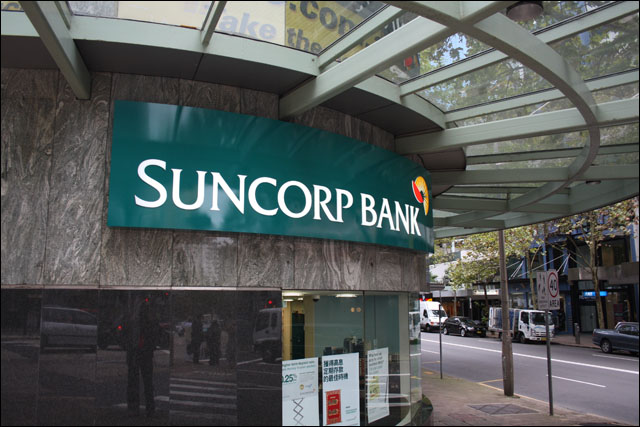
news Second-tier banking and insurance giant Suncorp has revealed it has evaluated deploying Microsoft’s latest Windows Server 2012 server operating system and Hyper-V virtualisation platform and reduce use of VMware’s rival technology, to assist in gaining efficiencies as part of its virtual desktop infrastructure rollout to staff.
In an extensive Microsoft case study published yesterday, the bank, one of the largest in Australia with some 16,000 staff, detailed how the 2011 Queensland floods, which submerged whole neighbourhoods under water, including many Suncorp office buildings, forced it to place business continuity and disaster recovery at the forefront of its technology strategy.
At the time, Suncorp already had a work from home initiative for staff. However, it needed to go further to ensure staff would have access to business resources at all times remotely. Eventually the bank deployed virtual desktop infrastructure to staff – where applications and the actual desktop environment itself ran on remote servers and were delivered online – with staff only requiring an Internet connection to start working remotely.
The Microsoft case study notes that Suncorp uses software from both Citrix (XenApp) and VMware for the project. XenApp is used to provide session virtualisation to about 5,500 staff who acess a centralised installation of a generic desktop. A further 1,500 staff, who need dedicated, personalised workstations, Suncorp put together a virtual desktop model from “various vendors”, which provided custom desktop images hosted in individual virtual machines.
More recently, where Windows Server 2012 and Hyper-V came into the puzzle was the bank’s use of the technology to set up an environment to test the replication of virtual desktop infrastructure (VDI). The company was using VMware’s virtualisation platform in this area, but already had an existing Microsoft Enterprise Agreement licence (which covers a great deal of the company’s enterprise technology) and wanted to take further advantage of that licence; this would allow it to reduce its licensing costs from VMware.
Consequently, the bank worked with Microsoft to set up a test environment. Key features which the bank wanted to evaluate included Hyper-V’s live migration (simultaneous virtual machine migrations with no downtime), storage migration (transfer of virtual hard disks to a new location without the downtime required to upgrade or migrate storage or perform storage maintenance) and ‘shared nothing’ (the ability to migrate a virtual machine from one Hyper-V host to another host that isn’t part of the same cluster, shares no storage, and has only a gigabit Ethernet connection to the first virtual machine) aspects.
“All these features performed as we’d hoped,” says Bryan Summerhayes, Subject Matter Expert for Virtualization at Suncorp. “The features compare well to VMware vMotion and will be critical to day-to-day hardware and storage maintenance.”
The bank plans to use the transparent failover feature in Windows Server 2012, which enables file shares to be moved between nodes without interrupting applications, and Hyper-V Network Virtualization, which provides a way to isolate network traffic on a common infrastructure without using virtual local area networks to boost the availability of its resources. The company also anticipates the Hyper-V Dynamic Memory feature in Windows Server 2012 will help it improve virtual machine density.
Microsoft’s case study does not definititively state that Suncorp is planning to go ahead with its Windows Server 2012 and Hyper-V deployment; it appears that the bank has only evaluated the technology so far, although a migration away from VMware and towards the Microsoft platforms appears likely.
However, it does contain some hard numbers. By switching to Hyper-V and more fully using its existing Microsoft Enterprise Agreement, Suncorp expects to save more than US$300,000 in total, as well as maintaining its existing levels of high level availability and increasing its use of virtual desktop infrastructure. The bank also praised the fact that it could use more technology from Microsoft in its server and desktop stack. Having one vendor simplifies things,” said Karen Mac Mahon, Team Leader for Virtualization at Suncorp. “The hypervisor works more smoothly with the operating system, troubleshooting problems is easier, and managing licenses is simpler.”
The news comes as Microsoft has had a flurry of wins for its server software – particularly Hyper-V — in Australia, at the expense of dominant virtualisation player VMware. Internet banking brand ING Direct revealed last week that it had upgraded its server infrastructure to the latest version 2012 of Microsoft’s Windows Server operating system and further standardised on the vendor’s Hyper-V solution. In August it was engineering services company Norfolk Group who revealed plans to adopt Hyper-V, in May clothing and homewares manufacturer Pacific Brands reveals plans to make the switch, and major organisations including Coles and the NSW Department of Education have also adopted the Microsoft platform.
However, VMware remains the dominant player in Australia’s virtualisation market, and has recently pleased customers by abandoning its unpopular memory-based licensing model, which had been criticised by local customers.
opinion/analysis
I wrote the following several weeks ago and it still stands:
“Microsoft is really sticking the knife into VMware in Australia at the moment. ING Direct, Coles, the NSW Department of Education … these are not small organisations, and they all appear to be very positive about Hyper-V. I’m sure VMware remains the overwhelming dominant player, and certainly I don’t think Hyper-V has anywhere near the full suite of features which VMware’s solutions offer; but I also have to say that I personally wouldn’t like to have Microsoft as a challenger in my market. Microsoft usually tends to move from ‘challenger’ to ‘dominant player’ fairly quickly in any market it gets serious about; and it currently seems very serious about the virtualisation market indeed.”
I’m not a huge MS fan, and in the past have enjoyed ESX… but man.. Hyper-V 2012 makes ESX look like something gross you found on the bottom of your shoe.
Its impressive.
Second-tier giant?
They are not a part of the ‘Big Four’ banks.
Comments are closed.