

This article is by Charis Palmer, news editor at The Conversation. It was first published on The Conversation and is re-published here with permission.
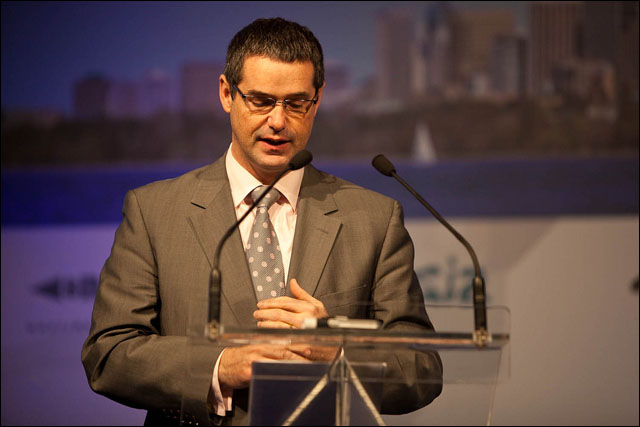
news Australian universities need to adapt their education models or face becoming irrelevant, says Communications Minister Stephen Conroy.
Speaking at a forum being held at the University of Melbourne on high-speed broadband and higher education, Senator Conroy said universities could choose to adapt to the challenges and opportunities presented by ubiquitous high-speed broadband. “This is a sector that has a choice, you can be a dinosaur, you can keep bellowing like some of our retailers, but there are new business models coming to challenge enormously in this sector.”
However University of New England vice-chancellor Jim Barber said there were specific government-induced problems at play in higher education. Professor Barber said Australia is at risk of surrendering its education market to international online providers as a result of government regulation.
“Our regulatory environment is obstructing innovation in online delivery and therefore jeopardising the nation’s competitiveness,” Professor Barber said. He cited numerous quality assurance standards universities were expected to comply with, forming what he called a quality framework “derived from dubious assumptions about how teaching should be performed”.
Professor Barber’s comments come as more universities around the world move to offer massive open online courses (MOOCs). University of Melbourne last week became the first Australian university to offer its courses with MOOC provider Coursera.
Professor Barber questioned the role of the many input standards that go to creating Australia’s education quality framework. “Even if there is evidence for their association with student outcomes, who’s to say they are superior to the methods that are emerging in the new world of MOOCs, social networks and augmented reality?” Professor Barber has called for a Bradley-type inquiry leading to federal government policy on the role of broadband in education.
Senator Conroy said the higher education sector needed to consider how its delivery model must change. He agreed that ubiquitous high-speed broadband meant students, including children, could choose to learn anywhere they wanted.
“Where does that leave us? Can we have a unique Australian curriculum, any more than we can have a unique Victorian curriculum? It’s only taken us 112 years to get a national curriculum, I don’t think we’ve got 112 years to work out what we want to provide in the globalised digital education world.”
Senator Conroy warned that brand alone would not protect universities from the changes being driven by the digital revolution. He said the shift in the balance of power between organisations and individuals was putting consumers, employees, citizens, patients and other individuals in the driver’s seat. “The status quo is not an option for any part of the economy,” Senator Conroy said.
Professor Barber said “broadcast teaching” had been rendered obsolete, with online pedagogy heading towards user-generated information repositories like Wikipedia. “Students today are demanding to be part of the educational process and they are blurring the acts of teaching and learning as a consequence,” he said.
Senator Conroy said in an environment where the marginal cost of providing a course online was zero, lecturers would question why they should be building their own lectures. “Would it not be better to have lecturers spend more of their time facilitating collaborative learning and discussion amongst students? “What is a lecture worth if the best lecturer in the world at MIT is online for free for all to access?”
Professor Barber said the answer lied in reconceptualising the approach to quality, taking online developments into account. “Some of this work can be accomplished domestically but much of it requires multi-national regulation,” he said. He added that as a matter of urgency the higher education sector needed to scour Australia’s Higher Education Standards Framework for obstacles to online learning and remove them.
This article was originally published at The Conversation. Read the original article. Image credit: Kim Davies, Creative Commons

I have to agree with Conroy — this is a sector which is about to experience violent, revolutionary change, just as the media and retail sectors are.
You’d be surprised how some Aussie Uni’s are adapting/adopting a lot of what is discussed in this article, they’ve had to look at ways of stretching their budgets since Howard was in. Most courses where I am have online lecture captures/notes (though it isn’t limited to just the teaching side of uni, research is also getting a lot of changes/advances).
Should “Professor Barber said the answer lied in reconceptualising the approach to quality” read “Professor Barber said the answer lay in reconceptualising the approach to quality”?
I think most universities are run by arseholes.
The principle being instead of catering in the majority, to the number of people who want to do the courses, that they LIMIT the number of people able to do the courses.
They charge what? $120,000 – $150,000 per person for a 4 year legal course. That is what? 50 people with bums on seats in buildings that have all long since been paid for.
One particular bunch of dumb fucks I have a great deal of irritation for, run the small business management courses in Box Hill – all applications will be vetted, and places are limited.
Well if your into RUNNING a small business, instead of being some institutionalised dumb fuck who tells people what they think about running business’s – the FIRST rule is if you deliver product A or Service B, and you get 100 people who want to exchange their money, for those material benefits – you cater for the customer.
But as business is neither static nor sedentary – if 500 or 1000 people are CONSISTENTLY turning up to do the exchange, NO fucking business manager in their right mind, turns away the other 400 or 900 people, they expand their business, by increasing staff and product / service delivery.
The idiots running the small business courses – however, remain fucking idiots.
So why should the LEAST competent service delivery services, get any further business?
All they do is turn out stupid people – just like them.
Much of what goes on in the current univerisities is all kiss our arse bullshit, while we rape your bank balance – instead of saying, “Well the market we believe will only absorb 2000 new lawyers per year – but 8000 people want to do the course – we can tell them this AND cater for the people who want to do the course anyway.”
The Australian College of Surgeons – is another pack of pricks – that have a very restricted intake level.
There is so many surgical proceedures that are little more than meat works process’s, and they know it – and these arseholes don’t like it when you call them on that bullshit either.
There are so many people who found the school system to be wanting that are more than capable with say 4 to 6 weeks of training, to do much of the surgical work.
I for one think fuck them – because there are too few of them, they are only in the cities, their fees are wayyyyy to high and the waiting lists are far too long.
I’d rather have a good bush doctor in a tin shed, with a sharp scalpel and a tin of fly spray – than half of these fucking arseholes.
The final note about these online courses, is that many of them are BADLY RUN, ad-hoc slap together versions of real class courses, that go nowhere, do nothing and give NO qualifications.
Doing the Melbourne university lip service courses like “Admiring Monkeys Arses” is not the same as a qualification as a vet.
While many courses ARE interesting, and do have SOME value, most of them are fucking worthless and BADLY put together wastes of time.
There are no assignments, there is no teacher input, there is no affirming that you have retained and understand what has actually been taught.
An online course – via the university THROUGH the great Australian fiber optic internet?
For all the good these courses and the arseholes in the universities actually provide, you may have well spent your time masturbating in front of the TV.
I stopped reading after you swore the second time.
Everyone loves to learn, but they hate to be taught. I’ve always considered a wiki-style approach to be a great idea, with more focus on projects (ends) where you are guided to learn the theory (means), instead of simply tests and examinations on the theory. I know that some universities overseas have their own local wikis (I’ve used their resources to learn stuff for my own studies at uni). One of the great things about a wiki is you kind of start at the end or in the middle – when there’s something you don’t know, or you need clarification on, you simply click the word (link) to get an explanation on that, and then you branch out naturally, organically, until you have everything you need. Not only that, but you get to learn at your own pace. Obviously it doesn’t suit every kind of learning, but I think that for many units or courses it’s the best way to learn.
Less group projects though, some people just get carried.
I attend a certain Queensland University, and I have one subject where all of the lecturers are either completely unintelligable or just hard to understand. I’ve been forced to find an online source to learn from (which is free). Why do I need to pay so much for so little when I can get an equivelent that is a better service for free?
I have to compare this to an equally hard subject last semester with an outstanding teacher who made a hard subject comprehensible. If I could have a similar experience every subject would that not be better for the students?
Do you study engineering?
Yep, get taught stuff you don’t understand by Lecturers you can’t understand…
But I suspect that the problems people occationally have with poor teachers is not unique to any Institution.
https://dl.dropbox.com/u/23959785/%21EN40/Cant%20understand.jpg
Haha, thought so.
Well, that might be true, but I mean, statistically, engineering have it much, much worse. Chemical engineering in particular, I have to say.
Personally, I’ve long since given up on lecturers and do 100% self-study. I’ve gotten through three years like this. My only struggles are with laziness and procrastination. Like reading Delimiter when I should be designing a heat exchanger.
Did undergrad on-campus. Doing postgrad with a mix of on-campus and online. Online is difficult for many reasons. And nothing will ever make it better than bricks and mortar. I predict a show down with Conroy attempting to force unis to adopt the NBN Co mantra or risk their funding.
Joel, saying nothing will ever be better than brick and mortar eductional institutions is like saying that the rotary phone can never be beat by the cellular phone. We’ve got to move forward and use technology to our advantage. Let’s keep an open mind to innovations and improvements:)
Comments are closed.