

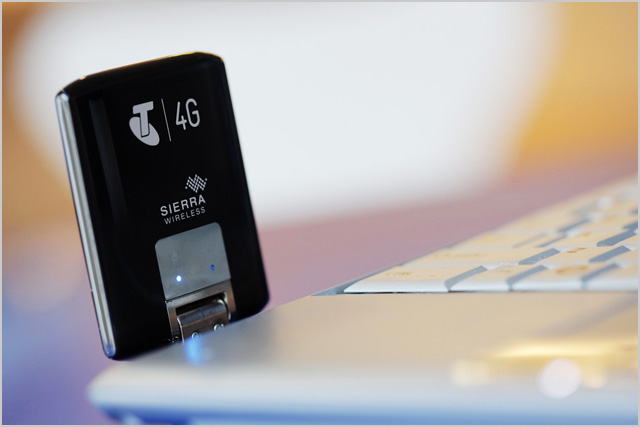
opinion Those claiming that Telstra’s 4G mobile broadband rollout is a shot across the bow of the fibre National Broadband Network need to take a chill pill and look a bit harder at what the company is really aiming to achieve with the project: Freed up capacity on its existing mobile infrastructure to deal with existing demand.
In a fairly trollish commentary for ZDNet.com.au, seasoned telco commentator David Braue argues that the telco’s launch this week was littered with references designed to subtly subvert the stipulation in its contract that it not promote wireless broadband as an alternative to the fibre being rolled out as part of the NBN:
“This is the same kind of marketing committee-driven BS that NBN opponents accuse Stephen Conroy and his peers of peddling. Either Telstra is making a play for the landline market, or it’s encouraging video producers to transfer gigabytes of files while in their cars — and medical specialists to start treating patients outside of their very fixed clinics.”
According to Braue, although Telstra has pledged not to promote wireless as a replacement for fibre, the telco is covertly engaged in a massive land grab at the moment that will see the telco convert existing fixed broadband customers en-masse to a glorious Next G mobile future.
When the NBN fibre is actually rolled out, this fairy tale goes, half of those who would have signed up for fibre to their premise will already be existing in a Telstra 4G high-bandwidth nirvana; allowing Telstra to stick to the terms of its contract while actually nicking off around the corner with the NBN’s future customers. And, the rationale goes, Telstra’s move to open up Next G to access by resellers like Dodo is just another part of chief executive David Thodey’s master plan.
On paper it sounds plausible. You can imagine Thodey’s innocent protestations in closed meetings with NBN Co chief executive Mike Quigley … “I can’t help it if the customers see Next G as an alternative to fibre,” he would cringe, inwardly rubbing his hands in glee. “The network is just so fast …”
It’s a nice vision, but like so many dreams which plague Australia’s telecommunications sector, it’s the sort of perverted fantasy which might have been dreamt up by Hunter S. Thompson in the depths of an ether binge.
The truth about Telstra’s enthusiasm for 4G is much more mundane, as the company has painstakingly laid out several times in press briefings over the past six months. In short, it’s all about freeing up capacity on the company’s mobile network to make space for the vast majority of users who will use it for the purposes God intended — semi-regular moderate access from a USB dongle and daily use on the road from a smartphone or tablet.
Right now, as every mobile carrier in Australia will tell you, there’s a class of hardcore users out there who are pushing mobile networks to their very limits. These users download and upload dramatically greater volumes of mobile data than most people, they connect every day, and they are largely concentrated in the urban centres of Australia’s major cities.
As the numbers of such users — and mobile data users in general — have started to increase, all of Australia’s mobile telcos have suffered shortfalls in their networks. Those with long memories will recall Optus’ problems when it grabbed the lion’s share of iPhone users in Australia a few years back, and Vodafone’s network basically collapsed last year as its cheap mobile broadband deals and smartphone plans attracted throngs of customers.
Now, as many Telstra customers can attest (tried any heavy mobile use in Sydney’s CBD recently? It’s getting a bit crowded), it’s time for the nation’s largest telco to feel the heat.
Over the past year, Telstra revealed in August, the telco has added a total of 1.6 million new mobile subscribers — that’s mobile broadband users, as well as those on mobile phone plans. And with the majority of phones being sold now being data-hungry smartphones, it’s not hard to see why Telstra, as its own executives would put it, is constantly throwing capacity at its mobile network in the form of fibre backhaul connections and new towers.
To keep up with the sheer pace at which mobile usage is growing, Telstra needs every strategy it can get — and its 4G rollout rollout will be a key part of that.
Through rolling out a 4G network alongside its current 3G network, Telstra is betting that many of its heaviest mobile users will gradually upgrade their mobile broadband modems (and, eventually, smartphones) to take advantage of the increased speeds, concentrated in areas where they are mostly located — urban central business districts.
As this happens, Telstra will suddenly find itself with freed-up capacity on its existing 3G mobile networks — resolving some of the capacity constraints it has started to experience with its influx of new users.
The telco’s plans to open up wholesale access to Next G will conveniently fit into this scenario rather well. If, as many suspect, Telstra plans to only open up wholesale access to the 3G component of its mobile network, and if it does so six months’ down the track when a number of its heaviest (and most profitable) users have shifted onto 4G, Telstra will have the capacity to take on an absolute boatload of light to moderate mobile users on its 3G network through resellers like Dodo, and without sacrificing capacity while doing so.
What does this have to do with fibre and the NBN? Well … nothing.
Let’s look at the situation realistically. Most of the heavy mobile broadband users which Telstra is attempting to shift onto its fledgling 4G network will be the sort of users who will have both fixed and mobile broadband connections. They’re internet junkies (I speak from personal experience). A small subset of the light to moderate users won’t sign up for the NBN fibre when it’s eventually rolled out in their neighbourhood, but only a small percentage.
Most will want their smartphone, tablet and possibly laptop connected to 3G, while also maintaining a fixed broadband connection at home. The growing migration of entertainment channels online (TV, movies on demand and so on) will alone ensure this, to say nothing of all the other internet services which just do better with a more reliable fixed broadband connection.
Is Telstra encouraging video producers to transfer gigabytes of files from their cars, and medical specialists to start treating patients outside of their very fixed clinics? Yes, as David Braue pointed out, it definitely is. However, in an NBN world, Telstra wants its cake and to eat it too. It will also encourage those same customers to have fixed broadband connections as well — and it’ll give them a discount for bundling both types of services together.
Now, as I’ve previously written, there is much that we don’t know about the future of wireless broadband and its potential to bridge the speed gap between copper-based broadband and fibre broadband. This fact, as well as its low deployment cost, is what makes the technology so alluring when comparing it to the NBN’s fibre.
However, it’s important not to mistake Telstra’s 4G announcement this week for something that it’s not. Telstra, like its rivals, is engaged right now in a desperate bid to keep its mobile network above water, and its 4G deployment is its latest sandbag designed to keep demand from overflowing its rapidly dwindling capacity supply.
Image credit: Telstra
50% of user on Wireless at home :O
Telstra 4G Dial up it will be with that many users you would be lucky to get dial up speeds and pings into the thousands
Have fun with that
Latency latency latency. The very reason moderate to hardcore internet users will always prefer a fixed connection over a wireless solution. Once rollout finishes in Coffs Harbour it will be NBN 25Mbit optic fibre for my home and 4G for my mobile usage.
Latency latency latency.
Not to mention cost cost cost, the benefits of the mobility of LTE/3G is still going to be outweighted by the usage limits provided by a fixed service provider.
Ive seen 35ms latency on Telstra 4g (completely uncontended, only user in the city using it at the time I suspect so best case scenario)
LTE has good latency when used in the right circumstance. the Wireless that NBNCo roll out in regional areas, will be quite nice I suspect if it is using similar technology.
Mmmmmm, ether. My sensibilities swoon. :-)
Have you ever heard the joke about the wide-mouthed frog?
Erm, why are the two concepts mutually exclusive?
Can Telstra not be trying an end run around it’s contractual ‘no spruik’ clause to trim some NBN fixed customers even as it invests in a much needed upgrade? As a side effect, it’s a pretty nice one.
Telstra 4G will probably be carried over NBN, from base stations to Controllers and into it’s Core.
All-wireless networks would be very limited in the MBH (mobile backhaul).
Comments are closed.