

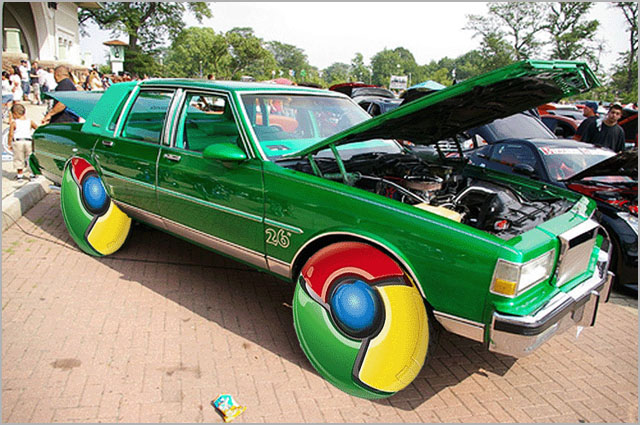
Delimiter’s new Curmudgeon column is contributed by David Braue, who has forgotten about more heavily-hyped gadgets and supposed life-changing technologies than you’ve probably ever seen. His hobbies include long sunset walks along iPhone-lit beaches, setting the proverbial clocks on peoples’ proverbial VCRs, embedding hidden swear words in the Delimiter CMS, and ranting about anything in the tech world that has it coming. Oh, and Scrabble.
opinion Remember when Linus Torvalds burst onto the world in some sort of Luther-esque declaration that things simply are. Not. Going. To. Be. The. Same. Ever. Again? Linux was here, and it was going to be our new master.
Then, of course, Windows 7 beat the snot out of Linux — which is still widely used by the pale-skinned sysadmin hordes but has had zero impact on the Windows-Mac OS X desktop duopoly. Apart from a small but dedicated community of countercultural stalwarts, early-2000s enthusiasm over Linux as a mainstream desktop platform is gone. With few exceptions, the only penguins you’re likely to see on Australia’s desktops these days are the stuffed ones you get from the Melbourne Aquarium.
I’m reminded of that enthusiasm over Linux when I hear Google spruiking the benefits of its new Chrome OS and those impending devices for which — terms like ‘laptop’, ‘notebook’ and ‘netbook’ apparently being inadequate — Google has invented a new one: ‘Chromebook’.
Just as Amazon redefined a category with its Kindle, Google wants to redefine a category with its Chromebooks. And, while I note great enthusiasm on Google’s part and an apparent curiosity on some end-users’ — Kogan tells me the first two shipments of its early-release Chromebook have sold out, but won’t say how many this implies — I can’t help but suspect that Australians will take to Chrome OS to more or less the same extent as they took to Linux.
That is to say, barely at all.
Why? Because it is, for all intents and purposes, Linux.
Google wants you to believe Chrome OS is some magical new environment where everything runs at breakneck speed and there’s no need for anything other than Google’s online apps. But underneath all the marketing hype and claims of technological wizardry, Chrome OS is just another Linux distribution. It’s based on OpenSUSE 11.4, and says so right there on the startup screen.
Google has just done what hundreds of other developers have done in the past, slicing and dicing Linux for its own purposes. Chrome OS, and its underlying Chromium OS open-source platform, has all the accoutrements you’d expect from a Linux distribution: GNOME desktop, Qt for cross-platform support, Wine for Windows emulation, XTerm, Totem, Picasa for picture management, LibreOffice productivity tools, and so on.
Google has no doubt made many tweaks under the hood and is, to be fair, the kind of company you actually do want to be curating Linux. However, it still won’t make a difference. Die-hard geeks will love Chromebooks, and everybody else will try them and then return them. In the tech world, philosophical outrage quickly wears thin; it’s like those who make a hippie change and then tire of being unable to wash their dreadlocked hair.
Australians are heady adopters of new technologies, but they’re also quick to drop new technologies when they prove to be too much bother. People — and I’m talking about your mum, brother and that girl you were trying to impress at that nightclub last weekend — are technologically lazy at heart, and they don’t care about Linux anywhere near as much as you might.
They don’t want to know about command lines, sudo and apt-get. They just want a computer that lets them do computer stuff without thinking about the fact they’re using a computer — and for most people, ten minutes using Linux is enough to dispel any anti-establishment fervour and send them running from an OS that, while free and lovely and all, has been built for engineers by engineers. Once they realise their new laptop can’t run Crysis, they’ll whinge, and return it, and run back to what’s familiar.
I watched this happen back in 2008, when the shelves of Officeworks’ computer section were lined with Asus’ newfangled Linux-based Eee PC netbooks. I played with them, and you probably did too. But a few months and a zillion new netbooks later, the Linux machines were invariably being heavily discounted to move, while Windows-based devices were positioned front and centre.
All ASUS managed to do was to bring down the entry-level price of Windows 7 — which, given Microsoft’s past Australian pricing proclivities, isn’t an entirely unimpressive result. But these days, even the entry-level Eee PC 1001PQ comes with Windows 7 Starter edition onboard, and none of Asus’ eleven current Eee models ships with Linux. If you want Linux on a laptop, you have to go to the likes of Kogan, which offers Ubuntu in a $389 laptop that is, we understand, guaranteed not to spontaneously combust but is otherwise likely to perform as $389 laptops do.
I say all of this not to ridicule those of you who have chosen to pursue a Linux-filled lifestyle — if a man can marry a goat or willingly buy Battlefield Earth for home viewing, who am I to judge decisions made in the privacy of one’s own home?
Yet I harbour great doubts that Chromebooks will pick up much momentum in Australia, where the market is already saturated with inexpensive laptops that — like the cozy blandness of My Kitchen Rules or the Herald Sun — challenge none of our preconceived notions and let us float along on a comfortable pillow of technological familiarity.
Obviously, Google will get other manufacturers onboard, and it will succeed in making a new market with cool-sounding devices that are basically the same as many sold before. Of course, Microsoft has managed to convince several hardware makers to test the Windows Phone 7 market but that doesn’t mean they’re rushing out the door yet.
Google is, to its credit, trying: It’s backed efforts to promote HTML5 versions of popular games like Angry Birds, and when the devices ship here later this year I’m told we can expect Chromebooks to be bundled with 3G access on a $30-ish-per-month payment plan. Optus, for one, did similar deals with Windows netbooks that have been so popular that the company currently offers a grand total of one such bundle for its SMB customers; consumers that Optus once tried to lure with Linux-based netbooks are pushed towards tablets instead).
Google has also been pushing Chrome OS through partnerships with the likes of Virgin America, which is offering loan units for use during domestic flights within the US, and New York’s Ace Hotel, which will loan you a Chromebook and free WiFi/3G for the duration of your stay.
Expect Chromebooks to soon appear at cultural events, music festivals, domestic airport lounges; could it be long before Google is offering psychedelic-coloured Chromebooks at the Big Day Out, and placing them in the hands of high-profile AFL players to spruik with awkward commercials?
But getting Australians to pay for something is much different than putting it in front of them, or letting them borrow and use it for free. When Chromebooks enter full retail mode, they’ll be once again pitting Linux against the tried-and-proven game-winning credentials of Windows 7 and Mac OS X. If the history of Linux-only laptops in Australia is any indicator — the place they’ll be moving the fastest will be through deal-of-the-day inventory liquidators.
Chrome OS may be all shiny and new now, but Google is taking a lot for granted in hoping that it can turn Australia Chrome overnight. Without some killer apps that you can’t get by loading the Chrome browser on the computer you already have, I suspect the world will quickly realise that a kilogram of Chrome OS carries exactly the same weight as a kilogram of penguin feathers — which is to say, not very much at all.
Prove me wrong: I would love to hear why you think we should care about Chrome OS.
Image credit: Shannon Hauser, Creative Commons
The only thing I can appreciate with Chromebooks is the speed, other than that I just don’t get them.
Recently I wanted something more portable (got sick of carrying the 15″ laptop) and didn’t want a tablet, ended up settling on a nice little HP Mininote. If I want to run Chrome it I’ll run Chrome, but it can do a hell of a lot more than just that.
Personally I think I will wait until the Android tablets get decent (and light).
Except it’s not Linux, in the same way those airport Internet access terminals are not Windows. It’s a cut down “browser only” operating system and digging under the hood to find its SuSE is about as relevant to users as the fact most ATMs run on Windows CE.
I still don’t understand why you would run any ATM on Windows when it’s a basic function that could be performed more securely on a Unix variant … A good example would be the fact that many poker machines run on Linux.
Neither, but it’s one of the many things about this world that doesn’t make much sense.
I suspect it’s an issue of skills availability and cost-vs-risk calculations that favour Windows over what the guys with the chequebooks will see as weirdo hippie Linux stuff. Which is all well and good until… http://bit.ly/13b9Oc.
I see your point but do you think users will necessarily see it the same? I’d suspect that the first thing users do with a new notebook, after fiddling around with it as delivered, is try to set it up with their own apps, settings, look-and-feel, and so on. Screwed-down SOEs might prevent this by setting up a tight wall around the Chrome browser, but unless a company is architecturally prepared to run EVERYthing through the browser, there will be a requirement for some degree of user autonomy. And I’d imagine users will quickly run into bizarre, unfamiliar territory when they start trying to add apps and such. I still run into people that struggle, conceptually, with Mac OS X and it’s not even that far removed from Windows.
…but unless a company is architecturally prepared to run EVERYthing through the browser, there will be a requirement for some degree of user autonomy
This is Google we’re talking about, remember? ;)
What a nonsensical article – although pretty well written!
To me ChromeOS is all about corporate environments. It will save you millions on sysadmins, software, file servers, and other infrastructure
That only works if the corporation is a Google Apps or other cloud based infrastructure only.
Fair point — I haven’t seen a lot written about the Chromebooks’ integration with any Microsoft suite. This also has the potential to limit their uptake.
I think that’s kind of the point :-)
Not really.
Chromebooks are good for accessing any web based Intranet service and virtualized Windows desktops. Basically if you have a server based IT infrastructure (like most enterprises, Chromebooks are a natural.
For small businesses with no IT staff, Chromebooks and their zero maintenance feature is perfect, and will save a boatload of time and money over Windows PCs or laptops, and you can always keep one or two Windows machines for specific Windows applications if you need them.
Any time someone says you can save millions on sysadmins, my inner sysadmin cries out in rage.
It will save on desktop maintenance and support staff big time. It will increase the job market for proper sysadmins, since more services will be server based, including cloud servers, corporate Intranet and corporate cloud servers, and virtual Windows desktop servers.
Check, and check! :-)
Chromebooks will certainly be highly optimised access devices for Google services and Web-based apps – but not everybody is using them. I wonder how many companies have the total Web-based back-end to support this sort of front-end interface exclusively. Would your company, for example, be in a position to replace its Windows laptops with Chromebooks? And would there be a valid business case in spending the capital to make it so?
Obviously, it won’t work for everyone, but i think there are certain kinds of jobs where it makes a lot of sense. Remote sales people who do most of their job via email and salesforce.com, call centre workers who basically only ever access a single application anyway (note: mac-mini style desktop boxes are in the works as well — the “Chromebox”), obviously schools and universities who want to limit what students access anyway,
I’ve even heard of newspapers replacing their entire workflow with Google Docs – stories are written in a Google Doc, collaboratively edited, then marked with a special label when it’s time to publish. An automated process gathers all of the docs and sends them to be layed out (that’s still manual)
Also the support is nice, too. Have a problem? Send it back and get a new one. A big company can keep some in reserve so that there’s no downtime.
OK, enough of the sales pitch :-)
The issue with Tux is that it was never meant to be usable by a large audience, differently from Chromebooks.
You are probably right about one thing “People — and I’m talking about your mum, brother and that girl you were trying to impress at that nightclub last weekend — are technologically lazy at heart, and they don’t care about Linux anywhere near as much as you might.” . True, LINUX AIN’T FOR EVERYONE but WINDOWS TOO AIN’T FOR EVERYTHING. Their a plenty of fields where Windows hasn’t matured enough and so Linux is the best Alternative. The only place Windows has succeed is in convincing the above mentioned people to be their customers. I’ve been using Linux for three years now, I’ve loved the experience and would be happy sharing the same with my friends or family but honestly, I gave up trying to convince anyone to use Linux, “Its for the engineers and was engineered by hobbyist engineers who do it for the mere love of it, Not to up the Linux market share or grab as much dime from the end user. If programming, systems administration, web designing or perhaps computer security & engineering doesn’t sound like a related field to your career then forget about trying out Linux. I’m not arguing that these fields can’t fit a windows user, but Linux will do you good in your pursuit for knowledge and a better experience in these fields. I’m also not implying that you can’t get a pleasant desktop experience in Linux, but windows having fixated your mind on what a computer desktop should look like, its unlikely that you’ll find Linux appealing. Take Linux to people who’ve never seen a computer Desktop, give them a five year experience with Linux desktops (GNOME or KDE). After the five years, throw before the same people Windows Desktop, believe you me they wont see Windows as they see it today. Bottom-line, its the mind set of “people” thats doing it windows. Its not that Windows is any better and we all know that its not even close to a secure system, Its just that Windows fits into the minds of the “people” you described above (including yours) as the only software component of a computer system other than the hardware the see (if they even understand what software or hardware means). So a computer is simply incomplete or in need of troubleshooting if the screen wont splash “Windows XP/Vista/7” on their screen when they start their machines. So thats it, its not a fight anymore especially when you understand whats controlling the Desktop market share. So no matter the Linux distro, be it Chrome OS or Mint Linux or my favorite Ubuntu, its all Linux and we are a community thats has come up with a secure and better alternative to what Raymond is supplying after coding their bogged up designs within their closed rooms so you “people” can bank their accounts like you’ve always done. So who cares anymore, If you can afford Windows grab it off the shelves, if you’d rather Linux stream it down the Internet for free or if you have plenty of cash and nothing to spend it own, Apple inc, is selling MacOS X. Its a free world right? Everyone gotta do what he’s gotta do and nobody cares if Chrome OS, like Tux, will never fly.
Chrome OS is just a custom windows manager made by Google similar to OpenBox. I’ve recently installed Arch Linux on my 6 years old laptop with OpenBox. The only application I installed was Google Chrome and xterm. When my computer boots, Chrome is automatically launched. So technically speaking I have a Chrome OS laptop.
Believe me or not it’s pretty fast.
Troll. Everyone knows the desktop doesn’t matter anymore. Have you seen what Microsoft is pushing lately?
Consider that nobody actually buys a copy of Windows, you just rent it from Microsoft, and while it’s in use, your hardware is under their control, supervision and ownership (legally, not physically).
Then again people like your mum, brother and that girl you were trying to impress at that nightclub last weekend, don’t care about those details either.
I almost took this blog seriously. Until I hit this:
“I say all of this not to ridicule those of you who have chosen to pursue a Linux-filled lifestyle — if a man can marry a goat or willingly buy Battlefield Earth for home viewing, who am I to judge decisions made in the privacy of one’s own home?”
So, the blogger is more of a need of serious mental help than anything else. I mean I like the vulgarity of South Park as the next guy, but this is supposed to be a technical blog? Nah, I did not think so. Just a sour loser who wished he invested in RHT, not MSFT. Ignore.
I’m confused, are you upset at the Scientology remark, or are you in love with and intend to marry (or already have married) a goat?
I know you are confused. Perhaps dazed too. It will pass if you stop the strong drugs. Maybe.
I have been a Linux user for ages; I was one of the idiots who spent weekends getting PowerPC Linux to boot on my Power Mac. I’m a coder, a sysadmin, and an engineer. So I’m the perfect demographic.
But let’s take a step back: Android, Google’s other OS, is solidly Linux based. And it’s happily captured the non-iOS side of the mobile phone and tablet market. So the argument that ‘no one cares if it’s Linux under the hood’ cuts both ways: as long as the system works as users expect, they’re happy.
What Chromebooks are trying to do is not to take over the market overnight; they’re trying to get the thought into people’s minds: what if I *did* live in my browser? No software installs, no “there’s a new version of XYZ, do you want to install it now?”, automatic backups to the cloud — and all they give up is Crysis. Which, by the way, nobody but gamer nerds (a similar, crossover market with your pale-skinned sysadmins, by the way) cares about. Of the 10 computer users in my extended family, only ONE plays 3D games on PC. The rest? Would be perfectly happy with a Chromebook, once their favorite apps can be run in the browser. And it’s getting close: IM, Photo-editing, blogging, TweetDeck, Calendars, Contacts, Office documents, presentations, casual games, even Web development can and is being done in the browser. Google’s “app store” is faster and simpler than Apple’s or even Android Market — most things show up in an instant, and by and large they ‘just work’.
I suspect that the first generation of these things will be dismissed repeatedly, until gradually you’ll find them everywhere.
You sir are either very misinformed or just a liar. I am hard pressed to find a single true statement about What ChromeOS is in your article.
“It’s based on OpenSUSE 11.4, and says so right there on the startup screen.” Simply not true, ChromeOS is built on Gentoo. On a true Chromebook, the startup screen says nothing but “Chrome” . I have to assume you are using something home built from Suse studio.
“Chrome OS, and its underlying Chromium OS open-source platform, has all the accoutrements you’d expect from a Linux distribution:
GNOME desktop” No it does not, there is no DE or WM, just the chrome of Chrome
“Qt for cross-platform support” – Nope wrong again
“Wine for Windows emulation” – Not even close, you can’t install anything locally much less a widows program
“XTerm” – it does have a shell (not Xterm, it’s called crosh) but you have no reason to use it (Mac has a shell as well)
“Totem” – NO
“Picasa for picture management” – Only the online version
“LibreOffice productivity tools” – and still wrong. The productivity suite is Google Docs.
Have you even used a Chromebook?
“Have you even used a Chromebook?”
No, he didn’t. You are right about the errorrs, all he wrote was about something else… lol.
Also this.
I never understand how someone is so anti Linux or thinks it’s a failure. Linux is everywhere from sat nav’s kindle’s, tv’s, mobiles even computers. Linux is pushing other os’s to improve but it’s going to take a long time for the other os’s to catch up if they they ever catch up.
Heh…a curmudgeon column – let’s see you get Dvorak in here…. ;)
[Why? Because it is, for all intents and purposes, Linux.]
So’s Android, and look how that is selling.
[I’m reminded of that enthusiasm over Linux when I hear Google spruiking the benefits of its new Chrome OS and those impending devices for which — terms like ‘laptop’, ‘notebook’ and ‘netbook’ apparently being inadequate — Google has invented a new one: ‘Chromebook’.]
ChromeOS is quite different from any other OS on the market – it is a stateless device, with state stored on the Cloud. This means it is an appliance which requires no user maintenance – just switch on and go, the machine takes care of itself.
[But a few months and a zillion new netbooks later, the Linux machines were invariably being heavily discounted to move, while Windows-based devices were positioned front and centre.]
Nobody discounts Linux, after all who is going to pay for those discounts, the freebie programmers who don’t earn any money from it? On the contrary it is Windows 7 on netbooks that is heavily discounted by Microsoft in order to keep OEMs from preloading Linux once Linux netbooks proved very popular with customers. As for Linux netbooks being moved off the retail displays in favour of Windows netbooks and Linux netbooks being relegated to online sales, that is down to Microsoft’s Windows advertising rebates, which are designed to prevent Linux netbooks from being advertised].
Comments are closed.