


If you believe the levels of hype currently emanating from telcos in the United States about their ‘fourth-generation’ or 4G mobile networks, the new deployments are all about speed.
“Verizon 4G LTE is lightning fast. Lightning strong. Think it, and 4G LTE makes it happen. Download movies in minutes. Photos in seconds. Apps. Games. News. It’s what you want, when you want it,” screams the marketing coverage on Verizon’s 4G promotional site. There’s even a little speed wheel demonstrating how much faster the new network is than the dated past.
And there’s no doubt the Long-Term Evolution standard which Verizon is using and all of Australia’s major mobile telcos plan to adopt over the next 18 months theoretically offers greater speeds — up to 100Mbps and even beyond; a step change from the performance of the nation’s mobile networks today.
At the Mobile World Congress several weeks ago, Telstra announced it would install LTE in mobile towers in the CBDs of all Australian capital cities and selected regional centres by the end of 2011. To do so, Telstra will use the 1800Mhz spectrum, and will run both that range and its existing 850Mhz HSPA+ technology on its network at the same time, with users able to switch between them.
However, speaking in Sydney today about its own 4G initiative, several of Telstra’s key executives this morning appeared keen to emphasis the ability of the new technology to free up capacity on its flagship Next G network for everyone, rather than just boosting top-line speeds. Mike Wright, Telstra’s executive director of Networks & Access Technologies (Wireless) told journalists the overarching theme at the conference had been the need to manage the demand for mobile bandwidth — with mobile data usage typically doubling “every 12 months”, telcos were struggling to cope.
The executive said LTE had typically been discussed in terms of it being “a new network”, he said. But he saw the technology more as giving Telstra the ability to build a “hybrid” network, rather than a whole new separate network.
The key to understanding this concept is several successful realisations. Firstly, Wright and Telstra chief technology officer Hugh Bradlow pointed out this morning that by far the biggest consumers of data on Telstra’s network were customers with USB dongles connected to their laptops — despite the fact that they existed in smaller numbers than smartphone users.
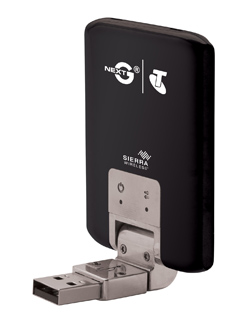
Hence, Telstra plans to start selling dual-mode LTE/HSPA+ mobile broadband modems — which will allow those users to use both the existing 850Mhz (HSPA+) and planned 1800Mhz (LTE) frequencies if they are in an area which supports them. When those users range off HSPA+ and onto LTE, Wright said this morning, they will free up that HSPA+ spectrum and bandwidth for other users.
“It’s a step change in what we’re putting on the network,” Wright said. “But it’s also about maintaining the network performance.” Advancing network technology, the executive pointed out, “doesn’t always mean maintaining higher peak speeds”.
In a period of several where Telstra’s rivals Optus and VHA have struggled to maintain network continuity across all metropolitan areas, it’s this ability to maintain service no matter what that may give Telstra an edge in the years to come — particularly as the devices that can take advantage of the peak theoretical speeds offered by the respective HSPA+ and LTE networks are still some way away.
Telstra’s Next G network has already pushed past the 42Mbps theoretical limit in some areas. However, Bradlow noted this morning that the telco was only now starting to see smartphone handsets available with chipsets which could do 21Mbps and 42Mbps speeds, with most still focusing on the legacy 7.2Mbps limit.
The telco doesn’t expect the first LTE handsets at 1800MHz to be available for while yet — within the next 12 to 18 months.
In a broader sense, Telstra’s shift to the 1800MHz spectrum for LTE mirrors the approach the telco took when it rolled out its 850Mhz Next G network starting in late 2005. At the time, the telco was pilloried by industry observers for using a spectrum frequency which was unpopular with international telcos — with some claiming few handsets would ever support the range.
However, since that time, a number of other telcos around the world have introduced the 850Mhz spectrum on their networks, and it is very common for handset manufacturers to support 850Mhz by default. This morning, Bradlow chuckled about how “wrong” Telstra’s critics had been.
As with 850Mhz, Telstra is taking a collaborative approach with the 1800Mhz spectrum and attempting to drag much of the rest of the telco industry along with it. Wright said Telstra had noticed interest in the band was “growing” around the world, and that it was beginning to emerge as a standard, with chipsets in development and vendor partners (Telstra has partnered with Qualcomm, Ericsson and Sierra Wireless) beginning to emerge.
Telstra, he said, had “essentially created a global interest group” around 1800MHz LTE and hosted a session on the standard at Mobile World Congress, which was attended by about 70 CTO-level executives. “The feedback from that session was very positive,” he said, noting he would be surprised if Telstra remained the only telco with a “hybrid” HSPA+/LTE network.
“I think a lot of people have been thinking about it and talking about it,” the executive added. “We said: ‘Why can’t we be the catalyst?’ And once we started having the discussion, we found — hey presto! — a lot of people agreed with us. It’s not that different from when we launched Next G … [we had] a user group at that stage also.”
And Telstra isn’t confining its gaze just to LTE.
Several times during this morning’s briefing, Bradlow mentioned that he was closely watching the development of the emerging TD-LTE (for time division LTE), which has the potential to further evolve Telstra’s network and is being investigated right now by countries like China, where Apple has been reported to be interested in launching a TD-LTE iPhone.
And of course Telstra is still evolving the 850MHz portion of its network — with 84Mbps speeds on the horizon, and some 93 percent of the telco’s base stations now featuring Ethernet backhaul, to ensure they can bring enough bandwidth to users.
Over the past several years, Telstra has garnered a reputation for stability and speed on Next G that its rivals are not currently matching — although a Fairfax report over the weekend positioned Optus’ Open Network as not too far behind Next G.
Wright said there were still events which could cause congestion headaches on Next G — for example, a major pile-up on a freeway, where every driver is trying to use their smartphone to get information on the road or just communicate with family or colleagues elsewhere. During the recent catastropic flood in North Queensland, he said, Next G was running at three to five times its normal capacity.
“It’s not impossible,” he said. At this stage, only time will tell whether Telstra can stay ahead of that demand curve.
Image credits: Telstra
Telstra has always seemed to be really smart when it comes to mobile, why then is it always behind in fixed line?
They haven’t always been smart in mobile … i-mode anyone?
Was just thinking the same thing… ;)
In terms of investment, it makes sense for Telstra to invest in mobile, since they get 100% of the benefit from that investment. Investing in fixed-line doesn’t make as much sense, because they’re a wholesale provider: any investment they make benefits not only Telstra, but also all of their competitors as well.
It also makes perfect sense for Telstra to beef up their mobile offerings, since their earnings from fixed line are going to drop significantly as the copper network is gradually decommissioned.
And the way to completely lighten the data demand on wireless broadband is to roam to a Wi-Fi LAN sharing a cheap fixed broadband service like NBN fibre. Cheap data, low latency, high stability, higher bandwidth.
It will be great for those who can only use wireless broadband like 3G/HSPA/LTE when 93% of the buildings in the country and most public transport offer mobile devices a Wi-Fi roaming option off their NBN connections.
The future of wireless is like Weet-Bix – full of fibre.
Reason why Telstra spends so much time/effort/money into there Mobile Network is because they (Telstra) are not forced to resell it.
If Telstra was forced to resell its Mobile Phone Network at a wholesale level, Telstra would simple let the mobile network run into the ground like it has done with the Copper Network.
Telstra does what ever it can to keep the shareholders wallets plump. Nothing more, nothing less.
What happens when Telstra structurally separates into wholesale and retail, anyone read the legislation? Do they have to wholesale mobile as well?
No, they certainly do not — as the Government has determined there is enough competition in the mobile segment for them not to have to.
“although a Fairfax report over the weekend positioned Optus’ Open Network as not too far behind Next G.”
they wrote that, but then said something like “it took 6 seconds on Next G, 9 seconds on Optus”
thats 50% slower…… not really close…
Comments are closed.