

It’s been dumped by Amazon and mirrored across the globe as it attempts to spread its whistleblowing message to the masses. But would any web hosting company in Australia consent to play host to WikiLeaks? The answer, so far, appears to be “probably not”.
Several large Australian web hosting companies said today they would be unlikely to host the WikiLeaks repository if asked to by a customer, for a number of reasons.
Bulletproof Networks has earned a reputation for stability and reliability with its customers. The Australian company hosts several large Australian sites which attract record amounts of traffic — and sometimes controversy.
For example, the hosting provider houses broadband information site Whirlpool, one of Australia’s most controversial customer forums. Whirlpool has attracted numerous legal threats over the years, as well as denial of service attacks not dissimilar to the attacks which have targeted WikiLeaks over the past several weeks as it released 250,000 US diplomatic cables to the public.
Bulletproof director Lorenzo Modesto said his group hadn’t been approached, but would have to seriously consider ethical, political, commercial and “the most obvious” legal or potentially criminal implications of hosting a WikiLeaks mirror for a customer if requested to do so.
“More than $1 billion per annum worth of transactions are served by Bulletproof’s mission-critical hosting infrastructure. As such, given potential issues with any number of the above considerations, we would probably kindly refuse, but refer them to another hosting partner like Rackspace,” he said. “The issue will be that the commercials required would preclude local public managed cloud hosting without the provider sponsoring it in some way.”
Another local web hosting provider not known to shy away from controversy is Netregistry, run and co-founded by chief executive officer Larry Bloch.
Today, Bloch said in many ways his sympathies were with the WikiLeaks organisation in general, as he believed in transparency — although he thought the organisation had overstepped the mark in terms of the diplomatic cable release. “For the effective functioning of many sorts of relationships, you do need a bit of diplomatic secrecy,” he said.
In addition, the CEO said typically Netregistry would tend not to make decisions about customers based on the content they wanted to host — as long as it wasn’t obviously illegal or unethical.
However, Bloch noted the WikiLeaks case was special, because of the scale of the situation from a technical perspective.
“It’d be suicide to put forward a hosting service other than one that is tailored absolutely to them,” he said, noting issues like the denial of service attacks could cause “ancillary damage”, and that Netregistry wasn’t set up for such needs.
“Ultimately what WikiLeaks needs to do to get a permanent hosting service is to be hosted directly on a tier 1 provider — like Telstra,” he said, noting such a provider could guarantee more bandwidth than online attackers could block out with denial of service attacks. WikiLeaks needed “dedicated data links and dedicated facilities,” he said, otherwise any hosting provider would be “asking for trouble”.
Bloch said additionally, he didn’t want to “go up against the US Government”, which had publicly indicated its displeasure with the whistleblowing website. Other hosting providers — such as Macquarie Telecom, which boasts one of the highest-grade hosting facilities in Australia — declined to comment on the issue.
However, at least one organisation is hoping to find an Australian web hosting company to help keep WikiLeaks alive — the local division of international electronic rights political movement the Pirate Party. The Pirate Party Australia yesterday issued a statement noting it had joined its international brethren in mirroring WikiLeaks.
“Instead of pursuing WikiLeaks at the behest of the US overnment, the Australian Government must move to protect WikiLeaks and organisations like it, and the important function it provides within the democratic process,” said Rodney Serkowski, party president.
“This is about more than WikiLeaks, but leaking in general, and its legitimacy in a modern, open democracy. This is a fight for fundamental freedoms on the Internet. We will not accept governmental attempts to restrict access to free press and constrain freedom of speech.”
Local party spokesperson Brendan Molloy clarified the organisation’s WikiLeaks mirror was currently hosted in Sweden because it already had servers in that country, but was looking to host locally in Australia if possible. “We don’t foresee any legal issues by hosting a WikiLeaks mirror in Australia,” he said.
Whether the Pirate Party Australia can find a local web hosting company to help them with the matter may be another question entirely.
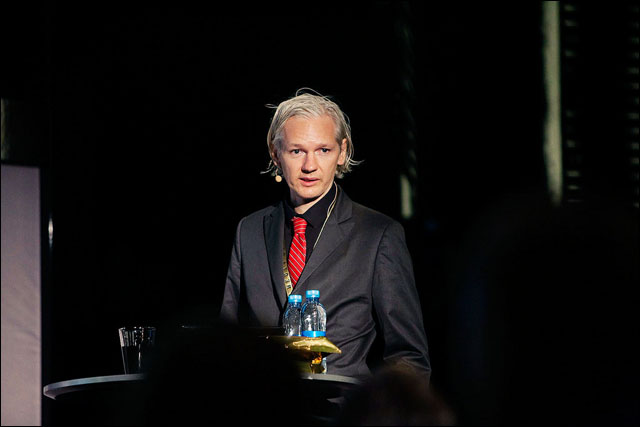
Image credit: New Media Days, Creative Commons
I’m in the Larry Bloch corner here.
There would be very few hosting providers anywhere in the world who could take on Wikileaks as a customer and hope to maintain a quality of service to other customers.
I dunno … Bulletproof hosts Whirlpool, which is already pretty massive. I’m sure they could handle things if they put their mind to it — and so could other hosting providers like Macquarie Telecom. Dedicated banks of servers in datacentres like Global Switch’s Sydney facility, which has massively redundant fibre coming in, would solve the problem. However, you have to ask how much this would cost — and how much WikiLeaks would be able to pay ;) A distributed solution is clearly better in this case.
I take your point there – and perhaps I didn’t word it so well either.
Anyone can pony up the bandwidth…you just have to pay for enough upstream bandwidth to deal with the load. I’m thinking more along the lines of the switching fabric/backplane speeds within the hardware.
It’s all well and good to dump 1Tbps of Wikileaks into your network, but if the routing and switching within your network cannot handle that extra throughput AND maintain service for your other customers, you’ve either got a very expensive core network upgrade on your hands, or you don’t do it.
Then there’s the attacks your networks – (and therefore other customers) – are going to face, along with possible legal issues down the track. As you quite correctly say, that then becomes a question of weighing the risks and making a business decision.
Very few would take the chance. I know I wouldn’t.
Oh yes, but I do agree with Larry’s comments though from the perspective of his business — he’s definitely taking the right approach. It’s pure business risk.
I see the potential risk for providers, and so understand Larry and Michael’s points. However, WikiLeaks and Julian Assange have not yet been charged with any crime with respect to the publications they have made, so perhaps the illegality is in the DDoS attacks (by whomever they may be coming from)?
Yeah, I agree; there has been *nothing* illegal proven so far with respect to any of this. Assange and Co should be treated as journalists and allowed to have their sources protected. What they are doing *is* journalism, right or wrong, and should be treated as such.
Don’t you mean “information terrorism”?
Perhaps.
On a philosophical level, I’m still personally undecided as to whether or not Wikileaks is a “good thing” or a “bad thing”. I can certainly see both sides.
My biggest problem with the current situation is how the authorities have handled it. It’s all well and good for Amazon to shut them down – (I have no doubt there is a watertight clause in their ToS that covers them) – but the subversion of the domain name system is stepping too far.
It’s a dangerous precedent.
Freedom of speech is protected under the first amendment to the US constitution, yet it is they who are yelling the loudest about shutting this whole show down. Somewhat hypocritical.
They should be more concerned that their own systems are so flawed that the information got out to anyone – regardless if that “anyone” was Wikileaks or someone else.
I hold defence security clearance for my own employment, and such a mechanism would not be in place – (and so well established) – if it were not needed.
They should be more concerned with prosecuting the guy who gave this stuff to Wikileaks, and talking to the IT people who allowed him to download it all and walk out with it.
+1
Agree Stephen.
There hasn’t even been any clear demonstration (if any) as yet that this event – (Cablegate) – or any other Wikileaks campaign has caused any damage to anyone, operationally or otherwise.
The real issue is that the US has been caught with its pants around its ankles, and they want to look like they are doing something about it.
Corporations – (like the Amazon’s and PayPal’s of the world) – are always going to tow the line, lest they come under the wrath of authorities, and jeopardise any existing or future US government contracts.
I’m not sure the issue is legality or illegality. Its a pure business risk / appropriate infrastructure issue when considering the core question: ‘Would you host WikiLeaks?”
As far as the site itself, there is such a thing as a right to privacy. The Press routinely claim a right to invade privacy on the basis of the public interest, or on the basis that a target is a public figure that necessarily holds themselves to a higher standard than the rest of the population.
Wikileaks has exposed abuses by powerful state players, and I 100% support that. It is in the global public interest that such abuses are brought to the fore and someone is held accountable – even if it is a general holding to account of an entire nation, as it was with Abu Graib and the US.
But I do say things in private to confidants about people I care deeply about that I wouldn’t want them to hear – and there’s nothing wrong with that. It doesn’t mean I care any less about them, but I do have a right to privacy.
The US Diplomatic Cables fall into this category. Australia may say something unflattering about China to the USA in private without in any way disrespecting or denigrating its relationship with China. For these private comments to be made public achieves the exact opposite of what Wikileaks is trying to achieve – increased communication and enhanced transparency.
Will Australia share their thoughts as candidly with their allies from now on? Unlikely. Is that better or worse? Worse, I think. The release of the cables will serve only to entrench and deepen the boundaries of mistrust between countries and on that basis, I believe it is a dangerous miscalculation by Assange – and implies a descent from principled ideological insurrection to populist, sensationalism.
Spot on.
Whilst I can see your point of view, Larry, I’d have to disagree.
Firstly, it’s common practice in any business that you don’t send dodgy communiques or record anything that can be leaked via a sub peona. i.e. if you think a customer or partner, for example, is an idiot, you leave this to the water cooler.
A government is a business on a grand scale and although they think they have protections, classifications, etc, they would be extremely foolish to think that there isn’t at least one person in at least one country that wants their dirt.
Whether it’s a whistleblower, journalist or a spy, a government knows it’s going to happen sometime. So a smart government official is like a smart business people: if in doubt, don’t record it.
Secondly, and this is where the transperancy becomes really important – if you’re in business/government and you’re going to do something dodgy, you don’t keep that in official documents.
Sure, some needs to be in classified for your own administrative purposes but at the end of the day, if you don’t want to get caught, don’t leave the evidence somewhere conspicuous. The first place some is going to suspect is of course classifed documents and they’ll FOI the heck out of it until it comes loose.
So keep it somewhere they are not going to look. Like boring, everyday seeming dossiers with regular communique and language that only makes sense when the pieces of the puzzle fit together.
The governments aren’t upset that the communications were leaked. They’re upset that the pieces of the puzzle are out there.
Comments are closed.