

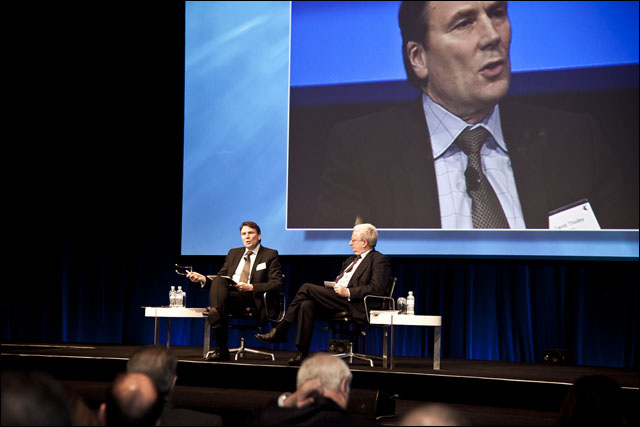
Telstra’s shareholders voted overwhelmingly in favour of three resolutions at its annual general meeting on Friday. The only problem? The company’s largest shareholder, the Federal Government’s Future Fund, issued a protest vote against all three.
On paper, the resolutions appeared relatively minor — relating to the appointment of a new director to Telstra’s board, the adoption of the remuneration report which governs the pay of the telco’s leadership, and the adoption of a modified constitution for the company. All three resolutions were passed by shareholder vote of between 75 and 80 percent.
However, in a statement issued Friday, the Future Fund — which owns about 10 percent of Telstra, worth several billion dollars — revealed it had voted against the trio of motions, stating that its decision was made based on its voting policy and principles designed to protect and enhance shareholder value.
First, the Future Fund said, it voted against the board appointment because it believed Telstra would benefit from increasing the level of telecommunications experience among its non-executive directors, “particularly given the very significant changes in the company’s operations that will have a lasting impact on shareholder value”.
Just two of Telstra’s non-executive directors have direct experience in the telecommunications sector — Geoffrey Cousins, who was the first chief executive of Optus Vision, the joint venture between Optus and Continental Cablevision which built Optus’ HFC cable network, and lawyer and US telecommunications veteran John Zeglis, who let AT&T’s Wireless Group in the US for five years from 1999 to 2004.
Furthermore, the Future Fund also objected to the changes to Telstra’s constitution.
“Resolutions to reduced the maximum number of director positions to 11 while making a further appointment have the effect of filling the board and preventing the appointment of non-executive directors with appropriate telecommunications experience,” the group wrote.
And even Telstra’s remuneration report came under pressure, with the Future Fund indicating that it had concerns about Telstra’s internal customer service overhaul, despite acknowledging the need to provide competitive remuneration to executives.
“There is inadequate detail around how the returns to be generated from the Project New reinvestment program will be measured,” the Future Fund wrote. “The Board of Guardians is also concerns at the use of a free cash flow measure as a hurdle for the Long Term Incentive Plan while the company is negotiating payments from NBN Co and the limited clarity on how this approach will align remuneration to the creation of shareholder value.”
The Future Fund is gradually and publicly reducing its share of Telstra — for example, selling down a full one percent in recent months, according to a recent Telstra statement to the Australian Stock Exchange. It is doing so with a view to rebalancing its portfolio
However, in its statement the organisation — which manages various funds worth $69.31 billion for the Federal Government, including relating to public sector superannuation — pointed out that it remained Telstra’s largest shareholder (courtesy of the transferral of shares into its coffers as part of the telco’s privatisation) and intended to “engage constructively with the company” and to exercise its ownership rights to enhance shareholder value.
Despite the fact that most shareholders voted in favour of the motions, the Future Fund wasn’t the only shareholder to pinion the telco on Friday at the AGM.
A number of small shareholders angry about the company’s dwindling share price expressed their concerns directly to the company’s management, with one accusing the beleaguered telco of having suffered “ten years of failure” in terms of its management and another branding the situation “a shocker”.
Telstra’s share price is currently languishing around the $2.60 mark, close to its 52-week low of $2.55 and close to its all-time low since it was listed in 1997. The company’s share price has steadily declined since the turn of the decade in 2000, when it was above $9.
Image credit: Telstra