

This post is by Colin Jacobs, the chair of Electronic Frontiers Australia. It first appeared on the EFA’s site and is re-published here with his permission.
opinion This election, online issues finally got the attention they deserve. And the situation is here to stay.
I’m not talking about which party had the most Facebook followers or made the most gaffes on Twitter (Julia Gillard and Family First, respectively). Serious issues around internet governance and our internet future came into play, and by all accounts will continue to be significant as the situation plays out this week.
The first issue that affected the election was Labor’s mandatory internet censorship policy, 3 years old and counting. Throughout that time, I believe the accepted wisdom amongst the scheme’s proponents — the most notable being of course Senator Conroy — was that it would be unpopular with a handful of geeks but would appeal to the wider audience of mums and dads in the electorate.
If this was indeed the strategy, I think it backfired. Although it’s based on mainly anecdotal evidence, I believe many internet users had their political consciousness awoken by this attempt to slap censorship on the country’s net connections. When this issue was important to people, it didn’t just put them slightly off-side, but made them hopping mad, if not lifelong skeptics of the ALP. Over time I have spoken to MPs and parliamentary staffers of all stripes, and I’m pleased to report that many people did indeed contact their elected representatives and let the opinions be known. For some MPs, this amounted to a veritable flood, and the issue was absolutely on their radar.
Unfortunately, we’ll never be able to quantify what this did to Labor’s vote. The fact is that Labor suffered a big swing against them, and it’s worth noting that most of this swing went to the Greens, the most vocal opponents of the filter in Parliament. At the ballot box, we can’t disentangle the filter from other issues such as climate change and refugees that the Greens campaigned on, but I believe the filter played a big role.
The Coalition, of course, decided to oppose the filter themselves, and this didn’t happen until the election campaign was already underway. Once again, from reading the feedback online, there’s some evidence that this gave their campaign a boost amongst Australia’s netizens. The fact that they decided to make an announcement then, rather than wait for the legislation as they had previously indicated, shows that they thought this was the case as well.
So while I wouldn’t want to oversell it, internet users are hardly a minority in Australia, and issues close to their hearts are at getting more attention than ever before.
The other major technological issue of the campaign was of course the National Broadband Network. This was without a doubt the one area where the policies of the two major parties differed the most. At the risk of over-editorialising, it was also one of the few policies with long-term vision and a nation-building agenda. Labor’s policy calls for a huge investment in our broadband infrastructure, and — setting the economic arguments aside — is a clear win for internet users. The Coalition’s policy is much more modest and boils down to wringing the last drops out of the copper network while leaving the market to take care of the rest.
As it happened, both policies got some real scrutiny, culminating in Tony Abbott’s embarrassing 7.30 Report appearance where he begged off discussing the details of broadband by claiming (correctly) that he was no “tech-head”. This is a major development; our leaders are now expected to know the difference between peak and actual speeds, symmetric and asymmetric connections, ADSL2+, DOCSIS 3 and fibre to the home. Telecommunications capability has assumed a place next to, even ahead of, rail and roads as critical infrastructure. This is as it should be.
The NBN is still making itself felt. The regional independents, now ubiquitously dubbed “kingmakers” by the media, have all flagged this as an issue. Nothing reduces the “tyranny of distance” like a fast net connection would, so it’s a crucial issue for regional voters. If the three amigos decide to put Gillard back in the Lodge, our broadband future may have something to do with it.
Incidentally, an example of just how badly the filter has damaged Labor’s credibility with regard to online issues is some of the negative comments we received for praising this broadband policy in contrast to that of the Liberal party. Although this failure to “maintain the rage” against Conroy is temporary and I hope forgivable, the ALP have a long way to go if they ever want to regain the trust of Australian internet users.
I haven’t yet touched on the uses of the net itself, including social media, in the campaign. The major parties focussed as normal on scary TV ads to get their message out, and online spending by the major parties (as best we can ascertain) came in at well under 10 percent. The Greens and minor parties relied much more heavily on drumming up support online, both as a deliberate strategy and due to financial necessity. It doesn’t seem to have done them any harm at all. It’s interesting to ponder what will the next election will look like; will the 30-second TV spot still reign supreme?
With the way things are going, we might not have to wait three years to find out.
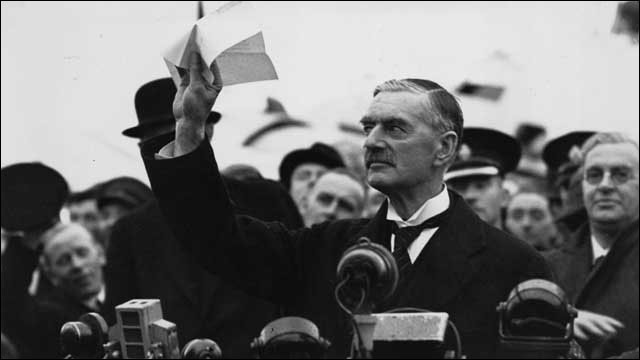
Image credit: Believed to be public domain or out of copyright
I have created the Neville Chamberlain monster. This is the third article with the “Peace in our time” pic. Surely you can find a pic of Curtain or Ming Menzies holding a piece of paper?
Am I the only that thinks that the technology stuff got a look in because there was a complete lack of policy during the campaign and the NBN is pretty much the only notable difference between Labor and the Coalition?
I hardly think it was because both sides deem it an important issue.
I voted Green, pref Labor, in the lower house to get the NBN
I voted Green, pref Liberal, in the upper house to kill the BB filter.
Overall, I’m very happy with the result.
Comments are closed.